

If you’re researching master bathroom remodel plans, here’s what you need to know:
A master bathroom remodel plans process can transform your daily routine and add significant value to your home. In fact, bathroom remodels provide one of the highest returns on investment in home improvement, with ROI ranging from 60-70% at resale. The master bathroom has evolved from a purely functional space to a personal retreat where style meets comfort.
Today’s homeowners are increasingly focused on creating spa-like experiences in their primary bathrooms. According to recent statistics, 80% of homeowners now choose walk-in showers over tubs, while 37% include freestanding tubs as statement pieces. Double vanities remain extremely popular, with 65% of remodels incorporating them for both convenience and visual appeal.
When planning your remodel, consider both immediate needs and long-term value. The most successful master bathroom remodel plans balance functionality with luxury elements that improve your daily experience while appealing to future buyers.
I’m Ryan Norman, founder of Norman Builders, and I’ve helped hundreds of homeowners transform their outdated bathrooms into stunning retreats through expertly crafted master bathroom remodel plans that maximize both function and style.
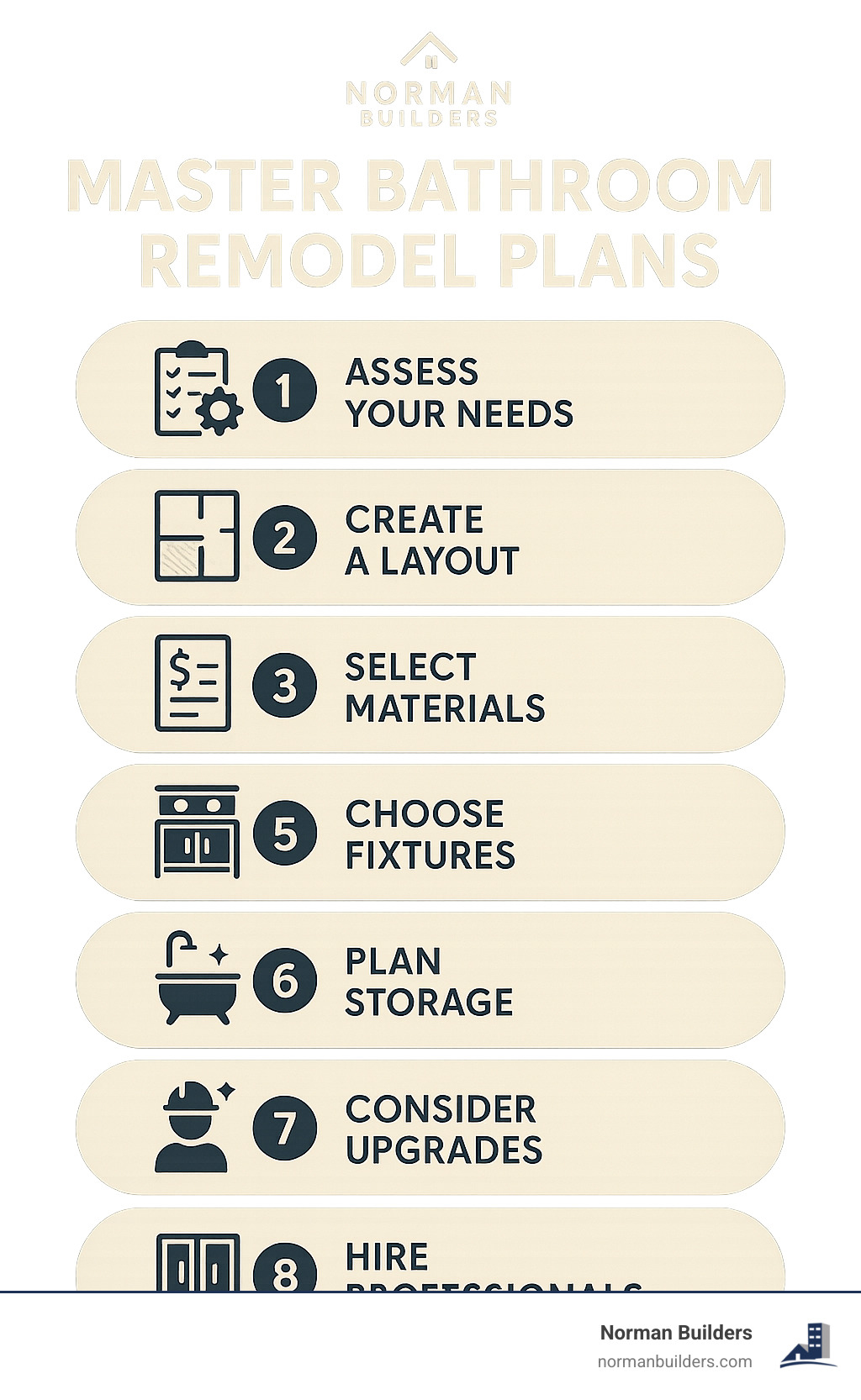
Learn more about master bathroom remodel plans:
– Transitional bathroom design ideas
– easy bathroom remodel ideas
– shower renovation
Before diving into design details, the foundation of successful master bathroom remodel plans starts with honest self-assessment. I’ve found that taking time to evaluate how you actually use your bathroom—not how you think you should use it—leads to spaces that truly improve daily life.
When chatting with our clients throughout the Merrimack Valley and Southern NH, we always begin by understanding their unique routines. Industry research backs this approach, showing that homeowners primarily remodel to improve functionality (45%), update style (32%), and increase home value (23%).
Your morning routine reveals more about your bathroom needs than any design magazine ever could. Take a week to notice your patterns:
Do you and your partner jostle for sink space during the morning rush? Is your shower barely used while you dream of soaking in a tub that doesn’t exist? Are towels constantly falling off inadequate hooks?
A client in Andover recently shared, “We realized our family of four was playing a daily game of bathroom Tetris. Once we tracked our actual usage patterns, we completely rethought our master bathroom remodel plans. Now everyone has their space, and mornings are actually pleasant!”
Consider how family usage affects your needs—do teenagers monopolize the space? Are you planning for aging parents to visit? Will small children need accessible features? These real-life considerations should drive your design choices, not just what looks pretty on Pinterest.
Creating a bathroom that works beautifully means balancing the practical with the indulgent. Start by identifying your non-negotiables—the features that would make daily life genuinely better.
For most families, functional priorities include adequate counter space, sufficient storage for everyone’s items, proper ventilation (those 80-110 CFM fans make a real difference!), and task-appropriate lighting. About 65% of our clients opt for double vanities, finding they dramatically reduce morning conflicts.
Once the essentials are covered, it’s time for the fun part—luxury elements that transform a bathroom into a sanctuary. Heated floors (now in 25% of master baths) feel like an indulgence but are surprisingly affordable when installed during a remodel. Walk-in showers with multiple spray options, freestanding soaking tubs, and smart features like programmable lighting can lift your daily routine.
One North Shore client told us, “I thought the heated floors were a splurge we’d regret, but honestly, they’ve changed winter mornings completely. Best decision we made.”
Don’t forget to future-proof your space. The National Kitchen and Bath Association (NKBA) offers excellent guidelines for incorporating universal design elements that accommodate changing needs without sacrificing style. Curbless showers, comfort-height toilets, and strategically placed blocking for future grab bars can be incorporated now, saving costly renovations later.

More info about Bathroom Remodel Design Program
The layout is truly the foundation of your master bathroom remodel plans. Even with the most luxurious fixtures and finishes, a poorly designed layout will undermine functionality and comfort. Here at Norman Builders, we’ve helped countless homeowners throughout the North Shore and Southern NH regions reimagine their spaces with layouts that maximize both form and function.
When we sit down with clients in Salem or Andover, we always start by considering the essential elements of a thoughtful bathroom layout:
– How to create distinct wet and dry zones to contain moisture
– Natural traffic patterns and necessary clearances
– Creating beautiful focal points and sight lines
– Balancing privacy with openness
– Maximizing both natural and artificial lighting
Several proven layout templates can serve as starting points for your master bathroom remodel plans:
The Tub-Focused Design places a freestanding tub as the central feature, often positioned opposite the entrance for maximum visual impact. This layout works beautifully in larger spaces and for those who truly prioritize bathing. One of our Newburyport clients chose this layout, commenting, “Walking into my bathroom and seeing that gorgeous tub makes me smile every single morning.”
The Hidden Toilet Layout uses a pony wall, pocket door, or separate water closet to conceal the toilet, enhancing both aesthetics and privacy. As one client in Andover noted, “Having the toilet in its own space has been a game-changer for our morning routine.”
The Japanese Bathroom Layout incorporates a wet room concept where the shower and soaking tub share an enclosed, waterproof space. This space-efficient design is gaining popularity for its clean, minimalist aesthetic and practical water containment. We’ve installed several of these in the Seacoast region with tremendous success.
The Dressing Room Layout integrates the bathroom with a walk-in closet or dressing area, creating a comprehensive suite. This works particularly well for master bedrooms with adequate square footage and creates a luxurious morning ritual space.
The Straight and Narrow Layout arranges fixtures along opposing walls in rectangular spaces, maximizing efficiency in compact areas. Perfect for the historic homes we often work with in Salem and Andover.
The “Spread Your Wings and Fly” Layout features separate vanity areas on opposite sides, ideal for couples who prefer personal space during morning and evening routines. As one Boxford homeowner put it, “Having our own vanities has probably saved our marriage!”
For standard-sized master bathrooms, these dimensions often work well:
– 9′ × 7′ (63 sq ft): Comfortable for a shower and vanity
– 10′ × 6′ (60 sq ft): Good for linear arrangements
– 14′ × 6′ (84 sq ft): Allows for more generous fixtures

Not every home in the Merrimack Valley or Seacoast region has the luxury of a spacious bathroom footprint. Over our years of experience, we’ve developed several proven strategies to maximize challenging spaces:
Strategic Wall Shifts can make a world of difference. Sometimes moving a non-load-bearing wall even 12-24 inches can dramatically improve functionality. In a recent Newton, NH project, we expanded into an adjacent linen closet to accommodate a double vanity, changing a cramped space into something far more functional.
Pocket Doors are absolute space-savers. They eliminate the swing radius needed for traditional doors, freeing up valuable floor space. They’re particularly effective in bathrooms under 80 square feet, where every inch counts.
Creative Adjacent Space Utilization often yields surprising results. One innovative solution we implemented for a Kingston client involved swapping the locations of a small bathroom and adjacent laundry room, resulting in better flow for both spaces. Sometimes thinking outside the bathroom is exactly what’s needed!
Optical Illusions can transform perception. Full-height mirrors, especially when placed in corners, can visually double the perceived size of a bathroom. Combined with strategic lighting, this approach makes compact spaces feel more generous without moving a single wall.
Slim Fixtures make a big difference in tight spaces. Selecting a narrow-profile vanity or wall-mounted toilet can reclaim precious inches in tight spaces – inches that add up to meaningful improvements in usability.
A Boxford homeowner shared: “We were convinced our awkward L-shaped bathroom couldn’t fit both a shower and tub. Norman Builders suggested a corner tub and reconfigured the layout in a way we never imagined possible.”
Any master bathroom remodel plans must comply with local building codes. Here are key considerations we always keep in mind:
Required Clearances are non-negotiable. You’ll need a minimum 30″ clearance in front of fixtures, at least 15″ from the centerline of a toilet to any side wall, and shower doors require adequate swing clearance. These aren’t just suggestions – they’re requirements for both safety and functionality.
Ventilation Requirements are crucial for preventing moisture problems. Bathrooms need proper ventilation (fans rated 80-110 CFM), and fans should vent to the exterior, not into attic spaces where moisture can cause serious damage over time.
Electrical Safety is paramount in wet areas. GFCI protection is required for all outlets, and specific clearances between water sources and electrical fixtures must be maintained. We’ve seen too many DIY projects go wrong in this area.
Universal Design Elements are worth considering even if you don’t currently need them:
– Zero-threshold showers for aging-in-place
– Grab bar blocking in walls (can be hidden until needed)
– 36″ wide doorways for potential wheelchair access
– Comfort-height toilets (17-19″ vs. standard 15″)
Most significant bathroom remodels require permits, which your contractor should handle. Be wary of any contractor asking you to pull permits yourself—this is often a red flag that they’re not properly licensed or insured.
More info about Luxury Bathroom Remodeling
Selecting materials and fixtures is where your master bathroom remodel plans truly come to life. This is the exciting part where your functional layout transforms into a personalized retreat that reflects your unique style while meeting practical needs.
The bathroom environment is tough on materials—constant moisture, temperature swings, and daily use demand thoughtful selections that balance beauty with practicality.
For flooring, porcelain tile remains our most recommended option. As one client in Hampton Falls told us, “Our marble-look porcelain floors give us the luxury look without the maintenance headaches.” Natural stone provides timeless elegance but demands regular sealing, while luxury vinyl tile offers a budget-friendly alternative that stays warm underfoot.
When it comes to shower surfaces, the trend is moving toward larger format tiles that minimize grout lines. Not only do they create a sleeker, more contemporary look, but they’re significantly easier to keep clean. For clients seeking the ultimate luxury, we’ve installed natural stone slabs in shower surrounds that eliminate grout entirely.
Countertop decisions often come down to the balance between beauty and practicality. Quartz has become our most requested material because it delivers marble-like aesthetics without the porosity and maintenance concerns. For those who prefer natural materials, properly sealed granite offers excellent durability with unique, one-of-a-kind patterns.
“Select materials not just for how they look today, but for how they’ll perform five years from now,” is advice we share with every client. That beautiful marble might be tempting, but are you prepared for the regular maintenance it requires?
Think of fixtures and lighting as the jewelry that completes your bathroom’s outfit. They add personality and can lift even simple spaces to something special.
Faucet finishes have evolved beyond chrome, with brushed nickel and matte black leading current preferences. One Newburyport client couldn’t contain her enthusiasm: “The faucet is my lover! I’ve never been head over heels with a faucet, but there’s a first for everything.”
Showerhead options have expanded dramatically, with many of our clients opting for multiple water sources—ceiling-mounted rain showerheads paired with adjustable handhelds and sometimes body sprays for a complete spa experience.
Lighting requires a thoughtful, layered approach. As one Salem, NH homeowner noted, “The combination of recessed ceiling lights, sconces flanking our mirrors, and a statement chandelier completely transformed how we experience the space.” Proper placement makes all the difference—especially for vanity lighting, where sconces at eye level provide the most flattering, shadow-free illumination for daily grooming.
Don’t overlook the power of statement sconces to add character. We’ve seen simple bathrooms transformed by distinctive lighting choices that reflect the homeowner’s personality.

Today’s master bathroom remodel plans increasingly incorporate elements once found only in luxury hotels and high-end spas.
Radiant floor heating has moved from luxury to near-standard status, now included in about 25% of our master bath projects. “It’s the feature clients most consistently rave about after installation,” notes our lead designer. “Nobody ever regrets heated floors in New England.” Paired with heated towel racks, these warming elements create a cozy experience even on the coldest winter mornings.
Water features have evolved dramatically, with digital shower controls allowing you to program your perfect temperature and flow settings. A Kensington client shared: “The programmable shower with voice control seemed like an unnecessary luxury during planning, but it’s now one of our favorite features. Setting the perfect temperature before stepping in has been a game-changer.”
Smart technology integration continues to expand with options like voice-activated lighting, mirror-integrated LEDs with defoggers, and even water leak detectors that can prevent costly damage. We’re particularly fond of in-drawer outlets that allow you to charge devices or power hair appliances while keeping countertops clear and clutter-free.
For the ultimate spa experience, steam showers create a luxurious retreat in your own home. While they require specialized installation with vapor barriers and sloped ceilings, they’re becoming increasingly popular among our clients seeking true relaxation spaces.
Audio integration has become surprisingly important, with many homeowners requesting waterproof speaker systems for enjoying music, podcasts, or even catching up on news during morning routines.
The bathroom bidet revolution has finally reached America, with smart bidets and bidet toilet seats growing in popularity for improved hygiene and comfort. As one client diplomatically put it, “Let’s just say our household toilet paper budget has decreased significantly.”
Latest research on radiant heat
More info about Luxury Bathroom Remodeling
Let’s talk money, paperwork, and timing—the practical side of your master bathroom remodel plans that deserves just as much attention as those gorgeous fixture selections. I’ve guided hundreds of homeowners through this process across the Merrimack Valley and Southern NH, and here’s what you should know.
Most master bathroom changes fall between $20,000 and $50,000, though luxury remodels with all the bells and whistles can easily exceed $100,000. Your final cost depends on room size, materials chosen, and how much you’re changing the existing layout.
Your budget typically breaks down like this: about half goes to skilled labor (40-50%), a third to materials (30-40%), a smaller portion to design and permits (5-10%), and—this is crucial—always set aside 10-15% as contingency. That last part isn’t optional, especially in our New England homes where century-old surprises lurk behind walls!
When deciding where to invest your dollars, think about what you touch and use daily. Quality plumbing fixtures that you’ll handle every morning and evening are worth the upgrade. The shower system deserves attention since it’s likely your most-used feature. Vanity cabinets impact both function and visual appeal, while statement lighting fixtures can transform the entire feel of the space.
On the flip side, you can make smart savings with look-alike materials (the porcelain that mimics marble is remarkably convincing these days), sticking to standard-sized fixtures (custom sizes can double costs), keeping plumbing in existing locations when possible, and choosing mid-range tile for larger surfaces.
I’ll never forget what a homeowner in Newton told me after their project: “We splurged on a frameless glass shower enclosure and saved by choosing porcelain tile that looks like natural stone. No one can tell the difference, but our budget certainly did!” That’s the kind of smart trade-off that leads to successful projects.

Let’s clear up a common misconception: permits aren’t just bureaucratic red tape—they protect your investment and ensure safety. Most significant bathroom remodels require them, and your contractor should handle this process entirely.
For a typical master bath remodel, you’ll need documentation that includes a site plan showing your property, floor plans (before and after), code compliance statements, and a detailed scope of work. Depending on what you’re changing, you’ll likely need specific permits for plumbing, electrical work, and possibly structural modifications if you’re moving walls.
Here’s a red flag to watch for: if a contractor asks you to pull permits yourself, proceed with caution. This often signals they’re not properly licensed or insured—not someone you want handling your valuable home improvement investment.
Permit costs vary by town (from a few hundred to over a thousand dollars), but they’re worth every penny for the peace of mind and legal protection they provide. Plus, unpermitted work can become a major headache when selling your home down the road.
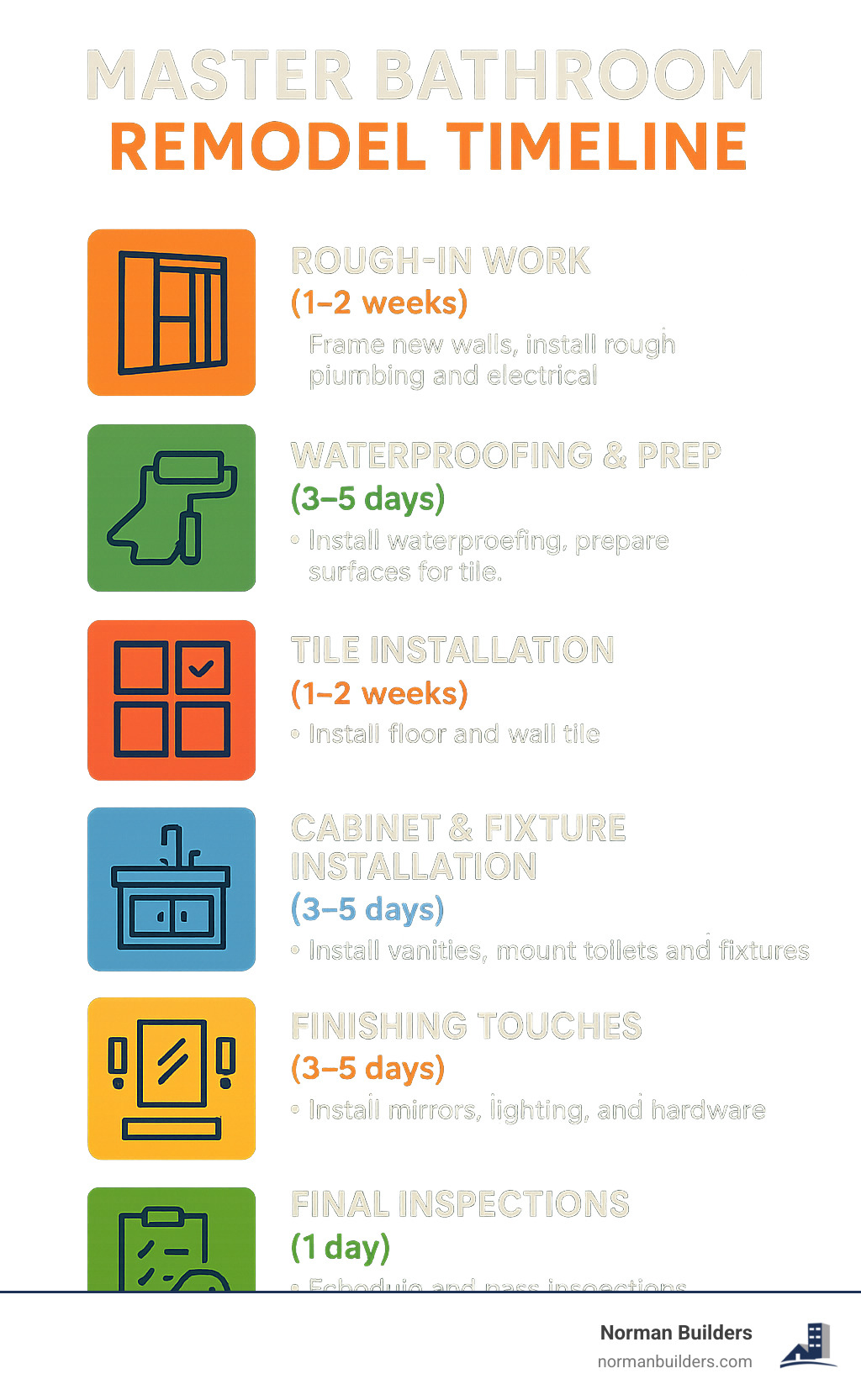
From first sketch to final inspection, here’s the journey your master bathroom remodel plans will take:
The process begins with Planning & Design (2-4 weeks), where we finalize your layout and selections, create detailed drawings, and order those special items with long lead times. This front-loaded effort pays dividends throughout the project.
Next comes Permitting (1-3 weeks), submitting applications and addressing any questions from building officials. Once approved, we move to Demolition (3-5 days)—the dramatic phase where your old bathroom disappears and we can identify any hidden issues requiring attention.
The Rough-In Work (1-2 weeks) includes framing new walls if needed, installing plumbing and electrical lines before they’re hidden behind walls, and scheduling those critical rough inspections. Then comes Waterproofing & Prep (3-5 days), installing cement board or other moisture barriers and preparing surfaces for tile.
Tile Installation (1-2 weeks) is a meticulous process that can’t be rushed—proper curing time between steps ensures longevity. Once complete, we move to Cabinet & Fixture Installation (3-5 days), mounting vanities, toilets, tubs, and shower fixtures.
The Finishing Touches (3-5 days) bring everything together with mirrors, lighting, hardware, paint, and trim work, followed by Final Inspections to ensure everything meets code requirements.
All told, you’re looking at 8-12 weeks from start to finish for a typical project, though complex renovations may take longer.
One insider tip our project manager always shares: “Order plumbing fixtures early in the process. This allows you to mock up actual heights, confirm availability, and handle any unforeseen fit issues before rough-in work begins.” Nothing derails a timeline faster than finding your dream shower system won’t fit as planned after walls are closed up!
Please note: Our services are exclusively available in Massachusetts, specifically in Andover, MA, the North Shore, and New Hampshire, covering the Seacoast and Southern NH regions.
When it comes to master bathroom remodel plans, storage consistently tops the priority list for homeowners. It’s no wonder—70% of our clients specifically mention wanting more efficient storage solutions. After all, a beautiful bathroom loses its appeal quickly when cluttered with toiletries, towels, and accessories.
The vanity area offers prime real estate for smart storage solutions. Beyond basic cabinets, consider custom drawer organizers that create dedicated spaces for makeup, hair tools, and toiletries. One of our Kingston clients recently shared, “Those custom drawer organizers completely transformed our morning routine. Everything has its place now, and I can actually find what I need!”
Pull-out hampers integrated within cabinetry keep dirty laundry hidden yet accessible. For tech-savvy homeowners, in-drawer outlets allow you to charge devices or use hair appliances while keeping countertops clear—a feature that’s become increasingly popular in our North Shore projects.
Don’t overlook the space beneath your cabinets. Toe-kick drawers use what would otherwise be wasted space, perfect for storing extra toilet paper, cleaning supplies, or rarely-used items.
Wall and vertical spaces offer tremendous storage potential without consuming precious floor space. Recessed medicine cabinets provide functional storage without protruding into the room—a perfect solution for smaller bathrooms. For a more decorative approach, floating shelves add both storage and display opportunities while maintaining a light, airy feel.
When working with couples who share the bathroom, we often recommend tower cabinets positioned between or alongside sinks. These tall, narrow cabinets maximize vertical space while providing personal storage for each partner. And don’t forget the wall space above the toilet—over-toilet storage units transform this often-wasted area into valuable storage real estate.

In shower and tub areas, built-in niches create recessed shelving that keeps shampoo and soap off the floor or tub edge. Unlike stick-on shower caddies, these integrated features look intentional and neat. For corner showers, corner shelves use otherwise awkward spaces efficiently. If your shower has room for a bench, consider one with hidden compartment storage beneath the seat—perfect for bath bombs, extra washcloths, or specialty products.
For bathrooms with limited square footage, several space-saving hacks have proven invaluable in our projects across Southern NH. Pocket doors eliminate the swing space required by traditional doors—as one Danville homeowner noted, “Converting to a pocket door reclaimed nearly 10 square feet, enough for the linen cabinet that transformed our storage situation.”
Wall-mounted faucets free up valuable counter depth, while slim-profile toilets extend just 24 inches from the wall versus the standard 30 inches. In awkward layouts, corner sinks can maximize challenging spaces that might otherwise go unused.
More info about Master Bathroom Ideas
The best layout begins with honest assessment of your daily routines and priorities. Consider how many people use the bathroom simultaneously, your bathing preferences (shower enthusiast or dedicated soaker?), required storage capacity, and existing plumbing locations.
Functional layouts typically separate wet areas (shower/tub) from dry areas (vanity/toilet) and provide adequate clearance around fixtures. While online inspiration is helpful, working with a professional designer often reveals possibilities you hadn’t considered—as one Exeter client finded: “We were convinced we needed to expand our bathroom footprint until our designer showed us how reconfiguring the existing space could give us everything on our wish list.”
After completing dozens of bathroom remodels across the Merrimack Valley, I’ve found certain elements consistently worth the splurge. Quality shower fixtures deserve investment as you’ll use them daily, and the difference between budget and quality options is immediately noticeable in both feel and longevity. Vanity cabinets impact both function and aesthetics, while proper lighting affects how you look and feel every day. Never skimp on waterproofing systems—they prevent costly damage down the road.
Smart savings can come from look-alike materials (like porcelain that convincingly mimics marble at a fraction of the cost), choosing stock versus custom cabinetry, using standard tile layouts rather than complex patterns, and whenever possible, keeping plumbing in its original location to avoid costly rerouting.
Visible, frequently touched items like faucets, shower controls, and cabinet hardware make a significant impact on your daily experience and are worth investing in quality that will last.
Most master bathroom remodels take 8-12 weeks from demolition to final touches, though several factors can extend this timeline. Size and complexity naturally affect duration—a complete gut renovation with custom features takes longer than a simpler update. Material availability can cause significant delays, especially with today’s supply chain challenges. Structural changes like moving walls or plumbing add time, and unexpected issues like hidden water damage or outdated wiring require additional attention.
Don’t forget the planning phase before construction begins—typically 2-6 weeks to finalize designs, selections, and permits. This preparation is crucial for a smooth construction process.
Our project manager offers this practical tip: “Order materials phase by phase rather than all at once. Just-in-time delivery keeps your project organized and prevents materials from being damaged before installation. Your home shouldn’t become a temporary warehouse!”
Please note: Our services are exclusively available in Massachusetts, specifically in Andover, MA, the North Shore, and New Hampshire, covering the Seacoast and Southern NH regions.
Creating thoughtful master bathroom remodel plans isn’t just about picking pretty fixtures—it’s the foundation of a change that will impact your daily life for years to come. Throughout this guide, we’ve walked through the essential elements that turn bathroom dreams into functional, beautiful realities.
At Norman Builders, we’ve guided countless homeowners across the Merrimack Valley, North Shore, Seacoast, and Southern NH regions through this journey since 2007. What we’ve learned is that the most successful bathroom changes balance immediate “wow factor” with lasting practicality.
Your new master bathroom should feel like it was designed specifically for you—because it was! A thoughtfully executed bathroom remodel delivers both immediate enjoyment and significant financial returns, with typical ROI ranging from 60-70% at resale. But the real value goes beyond numbers. There’s something truly special about stepping into a space that perfectly suits your needs and reflects your personal style.
Remember the cornerstones of success we’ve discussed:
– Assess before you address—understand how you actually use your bathroom daily
– Layout is everything—even luxury fixtures can’t overcome poor flow
– Quality where it counts—invest in items you touch and use every day
– Plan for surprises—that 15% contingency fund isn’t optional in New England homes
– Storage solutions—the difference between a showcase and a sanctuary is how it works when actually lived in
– Future-proof your investment—subtle universal design elements add value without sacrificing style
I’m Ryan Norman, and my team and I have transformed hundreds of outdated bathrooms into personalized retreats that homeowners love coming home to. The before-and-after changes never get old—there’s something magical about watching a client’s face light up when they see their vision brought to life with craftsmanship that exceeds their expectations.
Ready to start your own change story? I’d love to discuss how we can help bring your master bathroom remodel plans to life with our signature attention to detail and personalized approach.
More info about bathroom renovations services
Please note: Our services are exclusively available in Massachusetts, specifically in Andover, MA, the North Shore, and New Hampshire, covering the Seacoast and Southern NH regions.

We specialize in high-quality home construction and remodeling services, delivering exceptional craftsmanship tailored to meet your vision and needs. Whether you’re planning a renovation, new construction, or a custom remodel, our experienced team is committed to exceeding expectations with precision, attention to detail, and reliable service.
Our service area includes the Merrimack Valley, North Shore, Seacoast, and Southern NH Areas. We take pride in the quality of our workmanship and our prompt professionalism.
Contact us today to bring your project to life!