

If you’re considering a Craftsman home renovation, here are the essential elements to focus on:
Craftsman home renovation projects require a special blend of respect for history and practical modernization. These iconic homes, most built between 1900 and 1930, feature distinctive elements like low-pitched roofs, exposed rafters, tapered columns, and handcrafted woodwork that deserve careful preservation.
A well-executed renovation can increase your property’s value by 20-30%, but more importantly, it preserves a piece of architectural history while creating a warm, functional home for modern living.
Renovating a Craftsman home isn’t just about updating spaces—it’s about honoring the Arts and Crafts movement’s emphasis on craftsmanship, natural materials, and thoughtful design. The challenge lies in preserving the home’s character while integrating modern conveniences that today’s families need.
I’m Ryan Norman, founder of Norman Builders, and I’ve guided dozens of homeowners through successful Craftsman home renovation projects, helping them honor these historic treasures while creating spaces that work for contemporary lifestyles.
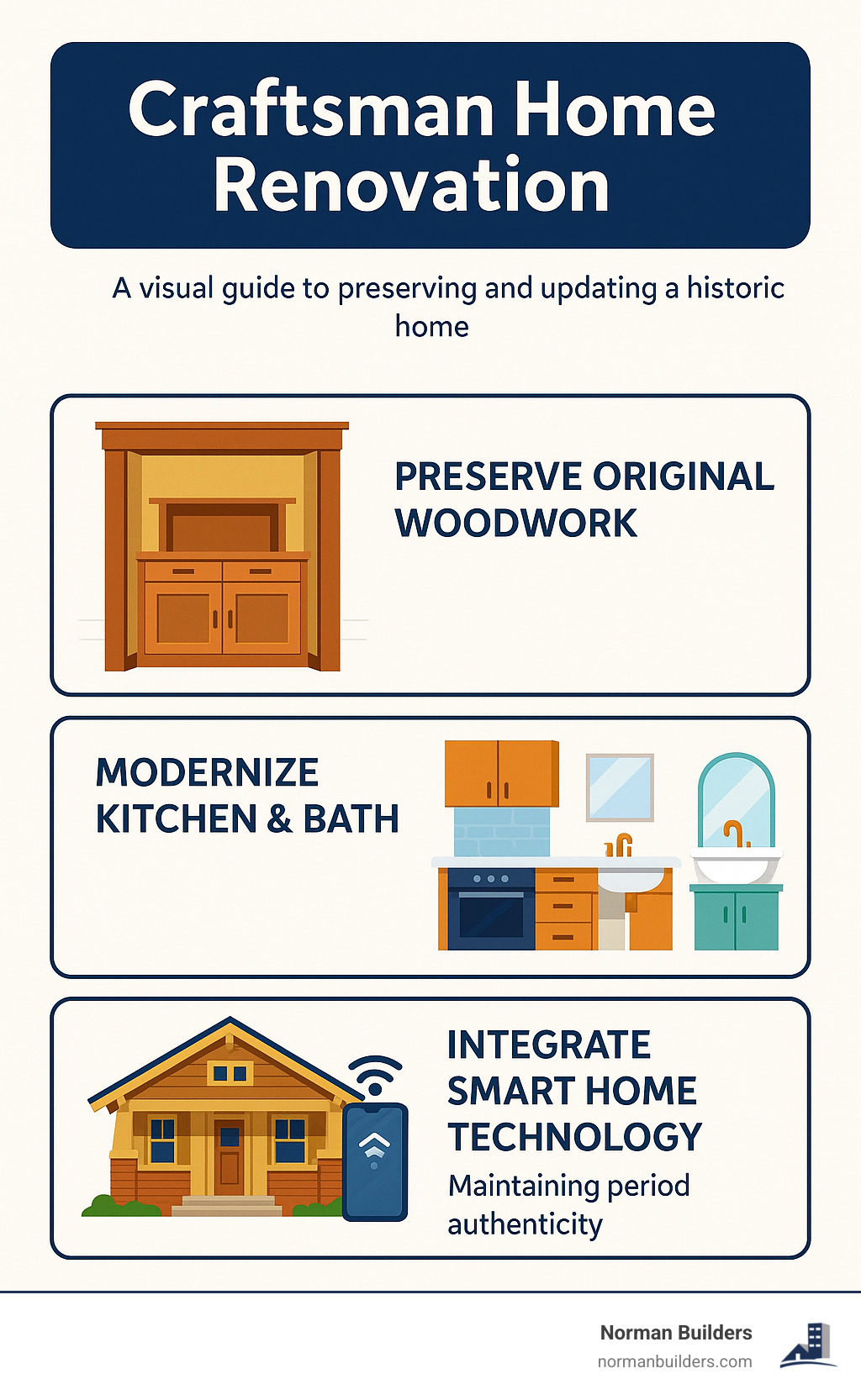
Simple Craftsman home renovation glossary:
– Eco-friendly home renovations
– High-end home renovations
– house design for renovation
There’s something magical about a Craftsman home that captures the heart. Born from the Arts and Crafts movement of the early 20th century, these architectural gems emerged as a thoughtful rebellion against Victorian excess and mass production. They celebrate what truly matters in a home: honest craftsmanship, natural beauty, and a genuine connection to the outdoors.
As one of my clients beautifully expressed after completing her 1910 Craftsman home renovation: “When a home and a homeowner find their perfect match, you can tell—they care for and protect each other.” This sentiment perfectly captures why people fall deeply in love with these special homes.
Did you know that Craftsman homes make up about 25% of all historic homes across America? Their enduring popularity isn’t just about nostalgia—it’s about timeless design principles that still make sense today: simplicity, functionality, and harmony with nature.
If you’re starting on a Craftsman home renovation, learning to recognize these distinctive features will help you preserve what makes your home special:
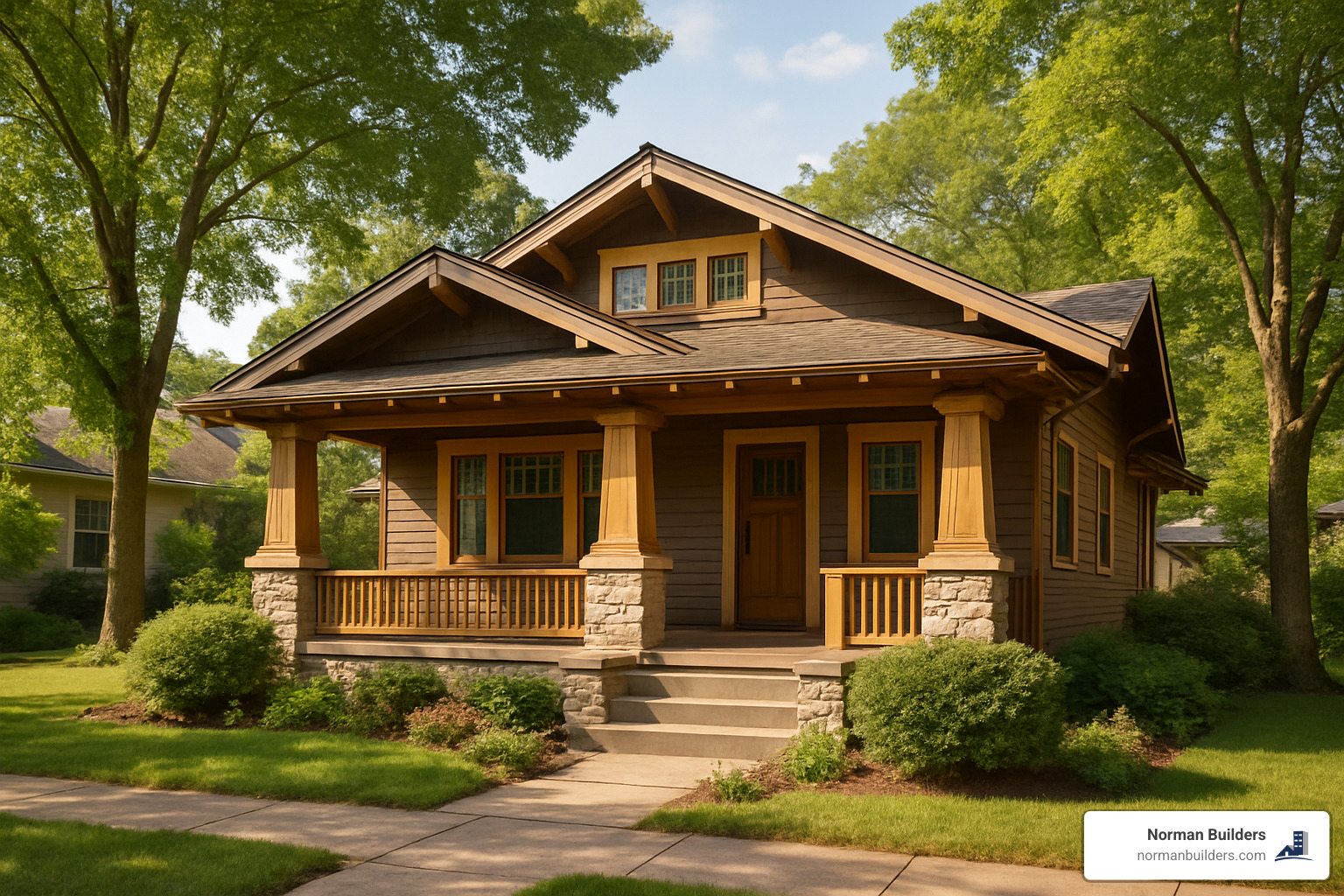
Those charming low-pitched rooflines with generous eaves and exposed rafter tails aren’t just beautiful—they’re functional, providing shade and protection from the elements. The inviting front porches with substantial square or tapered columns create that quintessential curb appeal that makes neighbors slow down to admire.
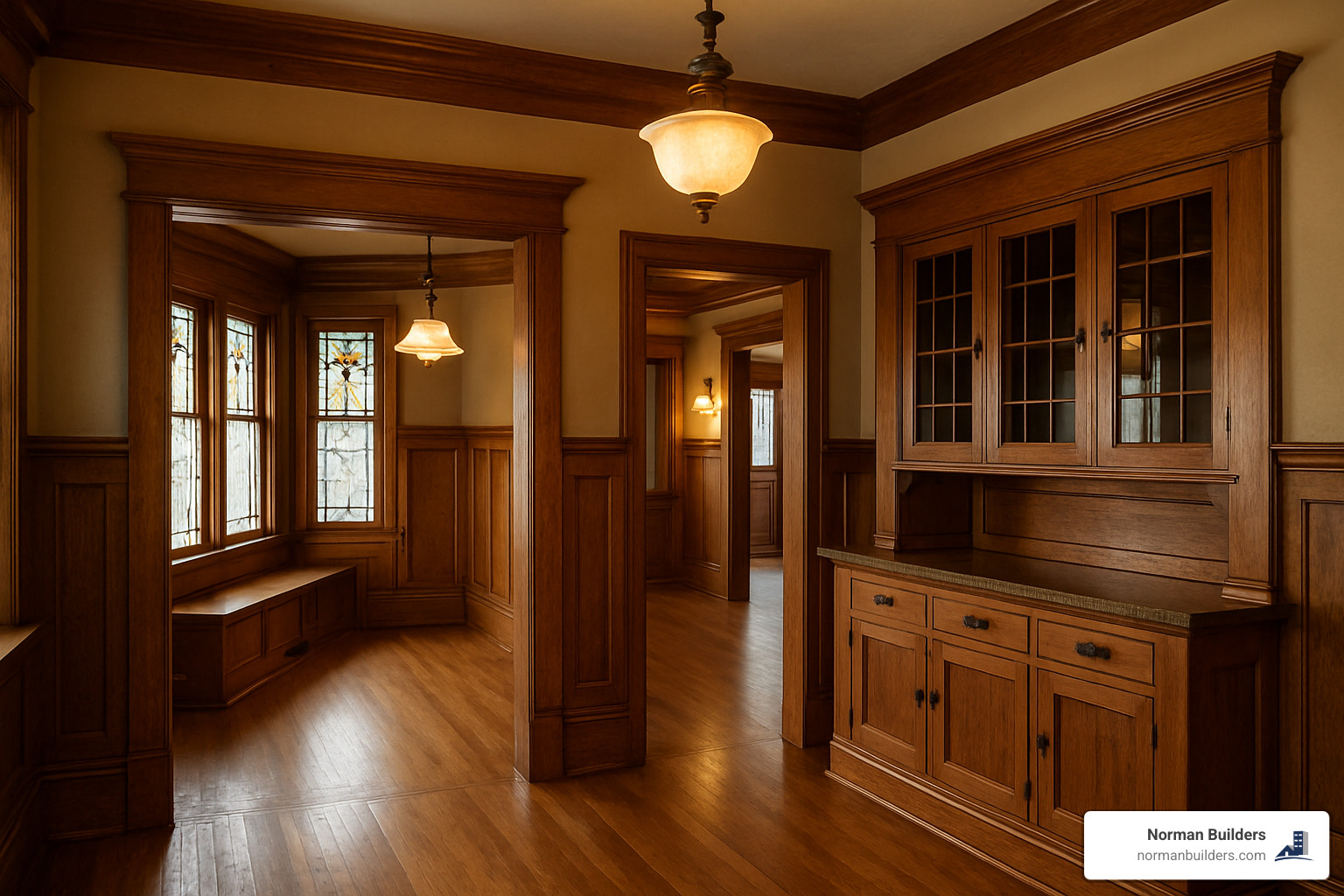
Inside, you’ll find handcrafted woodwork that simply can’t be replicated today—built-in cabinets, cozy window seats, and bookcases that tell stories of craftsmanship passed down through generations. The use of natural materials like stone, brick, wood, and copper connects these homes to the earth in a way that feels grounding and authentic.
Look up and you might spot decorative knee braces supporting those roof overhangs—small details that add character and structural integrity. The multi-paned windows, often featuring leaded or stained glass accents, filter light in ways that modern windows simply can’t match.
I’ll never forget when a homeowner in Portland shared her experience of uncovering original woodwork: “Stripping the paint off took a couple of months, but revealing that Colonial Yellow stain from the 1910 Sherwin Williams catalog was worth every minute of work.” That’s the kind of findy that makes a Craftsman home renovation so rewarding.
There’s a reason these homes continue to captivate buyers and renovators alike. Beyond their undeniable charm, a well-executed Craftsman home renovation typically increases property value by 20-30%—especially when original features are lovingly preserved.
These homes possess an architectural integrity that’s increasingly rare. In a world of cookie-cutter construction, a Craftsman stands as a testament to a time when homes were built with intention and care. They often serve as anchors in historic neighborhoods, contributing to a sense of community identity that residents deeply value.
The solid construction of Craftsman homes is legendary. Built with quality materials and techniques that have stood the test of time, they truly have “good bones.” Their versatile layouts somehow manage to feel both historic and surprisingly adaptable to modern living—a rare combination indeed.
As one first-time Craftsman owner told me, “It felt like an old-soul house with lots of potential.” That’s exactly what draws people to these homes—they sense the craftsmanship and quality that transcends time, waiting to be honored through thoughtful renovation.
For those interested in diving deeper into the philosophical roots of these beloved homes, the Metropolitan Museum’s overview of the Arts and Crafts movement provides fascinating context for why these architectural principles still resonate today.
Please note: Our services are exclusively available in Massachusetts, specifically in Andover, MA, the North Shore, and New Hampshire, covering the Seacoast and Southern NH regions.
Planning a Craftsman home renovation is like preparing for a journey through time – one that requires careful navigation between preserving history and embracing modern living. Before swinging that first hammer, take time for a thorough structural assessment that reveals both hidden treasures and necessary updates.
As one homeowner told us, “We lived in our 1912 Craftsman for almost a year before renovating. That time helped us understand which quirky features we wanted to keep and which ones were driving us crazy.” This patience often leads to more thoughtful renovation decisions.
The dance between preservation and code compliance is perhaps the trickiest part of any Craftsman home renovation:
“We finded original pocket doors hidden inside a wall during demolition,” shared a Massachusetts homeowner. “Our contractor helped us restore them while still meeting fire code requirements – it took creative thinking, but was absolutely worth it.”
Historic homes often present challenges including lead paint (common in pre-1978 homes), asbestos in older insulation and flooring, and outdated electrical systems. Professional testing is essential before work begins, as proper abatement requires specialized knowledge.
Many Craftsman homes also need structural updates – from foundation repairs to roof reinforcement – especially if you’re planning additions or removing walls. Working with engineers familiar with historic structures helps ensure your home remains sound for another century.
Renovating a Craftsman typically costs between $100-$400 per square foot, with the wide range reflecting both project scope and material quality. Historic restoration generally falls toward the higher end, especially when custom millwork or specialized craftsmanship is involved.
Smart budgeting starts with understanding where your money will go:
Invisible investments often consume 40-60% of your budget – these include foundation work, electrical updates, plumbing overhauls, and HVAC modernization. Though not glamorous, these updates create the safe, comfortable foundation for everything else.
Visible improvements like kitchen and bathroom renovations typically represent your biggest line items, with most Craftsman renovations including at least one of these spaces.
Contingency planning is non-negotiable – set aside at least 15-20% for surprises. As one renovation veteran put it: “In a hundred-year-old house, the only certainty is uncertainty. We found everything from hidden water damage to a beautiful original fireplace covered by drywall.”

Consider financing options carefully – from home equity loans to historic preservation grants. Some communities offer tax incentives for historically appropriate renovations, which can help offset costs.
A typical Craftsman home renovation unfolds through predictable stages, though the timeline varies dramatically based on scope and surprises:
The journey begins with inspection and design development – working with architects who understand Craftsman principles to create plans honoring your home’s character while meeting modern needs. This planning phase often takes 2-4 months and is not the place to rush.
Permit approval follows, sometimes requiring historic preservation board reviews if your home is in a designated district. This can add weeks or months to your timeline but ensures your renovation respects community standards.
The construction phase progresses from structural updates through systems installation to finish work. Throughout this process, regular communication with your contractor helps manage expectations and address inevitable surprises.
“We planned for six months of construction but ended up with nine,” shared one homeowner. “The extra time allowed our carpenter to recreate missing trim details exactly matching the originals – it wasn’t fast, but the results are stunning.”
Quality craftsmanship takes time. The Craftsman movement itself was a reaction against mass production – embracing this philosophy means accepting that proper restoration can’t be rushed.
Looking for more information about renovation costs? Visit our detailed guide on Home Renovation Costs to help with your planning.
Please note: Our services are exclusively available in Massachusetts, specifically in Andover, MA, the North Shore, and New Hampshire, covering the Seacoast and Southern NH regions.
The true art of Craftsman home renovation isn’t just about restoring old features—it’s about finding that sweet spot where history meets modern living. Think of it as a dance between honoring the past and embracing the future.
“The most important thing for the homeowners was to maintain the look and feel of the home,” one of our renovation clients told us after completing their project. This philosophy is exactly what guides successful Craftsman renovations—keeping the soul of the house intact while making it work for today’s families.
When you walk into a Craftsman home, certain elements immediately transport you to another era. These are the treasures worth fighting for during renovation:
Those gorgeous built-in cabinets and bookcases aren’t just beautiful—they’re practically impossible to recreate affordably today. The original woodwork around doors and windows tells stories of craftsmanship that modern contractors rarely match. Those wood floors with their gentle patina? With proper refinishing, they’ll outlast any modern flooring.
I’ll never forget a homeowner who finded an original built-in buffet hiding under layers of paint during their renovation. “We spent weeks carefully stripping the paint to reveal the original wood finish,” they shared with a smile. “It became the centerpiece of our dining room and a conversation starter for guests.”
When original elements are too damaged to save, working with skilled craftspeople makes all the difference. During one renovation, we “painstakingly reproduced architectural corbels by cutting to match original profiles.” These details might seem small, but they’re what maintains a home’s authentic character.
Kitchens and bathrooms typically need the most significant updates during a Craftsman home renovation. After all, these spaces have changed dramatically in function over the past century.
For a kitchen that feels both authentic and functional, consider inset cabinet doors with exposed hinges and simple styling. Paint them in muted colors or showcase natural wood—both work beautifully in Craftsman homes. For countertops, materials like soapstone or quartzite offer period-appropriate looks with modern durability. One homeowner selected Taj Mahal quartzite as “a durable marble alternative” that perfectly complemented their Craftsman aesthetic.
Handmade ceramic tile backsplashes, especially in subway patterns or Arts and Crafts motifs, honor the tradition of craftsmanship. For appliances, many homeowners choose panel-ready options to blend with cabinetry, though there’s something to be said for contrast too. As one designer noted, “There is something beautiful and industrial about seeing the stainless steel in such a painted and paneled room.”
For Craftsman bathrooms, white subway tile paired with black hex tile creates a classic vintage look. “Tumbled subway tile and small-scale hex tile feel more authentic to early 20th-century homes,” as one designer wisely advised. Pedestal sinks, clawfoot tubs, and fixtures in oil-rubbed bronze or brushed nickel complete the period-appropriate feeling.

Modern technology doesn’t have to clash with Craftsman charm—it just needs thoughtful integration:
HVAC systems can be updated without compromising aesthetics. Many homeowners replace old radiators with forced-air systems or install radiant floor heating for invisible comfort. One renovation team we worked with installed “a hydronic heating system with solar preheating” that reduced energy costs while maintaining the home’s historical look.
Lighting controls can now be wireless, eliminating the need for multiple visible switches. Home automation systems for thermostats, security, and entertainment can be tucked away in cabinets or closets, preserving wall space for original woodwork.
Energy efficiency upgrades are becoming standard in Craftsman renovations, with more than 45% including eco-friendly improvements like better insulation and energy-efficient windows. These changes can slash heating and cooling costs by up to 80-90% when done comprehensively, according to research from Forbes.
For electrical outlets, consider adding them inside cabinets or drawers for charging stations, or use floor outlets to avoid cutting into original trim. As one designer succinctly put it, “Integrating smart home technologies discreetly preserves craftsman aesthetics.” The technology should improve how you live without visually competing with the home’s historic character.
Please note: Our services are exclusively available in Massachusetts, specifically in Andover, MA, the North Shore, and New Hampshire, covering the Seacoast and Southern NH regions.
The soul of a Craftsman home renovation lives in the details. Every paint color, wood finish, and hardware choice tells a story about your home’s heritage and your respect for its craftsmanship.
“Every little detail mattered in achieving a true work of art,” one homeowner told me, describing their painstaking renovation journey. Their dedication to authenticity made all the difference in the final result.
Nature provides the perfect inspiration for Craftsman color schemes. These homes were designed to connect with the outdoors, and their palettes reflect that relationship.
Traditional Craftsman exteriors showcase earthy body colors like olive green, russet brown, golden yellow, and slate blue. These colors ground the home in its landscape while providing a perfect backdrop for cream or ivory trim. For a special touch, many homeowners add deep burgundy, forest green, or navy accents on doors and architectural details.
Inside, one of my clients chose Sherwin Williams Ruskin Room Green for their living room. This rich hue created a gorgeous backdrop that made their original oak woodwork absolutely glow. Their designer wisely suggested warmer whites for trim in rooms with dark wood, explaining, “A warmer white paint is preferable in moody, dark-wood spaces to maintain coziness.”
The great paint-or-stain debate often divides Craftsman enthusiasts. While wood purists might declare, “Painting everything white in a historic home is a crime against architectural history,” the truth is more nuanced. Some Craftsman subtypes historically featured painted trim, particularly in regions with limited natural light. Whatever direction you choose, invest in high-quality, period-appropriate finishes that will stand the test of time.
The original Arts and Crafts movement celebrated natural materials and skilled handcraftsmanship—values that align beautifully with today’s sustainability concerns.
When renovating your floors, try to salvage and refinish original hardwoods whenever possible. For new areas, consider reclaimed wood or sustainably harvested hardwood to maintain authenticity while reducing environmental impact.
For kitchen counters, natural stone options like soapstone or quartzite offer durability with period-appropriate aesthetics. One homeowner I worked with selected Verde soapstone for their kitchen, falling in love with its natural patina that only gets more beautiful with age.
Handmade ceramic tiles add incredible character to kitchens and bathrooms. Companies specializing in Arts and Crafts reproductions offer gorgeous options that look like they’ve been there for a century. Pair these with low-VOC paints and natural plaster finishes to improve indoor air quality while honoring traditional techniques.
Modern eco-friendly insulation materials can dramatically improve your home’s energy efficiency without compromising its historic character. As one preservation architect put it, “Treating eco-friendly materials and low-VOC finishes as central to honoring Craftsman heritage” connects the original movement’s environmental values with our contemporary concerns.
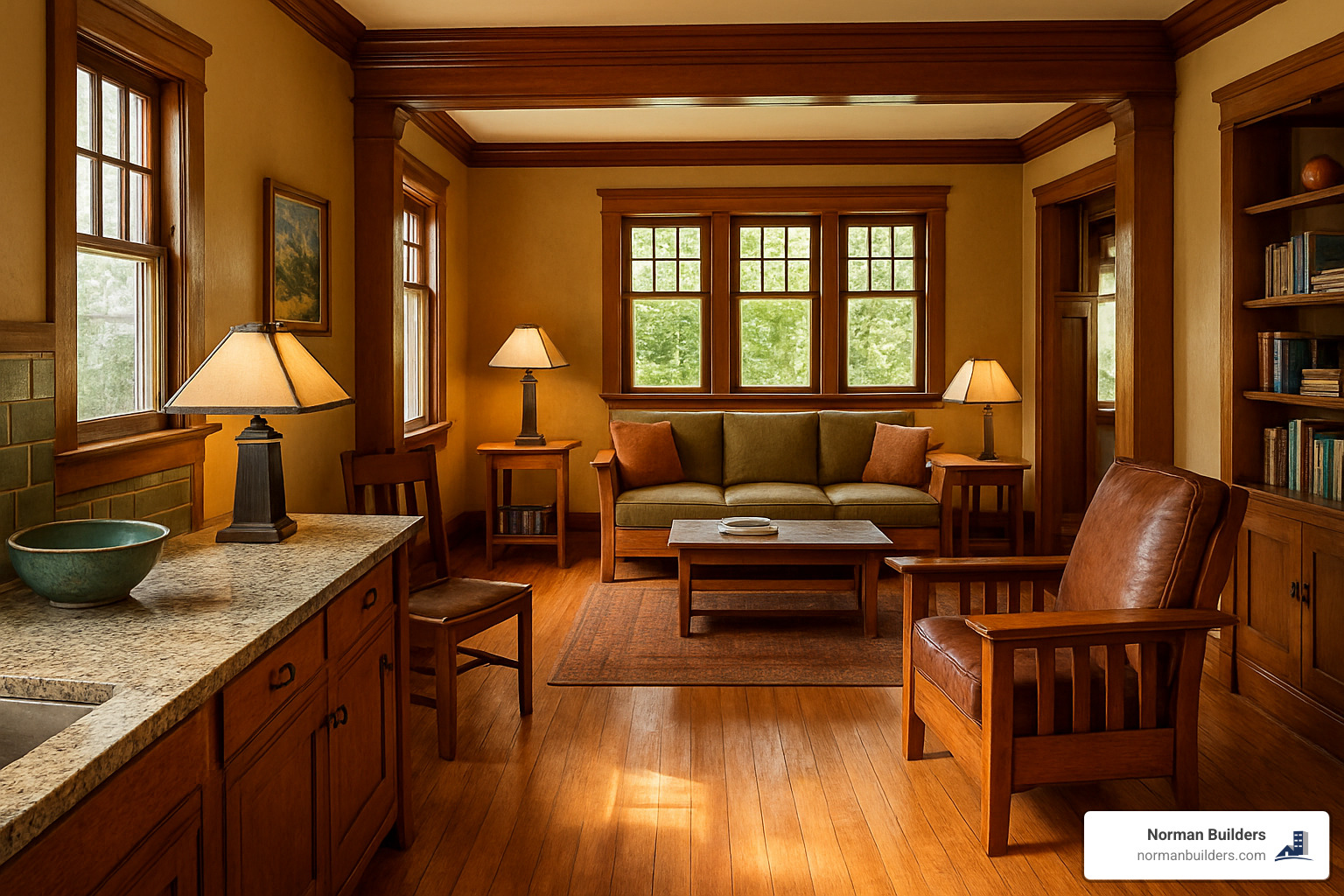
Your furniture and decor choices create the final layer in your Craftsman home renovation, where you can beautifully balance historic character with modern comfort.
Mission-style furniture with its clean lines and visible joinery naturally complements Craftsman architecture. But don’t feel obligated to create a museum—mix in contemporary pieces with simple forms for comfort and function. The best Craftsman interiors feel collected over time, not frozen in a specific era.
Lighting makes a tremendous impact on Craftsman spaces. Look for reproduction fixtures inspired by designers like Gustav Stickley or quality pieces from companies like Hubbardton Forge and Arroyo Craftsman. One particularly dedicated homeowner spent “months sourcing a combination of two vintage sconces” to create the perfect lighting for their kitchen—and the result was absolutely worth the wait.
Warm up your spaces with natural fiber textiles like wool, cotton, and linen in geometric patterns or nature-inspired motifs. Complement these with handcrafted pottery, copper vessels, and botanical elements that reflect the movement’s appreciation for craftsmanship and nature.
“Vintage and modern pieces can and should coexist to keep spaces feeling fresh,” advised one of my favorite designers. This approach creates homes that honor their historic roots while remaining vibrant, livable spaces for today’s families.
For more inspiration on creating authentic yet livable spaces, explore our home remodeling ideas or dive deeper into Craftsman color palettes to find the perfect combination for your home.
Expanding a Craftsman home renovation requires a delicate balance between modern needs and historic integrity. As one of our clients beautifully put it, “We didn’t want the add-on to look like an add-on.” This sentiment captures the essence of thoughtful Craftsman expansion—creating seamless transitions that respect the home’s original character.
While Craftsman homes traditionally featured distinct rooms rather than today’s wide-open layouts, you can improve flow without sacrificing character. The key is selective modification rather than wholesale demolition.
When working with homeowners in Andover, we often recommend creating archways between spaces rather than removing entire walls. This maintains the home’s rhythm while improving sightlines and connection. One North Shore client told us, “The arched opening between our dining room and living room gave us the openness we wanted while preserving the original craftsman feel—it was the perfect compromise.”
Pocket doors offer another authentic solution, as they were common in original Craftsman homes. These space-savers can be reintroduced to provide flexibility between rooms without sacrificing valuable wall space for furniture placement.
When structural needs require removing load-bearing walls, exposed beams can provide necessary support while adding architectural interest. We recently finished a project in Southern NH where darkly stained beams not only reinforced the newly opened space but became a favorite design element that felt completely authentic to the home’s origins.
Original built-in cabinets and colonnades between rooms are defining Craftsman elements worth preserving. These features can be incorporated into your new layout as natural room dividers that maintain character while allowing for a more connected living experience.
Adding square footage to a Craftsman home requires thoughtful design to ensure the addition complements rather than competes with the original structure.
Matching rooflines and pitches is perhaps the most critical factor in a successful addition. Those distinctive low-pitched roofs with generous overhangs are immediately recognizable Craftsman characteristics. One Seacoast homeowner remarked, “Our architect spent extra time getting the roof pitch exactly right on our addition, and that attention to detail made all the difference.”
Material continuity creates visual harmony between old and new sections. This means matching siding, trim profiles, and architectural details so precisely that the transition becomes nearly invisible. For a recent project in the Merrimack Valley, we sourced clinker brick that perfectly matched the original home’s exterior, creating a seamless blend between the century-old structure and new addition.
Scale and proportion matter tremendously in Craftsman design. We recently worked with homeowners who wanted to add a second story to their bungalow. Rather than creating a full-height second floor that would have overwhelmed the neighborhood, we designed pop-up dormers that provided the needed space while maintaining appropriate scale.
Window alignment creates visual rhythm across the entire structure. When designing additions, we carefully align new windows to relate visually to existing openings, matching both style and placement. This attention to detail might seem subtle, but it’s immediately noticeable when done incorrectly.
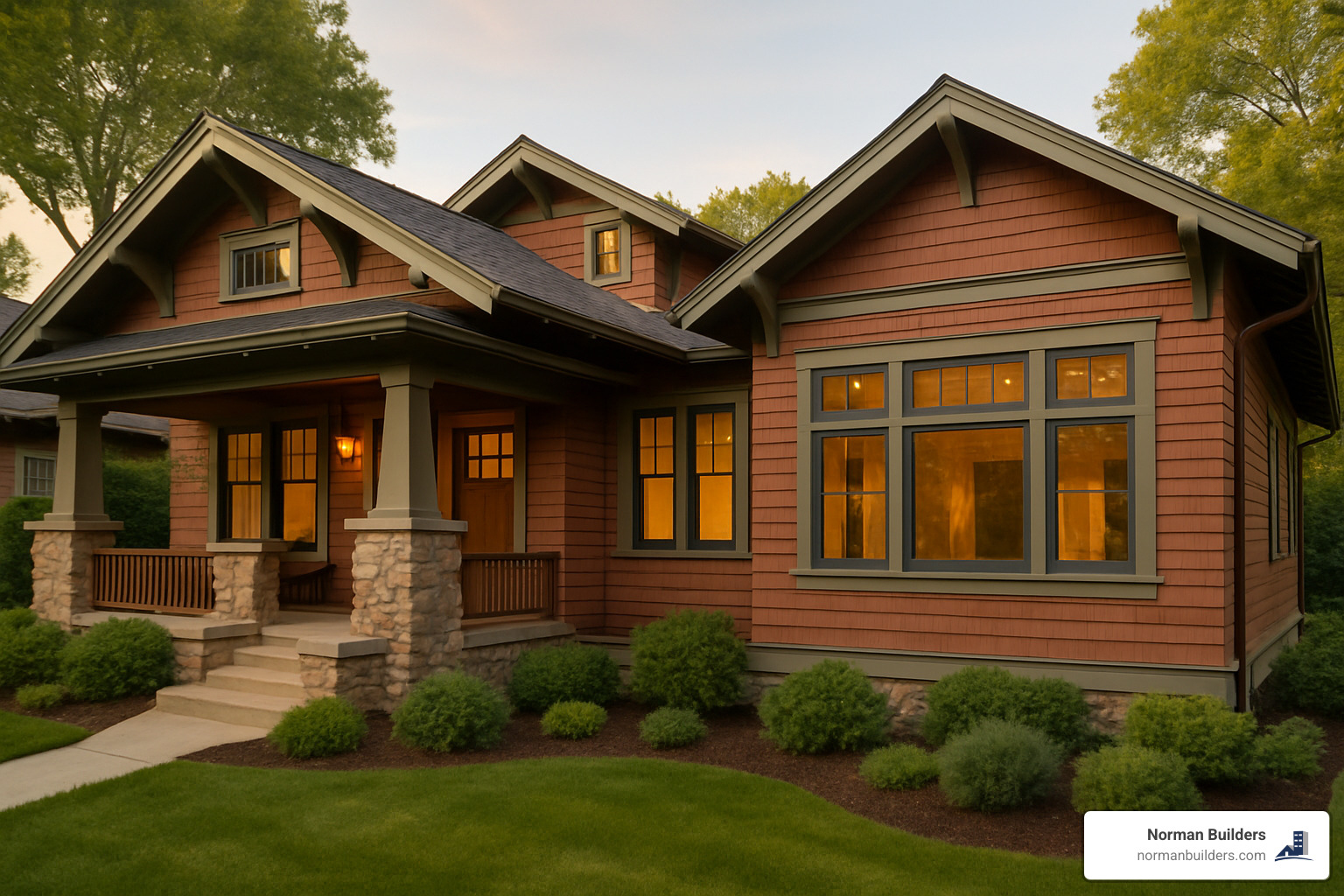
The Craftsman movement emphasized harmony with nature, making outdoor spaces essential to the complete home experience.
Front porches serve as both architectural elements and living spaces. During a recent Craftsman home renovation in Andover, we removed a poorly designed 1970s enclosed porch to reveal and restore the original stone pillars and deep covered entry. The homeowners now use this space daily, connecting with neighbors and enjoying their garden from a sheltered vantage point.
Native plantings honor the Craftsman philosophy of regional appropriateness. When designing landscapes for these homes, we recommend species that would have been available when the house was built, creating an authentic garden that requires less maintenance and supports local ecosystems. Imagine ferns, hostas, and hydrangeas creating a lush foundation for your bungalow’s earthy exterior colors.
Outdoor living areas extend your home’s functionality while celebrating the indoor-outdoor connection central to Craftsman design. One North Shore family we worked with now enjoys “a multilevel deck with defined lounging and dining areas” that feels like a natural extension of their interior spaces. As they told us, “It’s nice to have friends over and sit around the fire pit—it’s become our favorite ‘room’ in summer.”
Thoughtful lighting improves safety while preserving nighttime character. Period-appropriate copper lanterns along paths and flanking entries provide warm illumination that improves your home’s architectural details after dark.
Creating these harmonious connections between indoor and outdoor spaces isn’t just aesthetically pleasing—it honors the original intent of Craftsman design while supporting modern living patterns. As one client reflected after their renovation, “Our home now feels bigger, more connected to nature, and somehow more authentic than when we started.”
Looking to expand or reconfigure your Craftsman home? Learn more about our approach to whole house renovations or explore creative home remodeling ideas for inspiration.
Please note: Our services are exclusively available in Massachusetts, specifically in Andover, MA, the North Shore, and New Hampshire, covering the Seacoast and Southern NH regions.
There’s something humbling about renovating a century-old home. Even with the most careful planning, Craftsman home renovation projects often surprise even seasoned professionals with unexpected challenges and hidden treasures.
“Old houses aren’t straightforward,” a designer friend once told me after finding three layers of flooring during what was supposed to be a simple kitchen update. This sentiment captures the beautiful complexity of working with these historic homes.
I’ve watched countless homeowners fall in love with Craftsman homes only to make decisions they later regret. The most heartbreaking mistake? Over-modernizing these architectural treasures. Stripping away too many original features in pursuit of contemporary trends not only diminishes a home’s character but can significantly reduce its value.
Painting original woodwork is perhaps the most controversial decision in Craftsman renovations. While sometimes appropriate in certain rooms or for specific Craftsman subtypes, this choice should be made carefully as it’s extremely difficult to reverse. As one preservation expert bluntly put it, “It would be tragic to lose the beautiful historic wood trim, molding, and columns in a Craftsman home remodeling job.”
I’ve seen homeowners cut corners with inferior materials like MDF or vinyl instead of authentic wood and stone, only to regret it when these materials fail to age gracefully. Similarly, ignoring proportion in additions or window replacements can destroy a home’s architectural harmony faster than just about anything else.
One couple I worked with shared their painful lesson after rushing the process: “We started demolition the week after closing and regretted not living with the space first.” Their advice? “Live in the house at least six months before beginning renovation” to truly understand its quirks and character.
Perhaps the most common mistake is simply underbudgeting. Another family found “rotting cabinets under multiple paint layers and had to rebuild custom boxes, tripling their budget.” These hidden conditions can dramatically impact costs and timelines, which is why experienced renovators always build in generous contingencies.
Finding authentic materials and skilled craftspeople is essential for a successful Craftsman home renovation. Here’s where to look:
Architectural salvage yards have become treasure troves for renovators seeking original doors, hardware, lighting fixtures, and millwork from the same era. One homeowner described the thrill of finding original five-panel doors that perfectly matched the ones remaining in their home: “It was like winning the lottery!”
When originals can’t be found, specialty manufacturers offer historically accurate reproductions of everything from lighting to hardware. Companies like Rejuvenation, House of Antique Hardware, and Schoolhouse Electric specialize in period-appropriate pieces.
For missing trim, cabinetry, or built-ins, developing relationships with custom millwork shops and skilled woodworkers is invaluable. One craftsman I know keeps a collection of antique planes specifically for matching historic profiles in Craftsman homes.
Many renovators find inspiration in historic catalogs – original Sears, Roebuck catalogs or historical millwork catalogs (many now available online) provide accurate details for authentic restorations. These resources show exactly what would have been available when these homes were built.
I’ve watched one particularly dedicated homeowner “spend months sourcing a combination of two vintage sconces” for their kitchen. While this level of commitment isn’t always necessary, it demonstrates the patience often required to find just the right pieces for these special homes.
The Arts and Crafts movement rebelled against industrialization and mass production, embracing natural materials and craftsmanship – values that align beautifully with today’s sustainability concerns. Modern Craftsman home renovation projects increasingly incorporate eco-friendly practices that honor these original principles.
Energy-efficient windows present a particular challenge in historic homes. Many preservationists recommend restoring original windows and adding storm windows rather than replacing them outright. When replacements are necessary, companies specializing in historic reproductions can create energy-efficient versions that maintain the original look.
Adding improved insulation in attics, basements, and during wall repairs significantly reduces energy consumption without altering a home’s appearance. One homeowner in Maine reduced their heating costs by 40% after carefully insulating their 1912 Craftsman.
Forward-thinking renovators are designing electrical systems with solar preparation in mind, making future renewable energy integration simpler. Similarly, water conservation through low-flow fixtures and rainwater harvesting systems honors the Craftsman ethos of working harmoniously with nature.
Many Craftsman enthusiasts are also incorporating subtle aging-in-place features that will allow them to remain in their beloved homes for decades to come. Thoughtfully designed bathrooms, strategic grab bar blocking in walls, and first-floor master suites can be incorporated without compromising historic character.
Industry data shows that “eco-friendly upgrades, such as energy-efficient windows and insulation, are included in 45% of modern Craftsman renovations,” reflecting a growing understanding that sustainability and historic preservation can work hand in hand.
For more guidance on finding qualified professionals for your renovation, check out our guide to Home Remodeling Contractors Near Me.
Please note: Our services are exclusively available in Massachusetts, specifically in Andover, MA, the North Shore, and New Hampshire, covering the Seacoast and Southern NH regions.
When you start on a Craftsman home renovation, it’s natural to wonder which original elements deserve your immediate attention. In my years of guiding homeowners through these projects, I’ve found that certain features truly define the Craftsman character.
Start with the built-ins and custom cabinetry—these handcrafted elements tell your home’s unique story. One homeowner told me, “Once we restored the original buffet in our dining room, the whole house seemed to come alive again.” These pieces aren’t just beautiful; they’re practically impossible to replicate without spending a small fortune.
Original woodwork should be next on your preservation list. The door and window trim, substantial baseboards, and warm wainscoting showcase the craftsmanship that makes these homes special. When properly restored, this woodwork creates a framework that ties your entire renovation together.
Those charming original windows with wavy glass deserve your protection too. While they might not meet modern energy standards on their own, adding storm windows or having them professionally restored can give you the best of both worlds—authentic character and improved efficiency.
Don’t overlook your fireplace—more than just a heat source, it’s often the soul of a Craftsman home. Whether faced with distinctive tile, natural stone, or surrounded by built-in seating, these focal points anchor your living spaces and deserve careful preservation.
Last but certainly not least, those hardwood floors beneath your feet have stories to tell. Even when they seem beyond hope, an experienced flooring specialist can often bring them back to life, preserving decades of character that new materials simply can’t match.
“How do I create a more open feel without sacrificing the soul of my Craftsman home?” This might be the question I hear most often from homeowners. The good news is that you absolutely can open things up—if you do it thoughtfully.
Start by partnering with a structural engineer who understands historic homes. They’ll help identify which walls are load-bearing and develop smart reinforcement strategies that respect the home’s integrity. Sometimes, what looks like a simple wall removal requires carefully planned beam installations to maintain structural soundness.
Consider partial openings rather than completely removing walls. One family I worked with installed a beautiful colonnade between their living and dining rooms—wide enough to improve flow and sightlines, but still defining each space in a way that honors the Craftsman tradition. Another option is creating archways that maintain the sense of transition between rooms while allowing more light and connection.
Whatever changes you make, preserve those signature Craftsman elements like fireplaces, built-ins, and millwork. These features can be incorporated into your new, more open layout in ways that actually highlight their beauty. One homeowner told me, “Opening up our kitchen to the dining room actually made the original built-in hutch more of a showpiece.”
Maintaining consistent flooring, trim details, and ceiling heights throughout the opened areas helps create visual harmony that makes the changes feel intentional rather than jarring. Your goal is to make it look like the home was always meant to flow this way.
Few questions spark more passionate debate among Craftsman enthusiasts than whether to paint or refinish original woodwork. There’s no one-size-fits-all answer, but I can help you steer this decision.
First, consider historical accuracy. While many Craftsman homes showcased natural wood, some subtypes—particularly in certain regions—actually featured painted woodwork originally. A bit of research into your specific home’s history might provide valuable guidance.
Next, honestly assess the condition of the wood. When wood is severely damaged or has been repeatedly painted over decades, a fresh coat of quality paint might be the most practical preservation strategy. On the other hand, well-maintained finishes or wood that has never been painted might be worth the effort to restore.
Your personal preferences matter too. After all, you’re the one living in the home. Some families prefer the brightness that painted trim brings to naturally dark Craftsman interiors, while others cherish the warmth and depth of natural wood tones. Either can be beautiful when done with care and quality materials.
Painting is relatively permanent—once wood is painted, returning it to its natural state becomes extremely difficult. Refinishing, while more labor-intensive initially, preserves options for future owners.
For gentler restoration approaches, try simple solutions first. “I was amazed at how much of the grime on our original oak trim came off with just warm water and mild dish soap,” shared one homeowner. “We saved ourselves weeks of stripping and refinishing by starting with the least invasive cleaning methods.”
Please note: Our services are exclusively available in Massachusetts, specifically in Andover, MA, the North Shore, and New Hampshire, covering the Seacoast and Southern NH regions.
There’s something magical about watching a Craftsman home renovation come to life. These architectural treasures, with their handcrafted details and warm character, deserve the care and attention that comes from thoughtful restoration. When done right, renovating a Craftsman isn’t just about updating an old house—it’s about honoring a piece of American architectural history while creating a home that works for modern life.
Throughout your renovation journey, the elements that make these homes special—the natural materials, the exposed rafters, the built-in cabinetry—are the very features that will bring you joy for years to come. By preserving these details while thoughtfully updating systems and spaces, you create a home that tells a story while meeting your family’s needs.
Many homeowners tell us that living in their renovated Craftsman brings a special kind of satisfaction. “There’s something about the solid feel of these homes,” one client shared. “The craftsmanship speaks to you daily—you can feel the care that went into building it a century ago.”
At Norman Builders, we approach each Craftsman home renovation with both respect for tradition and excitement about possibilities. Our team deeply understands the original building techniques that make these homes special, while also bringing expertise in modern systems that make them comfortable and efficient. This balance is essential to a successful renovation that honors the past while embracing the future.
Whether you’re dreaming of restoring original woodwork, creating a period-appropriate kitchen with modern functionality, or thoughtfully adding space for your growing family, we’re passionate about helping bring your vision to life. Our craftspeople take pride in matching original millwork, finding authentic materials, and solving the unique challenges these historic homes present.
The most successful Craftsman home renovation projects come from thoughtful planning, attention to detail, and a commitment to quality that matches the original builders’ dedication to craftsmanship. When you partner with professionals who share your appreciation for these special homes, the results can be truly remarkable.
Ready to start your Craftsman journey? Learn more about our whole house renovations and find how we can help transform your historic home into a space that celebrates its heritage while perfectly suiting your lifestyle.
Please note: Our services are exclusively available in Massachusetts, specifically in Andover, MA, the North Shore, and New Hampshire, covering the Seacoast and Southern NH regions.

We specialize in high-quality home construction and remodeling services, delivering exceptional craftsmanship tailored to meet your vision and needs. Whether you’re planning a renovation, new construction, or a custom remodel, our experienced team is committed to exceeding expectations with precision, attention to detail, and reliable service.
Our service area includes the Merrimack Valley, North Shore, Seacoast, and Southern NH Areas. We take pride in the quality of our workmanship and our prompt professionalism.
Contact us today to bring your project to life!