

Home renovation budget planning is the single most important step before swinging a hammer — and getting it right can mean the difference between a dream transformation and a financial nightmare.
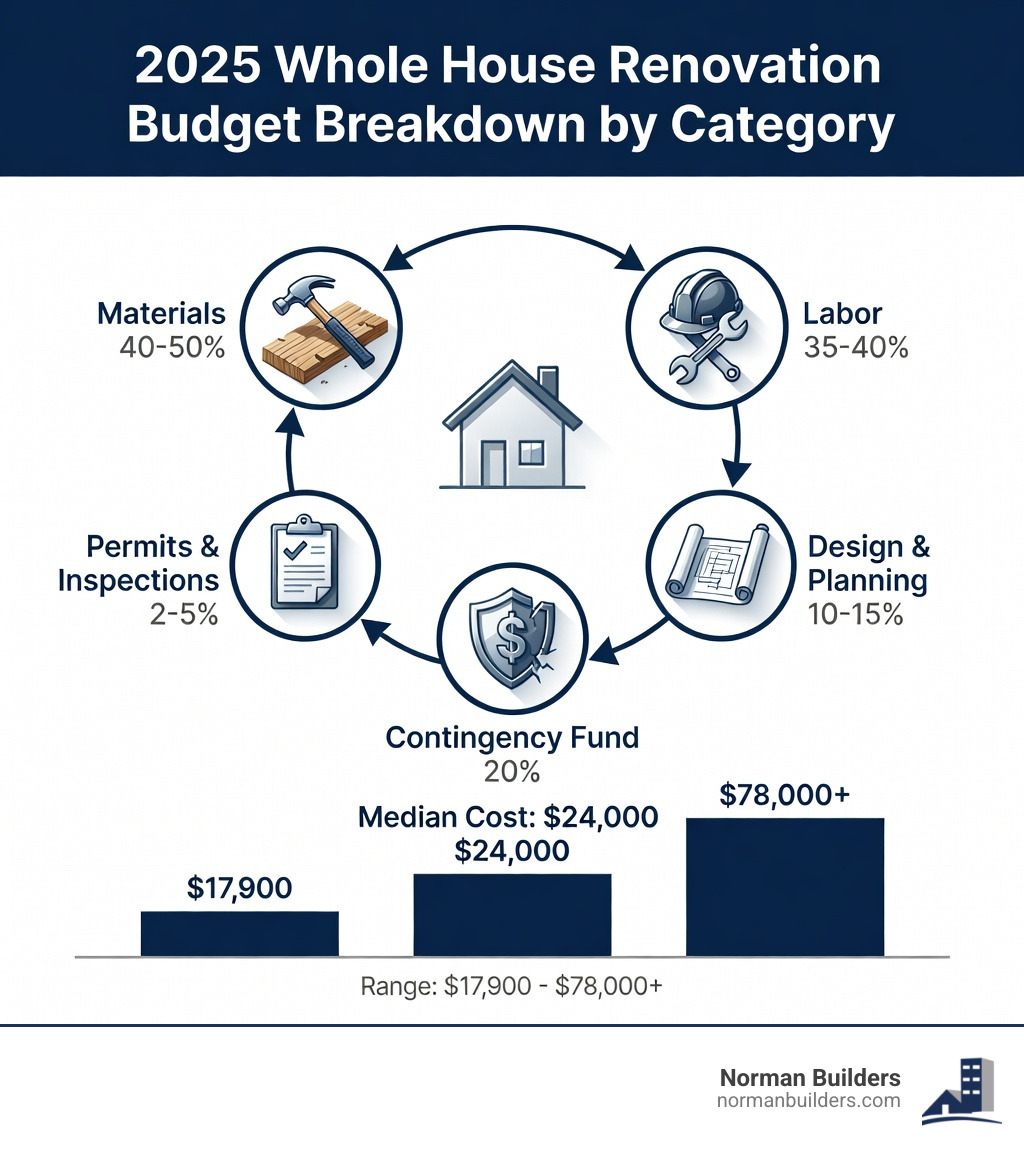
Here’s a quick overview of what a solid renovation budget covers:
| Budget Category | Typical Allocation |
|---|---|
| Materials | 40-50% of total budget |
| Labor | 35-40% of total budget |
| Design & Planning | 10-15% of total budget |
| Permits & Inspections | 2-5% of total budget |
| Contingency Fund | 20% of total budget |
According to recent data, the median American home renovation costs around $24,000 — but at the high end, projects can reach $150,000 or more. Most homeowners land somewhere between $17,900 and $78,000, depending on scope, location, and finish level.
The hard truth? Most renovation budgets go over. Not because homeowners are careless, but because whole-house projects are complex — with hidden costs, supply chain surprises, and structural discoveries that no one sees coming until a wall comes down.
That’s why going in with a realistic, detailed budget isn’t just smart — it’s essential.
I’m Ryan Norman, founder of Norman Builders, and after building and renovating homes across Massachusetts and New Hampshire since 2007, home renovation budget planning is something I’ve helped hundreds of clients navigate from the first estimate to the final walkthrough. In the guide below, I’ll walk you through everything you need to know to plan your budget with confidence.
Similar topics to Home renovation budget planning:

When we sit down with homeowners in the Merrimack Valley or the Seacoast area, the first thing we emphasize is that a budget is more than just a single number. It is a collection of moving parts that must be balanced. Effective home renovation budget planning requires breaking your total investment into distinct buckets to ensure no detail is overlooked.
The main categories you need to account for include:
To stay organized, we recommend using a whole house renovation checklist to track every phase of the project. This prevents the “I forgot we needed to buy door hinges” moment that can stall a project late in the game. For more high-level guidance on the financial side, Fidelity provides excellent insights on long-term budgeting.
In the industry, we often talk about “hard costs” and “soft costs.” Hard costs are the physical construction expenses (labor and materials), while soft costs are the fees for design, permits, and insurance.
When you are looking at internet data for average cost per square foot to renovate a house, it is important to remember that labor typically accounts for 30% to 40% of your total spend. In our region—the North Shore and Southern New Hampshire—labor costs can be higher than the national average due to the high demand for skilled tradespeople.
Materials usually take up the largest chunk, often 40% to 50%. One of the best ways to manage your home renovation budget planning is to distinguish between “fixed” and “variable” material costs. A fixed cost might be the square footage of flooring you need, while a variable cost is the quality of that flooring. Choosing a mid-range material in a guest room while splurging on premium tile in the master bath is a classic strategy to balance the books.
If there is one piece of advice we give every client from Salem, NH, to Newburyport, MA, it is this: Build in a contingency fund.
We recommend setting aside a buffer of 20% to 30% of your total project cost. Why so much? Because until we open up the walls of a 100-year-old home in the Seacoast region, we don’t know what’s hiding inside. Common “budget busters” include:
Without a contingency fund, these discoveries can force you to cut corners on the finishes you actually wanted. By planning for the unexpected, you ensure the project finishes as strong as it started.
Not all rooms are created equal when it comes to home renovation budget planning. A kitchen is vastly more expensive than a bedroom of the same size because of the density of plumbing, electrical, and cabinetry required.
The following table outlines average internet costs for various project types. Please note that these are based on broad market data and are not specific quotes for our services.
| Project Type | Average Low-End Cost | Average High-End Cost |
|---|---|---|
| Kitchen Remodel | $15,000 | $150,000+ |
| Bathroom Remodel | $6,000 | $42,000+ |
| Basement Finishing | $20,000 | $70,000+ |
| Whole House Reno | $100,000 | $400,000+ |
As you can see, the high end can easily be 3x to 5x the average or low-end costs, especially when you move into luxury finishes or structural reconfigurations. For those specifically looking at bathrooms, you can find more detailed information on bathroom remodeling costs to help narrow down your expectations.
Kitchens and bathrooms are the “engines” of your home’s value. According to the 2022 Remodeling Impact Report from the NAR, 86% of homeowners report a significant increase in their enjoyment of their home after a kitchen remodel.
However, these rooms are also where budgets most frequently expand. Significant costs include:
When planning a master suite, the master bath remodel costs will often lean toward the higher end of the spectrum due to the desire for premium fixtures and larger layouts.
Basements offer a fantastic way to add square footage without the cost of a full addition. However, home renovation budget planning for a basement must prioritize “invisible” work first. This includes moisture barriers, foundation integrity checks, and ensuring proper ceiling height and egress windows for safety.
A whole house renovation is a different beast entirely. This involves a holistic look at the home’s flow. We often see clients wanting to create “open-concept” layouts, which usually require structural beams to replace load-bearing walls. This is a high-impact move that requires careful financial planning but offers the greatest transformation in how you live in your space.
Why does a renovation in Newton, NH, cost differently than one in a different part of the country? Several regional and property-specific factors play a role in your final investment.
Understanding the cost of renovating a house requires looking at your specific property through these lenses.
Never underestimate the role of local government in your budget. Whether you are in Salisbury, MA, or Kingston, NH, you will need permits for structural, electrical, and plumbing work.
If you are considering expanding your footprint, using a home addition cost calculator can help you estimate these regulatory and structural costs upfront.
Once you have a clear picture of the costs, the next step in home renovation budget planning is determining how to pay for it. Most homeowners use a combination of methods:
If you are renovating with an eye toward selling in the future, you want to prioritize projects that offer the best ROI.
When you look at the cost to renovate an entire house, we always suggest starting with the “must-haves” (structural and functional) before moving to the “nice-to-haves” (cosmetic).
While it varies based on your choice of finishes, a full renovation in our service area typically ranges from $150 to $300+ per square foot. The lower end covers cosmetic updates like paint and flooring, while the higher end includes structural changes, custom cabinetry, and high-end materials.
A common industry rule of thumb is the 15% rule: no single room renovation should exceed 15% of your home’s total value. For example, if your home in Andover is worth $600,000, your kitchen renovation budget should ideally stay under $90,000 to avoid “over-improving” for the neighborhood.
Beyond the construction itself, homeowners often forget to budget for:
At Norman Builders, we believe that home renovation budget planning shouldn’t be a source of stress. It should be the roadmap that leads you to the home you’ve always wanted. Since 2007, we’ve built our reputation on exceptional craftsmanship and personalized service across Newton, NH, Southern New Hampshire, and the North Shore.
We pride ourselves on transparency and helping our clients understand exactly where their investment is going. Whether you are transforming a historic home in Newburyport or finishing a basement in Windham, we are here to ensure your project is a success from the first line of the budget to the final coat of paint.
Ready to start your journey? Explore our guide on creating a whole house renovation budget to get started today.
Please note: Our services are exclusively available in Massachusetts, specifically in Andover, MA, the North Shore, and New Hampshire, covering the Seacoast and Southern NH regions.

We specialize in high-quality home construction and remodeling services, delivering exceptional craftsmanship tailored to meet your vision and needs. Whether you’re planning a renovation, new construction, or a custom remodel, our experienced team is committed to exceeding expectations with precision, attention to detail, and reliable service.
Our service area includes the Merrimack Valley, North Shore, Seacoast, and Southern NH Areas. We take pride in the quality of our workmanship and our prompt professionalism.
Contact us today to bring your project to life!