

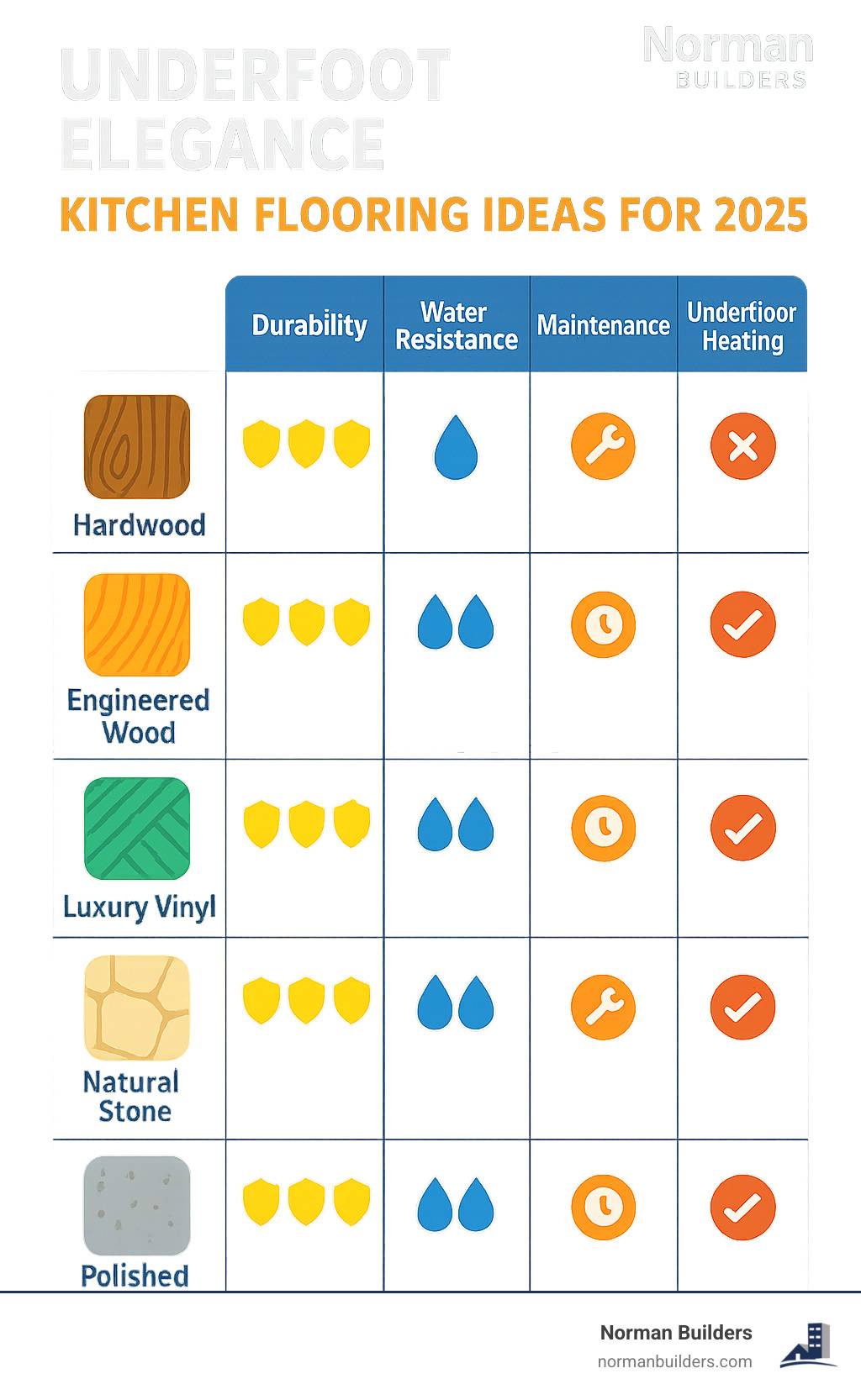
When planning a kitchen remodel flooring ideas should be one of your first considerations, as your floor literally supports everything else in the space. For those looking to quickly update their kitchen floors in 2025, here are the top options to consider:
Your kitchen floor works harder than any other surface in your home. It endures spills, dropped utensils, constant foot traffic, and serves as the foundation for your entire kitchen design. The right flooring choice balances durability, style, and practicality while complementing your overall kitchen aesthetic.
Modern kitchen floors need to perform multiple functions simultaneously – they must be easy to clean, comfortable to stand on for long periods, resistant to moisture, and visually appealing. With open-concept homes becoming increasingly popular, many homeowners also want flooring that flows seamlessly into adjoining living spaces.
As designer Jean Rehkamp Larson notes, a flooring change in an open-plan kitchen can feel like a “taped line” on the floor, potentially disrupting the visual harmony of your space. This is why material selection and transition planning are crucial considerations in your kitchen remodel.
I’m Ryan Norman, founder of Norman Builders, and I’ve guided hundreds of homeowners through successful kitchen remodel flooring ideas implementation since 2007, changing outdated kitchens into functional, beautiful spaces that stand the test of time. My background in construction and property management has given me unique insights into which flooring options deliver the best balance of style, durability, and value.
Please note: Our services are exclusively available in Massachusetts, specifically in Andover, MA, the North Shore, and New Hampshire, covering the Seacoast and Southern NH regions.
Kitchen remodel flooring ideas terms to learn:
– kitchen remodel ideas 2025
– modern kitchen design ideas 2025
The flooring you choose for your kitchen remodel sets the tone for the entire space while determining how your kitchen will perform under daily use. Here’s our comprehensive breakdown of the top kitchen remodel flooring ideas trending for 2025, based on our extensive experience with homes throughout the Merrimack Valley, North Shore, Seacoast, and Southern NH areas.
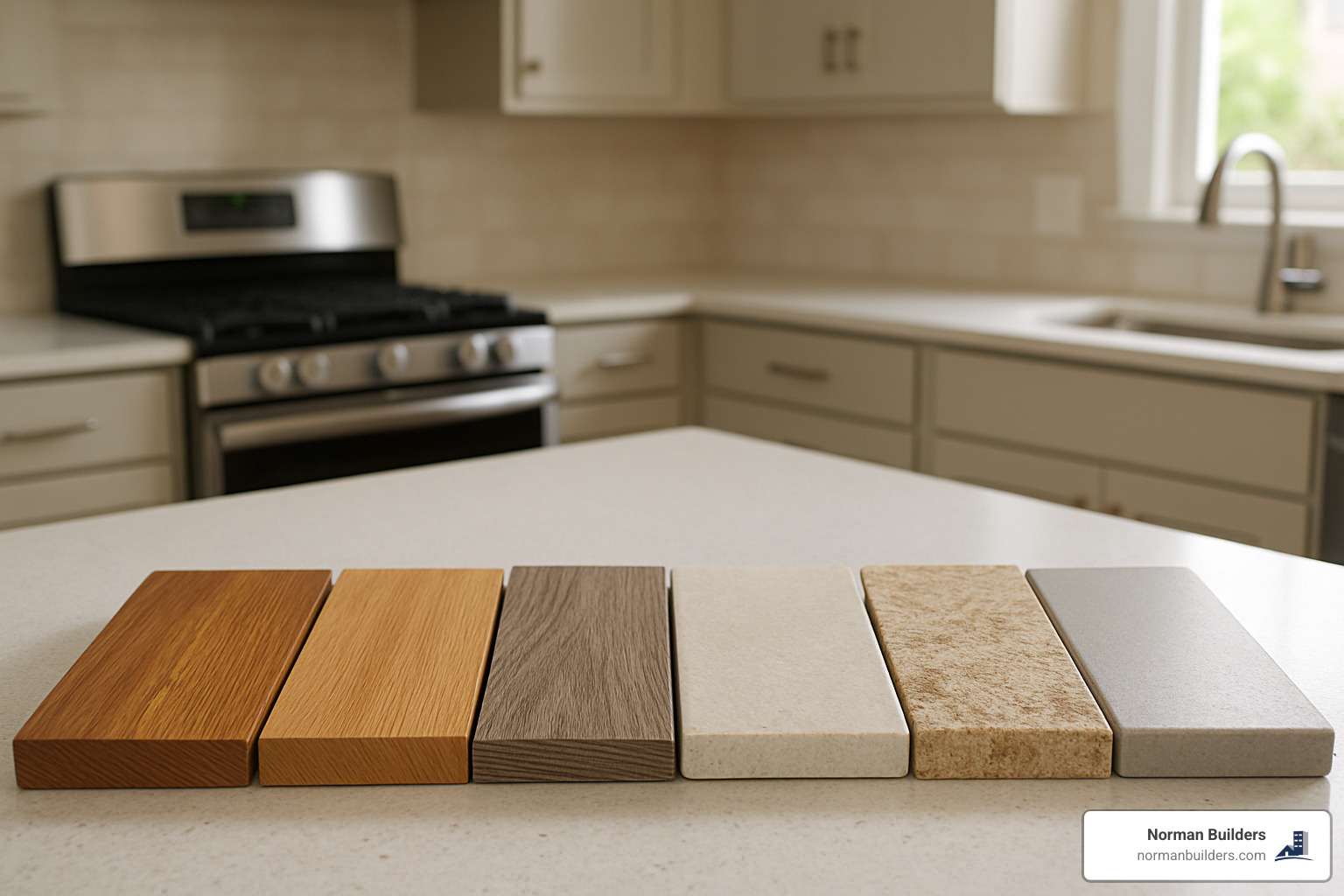
Each flooring option brings its own unique blend of aesthetics, durability, and practical benefits. Understanding these differences is crucial to making an informed decision that will serve your kitchen well for years to come.
Hardwood flooring continues to reign supreme in kitchen design, offering timeless appeal and remarkable longevity. We’re seeing wood floors in kitchens now more than ever, especially in open-concept homes where continuous flooring creates visual harmony between spaces.
Solid hardwood brings warmth and natural character that can last over a century with proper care. It can be sanded and refinished 3-4 times throughout its lifespan, which significantly increases your home’s resale value. For kitchens specifically, lighter wood species like white oak tend to hide scratches better, making them practical choices for busy families.
Engineered hardwood offers more stability in humid environments with less expansion and contraction than solid wood. With a typical lifespan of 20-30 years and a more budget-friendly price point, it’s becoming increasingly popular. The cleanup is often easier too, with fewer gaps between boards to trap crumbs and debris.
For kitchens, I always recommend looking for engineered wood with a wear layer of 1/8″ to 3/16″ thick. This provides adequate material for future refinishing when inevitable wear occurs. A simple but effective tip I share with my clients: place a floor mat at the sink area to protect against water damage, regardless of which wood option you choose.
For added protection with any wood flooring in kitchens, consider installing sheet-metal pans under dishwashers and refrigerators, piped to drain outdoors. I’ve seen this simple precaution prevent catastrophic water damage from appliance leaks many times in my years of building. For more detailed information on wood flooring options, PID Floors guide to wood floors offers excellent resources.
Luxury vinyl plank (LVP) and luxury vinyl tile (LVT) have revolutionized kitchen flooring with their remarkable combination of affordability, durability, and style. These products have come a long way from the plasticky sheet vinyl of decades past.
The 100% waterproof core of luxury vinyl makes it ideal for kitchens where spills are inevitable. Modern options are highly resistant to scratches, dents, and stains while mimicking the look of natural wood or stone with astonishing realism. They’re comfortable underfoot and warmer than tile, which your feet will appreciate during early morning coffee runs.
When selecting luxury vinyl for your kitchen, pay attention to the wear layer thickness—20 mil or higher is recommended for busy kitchens. The thicker the wear layer, the better protected your floor will be against scratches and dents from dropped utensils or sliding chairs.
Laminate flooring has also seen significant improvements in recent years. Modern options like the Arista Waterproof Laminate are 100% PVC-free with an AC5 wear layer for superior scratch resistance. These products offer the look of hardwood with improved durability and easier maintenance.
Both luxury vinyl and laminate can typically be installed in less than a day and used immediately after installation, making them perfect for homeowners who want to minimize kitchen downtime. They’re also ideal for DIY installations thanks to click-lock systems that don’t require adhesives. For more insights on luxury vinyl, check out ASAP Restoration insights on LVT or browse our Kitchen Remodeling Ideas for inspiration.
Tile remains one of the most popular choices for kitchen floors, and for good reason. The versatility, durability, and water resistance of tile make it perfectly suited to kitchen environments.
Porcelain tile stands out as the hardest and most water-resistant tile option, requiring no sealing (unlike ceramic). It’s available in countless styles, including realistic wood and stone looks that offer the aesthetics of natural materials with superior durability. It’s also perfect for underfloor heating systems, creating a cozy kitchen environment even in our cold New England winters.
When selecting porcelain tile for your kitchen, look for tiles with a PEI rating of IV or V to ensure adequate hardness and wear resistance. For safety, especially in kitchens where spills happen, choose tiles with a dynamic coefficient of friction (DCOF) of 0.42 or greater to prevent slips.
Large-format porcelain tiles (24″ x 24″ or larger) continue to grow in popularity for 2025, creating a seamless, contemporary look with fewer grout lines to clean. As tile setter Joshua Oduin recommends, “Source porcelain from Italy and Spain for superior uniformity and quality. The precision of European manufacturing makes installation smoother and the finished product more refined.”
Cement tiles are making a strong comeback in kitchen design, offering bold patterns and colors that serve as the focal point of the space. These handcrafted tiles develop a beautiful patina over time, adding character to your kitchen floor.

Important note: Cement tiles are porous and require proper sealing before use in kitchens. As one designer warns, “Be sure you are ready for the inevitable olive oil stain” if you choose unsealed cement tiles. This is why professional installation and sealing are particularly important with these statement-making tiles.
Please note: Our services are exclusively available in Massachusetts, specifically in Andover, MA, the North Shore, and New Hampshire, covering the Seacoast and Southern NH regions.
The way you arrange your flooring can transform your kitchen as dramatically as the material itself. In 2025, we’re seeing homeowners throughout our service areas embracing creative patterns and thoughtful transitions as key elements in their kitchen remodel flooring ideas.
Kitchen flooring colors are making a warm shift in 2025, leaving behind the cool grays that dominated recent years. When I visit homes in Andover or Portsmouth for consultations, I’m noticing clients gravitating toward these emerging trends:
Warm Neutrals are having a moment, with light to medium oak tones, cozy beiges, and soft taupes creating inviting foundations that play well with virtually any cabinet color you choose.
Unexpected Red has made a surprising comeback – we’ve installed several Berlin Red vinyl floors and terra cotta tiles recently, adding wonderful warmth and energy to contemporary kitchen designs.
Soft Sage flooring options pair beautifully with white or wood-toned cabinetry, bringing a fresh, natural element that connects indoor spaces with outdoor views.
Graphic Black-and-White patterns continue making bold statements, especially in period homes throughout the North Shore where vintage-inspired designs complement historical architecture.
Pattern-wise, we’re installing a lot of herringbone and chevron layouts for wood and plank-style tiles. Hexagon mosaics offer subtle geometric interest without overwhelming the space. For natural stone, the classic Versailles pattern remains timeless, while 3D-effect parquet adds visual depth to modern spaces.
For homeowners wanting to refresh existing wood floors without completely replacing them, we’ve had great success painting custom geometric patterns. This approach preserves the wood’s natural texture while dramatically changing the look – and saving considerably on replacement costs.

In the open-concept homes we build and remodel throughout Southern NH and the North Shore, creating cohesive transitions between kitchen and adjacent spaces is crucial. As I often tell my clients, think of your kitchen floor as part of your home’s overall design story, not just a practical surface.
Continuous flooring provides the most seamless look when possible. Running the same material throughout open spaces eliminates that awkward “taped line” effect that can make spaces feel disconnected. This approach works particularly well in the open-plan homes we build in Newburyport and surrounding areas.
When different flooring materials are necessary, we use architectural elements like ceiling height changes or partial walls to naturally delineate where materials transition. This creates a purposeful change rather than an arbitrary line.
One of my favorite techniques involves creating jagged transitions between different materials. Instead of a straight line where tile meets wood, for instance, we design an irregular border that feels organic and intentional. This approach has transformed many kitchens throughout the Merrimack Valley.
Color coordination is key when using different flooring types. We ensure they complement each other in tone and style, creating visual harmony even with material changes. Quality threshold details make all the difference – we invest in transition strips that coordinate beautifully with both flooring materials for a truly polished look.
For more inspiration on pattern layouts, this helpful guide showcases classic arrangements that work beautifully in kitchen spaces. And if you’re planning a complete kitchen change, our Kitchen Remodel Ideas 2025 page offers additional insights on creating cohesive designs.
Please note: Our services are exclusively available in Massachusetts, specifically in Andover, MA, the North Shore, and New Hampshire, covering the Seacoast and Southern NH regions.
Let’s talk about finding that “just right” kitchen floor – one that you’ll love looking at every morning while making coffee and that can handle whatever your family dishes out. After helping hundreds of Massachusetts and New Hampshire homeowners transform their kitchens, I’ve learned that the perfect floor balances beauty with practicality.
When clients visit our showroom in Newton, they often ask, “How long will this floor last?” Here’s my honest assessment, ranking kitchen flooring from most to least durable:
Porcelain tile takes the crown at 50+ years with proper installation. It’s practically bombproof – I’ve seen 30-year-old porcelain floors that look nearly new. Natural stone follows at 20+ years, though it needs regular sealing to maintain its beauty. Polished concrete offers similar longevity with occasional resealing.
For wood lovers, solid hardwood can genuinely last generations – I’ve refinished 100-year-old oak floors that came back beautifully. Engineered hardwood typically gives you 20-30 years, with limited refinishing opportunities. Luxury vinyl plank provides 10-20 years of service, depending on the wear layer thickness (thicker is better!). Laminate usually needs replacement after 10-15 years, while cork and bamboo range from 10-25 years with proper care.
If you have four-legged family members, I typically steer clients toward porcelain tile, quality luxury vinyl, or engineered hardwood with a factory-applied aluminum oxide finish. These surfaces stand up to claws and the occasional accident without showing wear too quickly.
Remember to think long-term when budgeting. While internet prices show luxury vinyl ranging from $2-$8 per square foot and natural stone from $10-$30+ per square foot, factor in both installation and lifetime maintenance costs. Sometimes the more expensive initial investment saves money over decades of use.
More homeowners throughout Andover, the North Shore and our entire service area are prioritizing eco-friendly materials that don’t compromise indoor air quality. The good news? Green options have come a long way.
Marmoleum (modern linoleum) deserves more attention than it gets. Made from linseed oil, pine resin, and wood flour, it’s naturally antibacterial and emits zero harmful VOCs. I installed it in my own mudroom, and it’s held up beautifully to boots, dog paws, and whatever else comes through the door.
Cork flooring feels amazing underfoot – it has a slight give that makes standing at the kitchen island much more comfortable. It’s naturally water-resistant and provides excellent thermal insulation, keeping your kitchen warmer in winter. The only downside? You’ll need to reseal it every few years.
Bamboo grows to maturity in just 3-5 years (compared to 20+ for hardwoods), making it a rapidly renewable resource. Today’s bamboo floors are engineered to resist moisture better than traditional hardwoods, though quality varies widely between manufacturers.
For families with allergy concerns, I always recommend hard surfaces over carpet. Porcelain tile is particularly good for allergy sufferers, as it doesn’t harbor dust mites or trap allergens. If indoor air quality is a priority, look for FloorScore® certified products with minimal VOC emissions.
Whether you’re hiring our team at Norman Builders or tackling a DIY project, proper installation makes all the difference in how your floor performs.
Start with a perfect foundation. I can’t stress this enough – the subfloor must be clean, dry, and level before you install anything on top. For large-format tiles (24″ or larger), the subfloor should be within 1/8″ of level over 10 feet. An uneven subfloor will lead to lippage (uneven edges) or cracked tiles that no amount of maintenance can fix.
Respect material properties. Wood and bamboo need to acclimate in your home for at least 48 hours before installation. This prevents warping and gapping later. Store materials in the actual room where they’ll be installed so they adjust to those specific conditions.
I’ve seen beautiful floors fail prematurely because homeowners skipped crucial steps: forgetting expansion gaps around the perimeter for wood floors (wood moves!), using the wrong adhesive, or neglecting to seal natural stone before grouting. These simple oversights can turn your dream floor into a nightmare.
For wood floors in kitchens, I always recommend two practical safeguards: place a floor mat at the sink area and install metal drip pans under appliances that use water. These simple precautions can prevent costly water damage that might not be covered by warranty.

When it comes to grout in kitchen floors, I recommend epoxy grout for areas near sinks and cooking zones. It costs more initially but resists staining far better than traditional cement grout. For busy families, this extra investment pays dividends in reduced maintenance and longer-lasting beauty.
Some installations are better left to professionals. Waterproofing systems, radiant heat installation, and large-format tile work require specialized knowledge and tools. The money you save attempting a complex DIY might cost you much more in repairs down the road.
Please note: Our services are exclusively available in Massachusetts, specifically in Andover, MA, the North Shore, and New Hampshire, covering the Seacoast and Southern NH regions.
If you’re looking for the ultimate combination of durability and minimal upkeep, porcelain tile stands head and shoulders above the rest. Unlike its ceramic cousin, porcelain doesn’t require sealing and stubbornly resists scratches, stains, and moisture damage. When properly installed, you can expect your porcelain tile floor to serve your kitchen faithfully for 50+ years with little more than regular sweeping and occasional mopping.
For homeowners who prioritize comfort alongside durability, luxury vinyl plank (LVP) deserves serious consideration. Modern LVP with wear layers of 20 mil or thicker provides impressive scratch and dent resistance while being completely waterproof – a crucial feature in busy kitchens. Many of our clients in Andover and throughout the North Shore appreciate that LVP feels warmer and softer underfoot than tile, making those long cooking sessions more comfortable.
If you love the look of natural stone but dread the maintenance, engineered stone or quartz composite tiles offer an excellent middle ground. These materials capture the visual appeal of natural stone while eliminating the need for regular sealing and special cleaners. They’re particularly popular in our Southern NH projects where homeowners want both beauty and practicality.
Yes! Wood floors can absolutely thrive in family kitchens when you take the right precautions. Many of our clients with active households and furry family members enjoy beautiful wood floors that have stood the test of time.
The secret is in the details: choose lighter wood species like white oak that naturally camouflage scratches better than darker varieties. Engineered wood often performs better in kitchen environments thanks to its improved stability and moisture resistance. When selecting your finish, opt for a matte or satin sheen rather than high-gloss – the lower sheen hides minor scratches and paw prints much more effectively.
Strategic protection makes a world of difference too. Place protective mats near the sink and food prep areas, and make regular pet nail trims part of your routine. For families with larger dogs or particularly active children, consider a site-finished floor with multiple coats of commercial-grade finish for maximum durability.
Throughout our years serving the Merrimack Valley and Seacoast regions, we’ve found that most homeowners feel the natural warmth and character wood brings to their kitchen outweighs the slightly higher maintenance requirements. As one of our Newton clients put it, “My floors show a little wear after 15 years with three kids and two dogs, but that just adds to their character!”
Creating harmonious transitions between different flooring materials is where craftsmanship truly shines. In our experience working throughout Massachusetts and New Hampshire, the most successful transitions feel intentional rather than arbitrary.
Whenever possible, use architectural features to your advantage. Doorways, archways, or changes in ceiling height naturally define spaces and provide logical points for flooring changes. When working with open-concept designs, consider jagged or irregular transition lines rather than straight cuts – these create a more organic flow between spaces that feels designed rather than compromised.
The physical transition itself deserves quality materials. Invest in proper transition strips that complement both flooring types, and always ensure floors are matched for height to eliminate trip hazards. For kitchen-to-dining transitions in open spaces, one of our favorite techniques is using the same material with different patterns – perhaps straight-laid hardwood in the kitchen transitioning to a herringbone pattern in the dining area.
Color coordination plays a crucial role too. Even when using different materials, ensuring they share similar undertones creates visual harmony. We recently completed a project in Exeter where we transitioned from porcelain tile in the kitchen to engineered wood in the living area, using a custom stain on the wood to echo the warm tones in the tile.
In doorways between distinct rooms, T-moldings provide clean, defined transitions. For areas where moisture might be a concern, like between a kitchen and bathroom, proper threshold installation prevents water migration while creating a polished look.
In truly open-concept homes, running the same flooring throughout the main living spaces often creates the most cohesive look. As one designer we work with regularly says, “Sometimes the best transition is no transition at all.”
Please note: Our services are exclusively available in Massachusetts, specifically in Andover, MA, the North Shore, and New Hampshire, covering the Seacoast and Southern NH regions.
The perfect kitchen floor isn’t just another design element—it’s the literal foundation upon which your entire kitchen remodel stands. After helping hundreds of homeowners transform their kitchens since 2007, I’ve seen how the right flooring choice can lift an entire space while providing years of practical service.
Whether you’re drawn to the warm, timeless appeal of hardwood, the practical resilience of luxury vinyl, or the endless creative possibilities of tile, your flooring decision should reflect both your personal style and your family’s day-to-day needs. The best kitchen floors balance beauty with functionality, creating a surface that not only looks stunning but performs beautifully under the demands of real life.
At Norman Builders, we understand that New England homes present unique challenges and opportunities. From historic properties in Newburyport with their distinctive character to contemporary builds in Andover requiring modern solutions, we’ve guided homeowners through kitchen remodel flooring ideas that complement their specific spaces.
While cabinets, countertops, and appliances might be replaced multiple times over decades, your kitchen floor will likely remain in place much longer. This makes it one of the most important investment decisions in your remodel. Quality materials and professional installation pay dividends not just in daily enjoyment but in long-term value and durability.
The right kitchen floor does more than just look good—it supports your family’s lifestyle, improves your home’s value, and provides a durable foundation that stands up to everything from holiday gatherings to everyday breakfast rushes. When thoughtfully selected and properly installed, your kitchen floor becomes a quiet hero in your home, performing beautifully day after day with minimal fuss.
Ready to transform your kitchen from the ground up? Our team brings craftsmanship and attention to detail to every project, ensuring your new kitchen floor is installed with precision and care. Contact our kitchen remodeling contractor team for a consultation, and we’ll help you steer the many options available to create a kitchen floor that beautifully supports your life for years to come.
Please note: Our services are exclusively available in Massachusetts, specifically in Andover, MA, the North Shore, and New Hampshire, covering the Seacoast and Southern NH regions.

We specialize in high-quality home construction and remodeling services, delivering exceptional craftsmanship tailored to meet your vision and needs. Whether you’re planning a renovation, new construction, or a custom remodel, our experienced team is committed to exceeding expectations with precision, attention to detail, and reliable service.
Our service area includes the Merrimack Valley, North Shore, Seacoast, and Southern NH Areas. We take pride in the quality of our workmanship and our prompt professionalism.
Contact us today to bring your project to life!