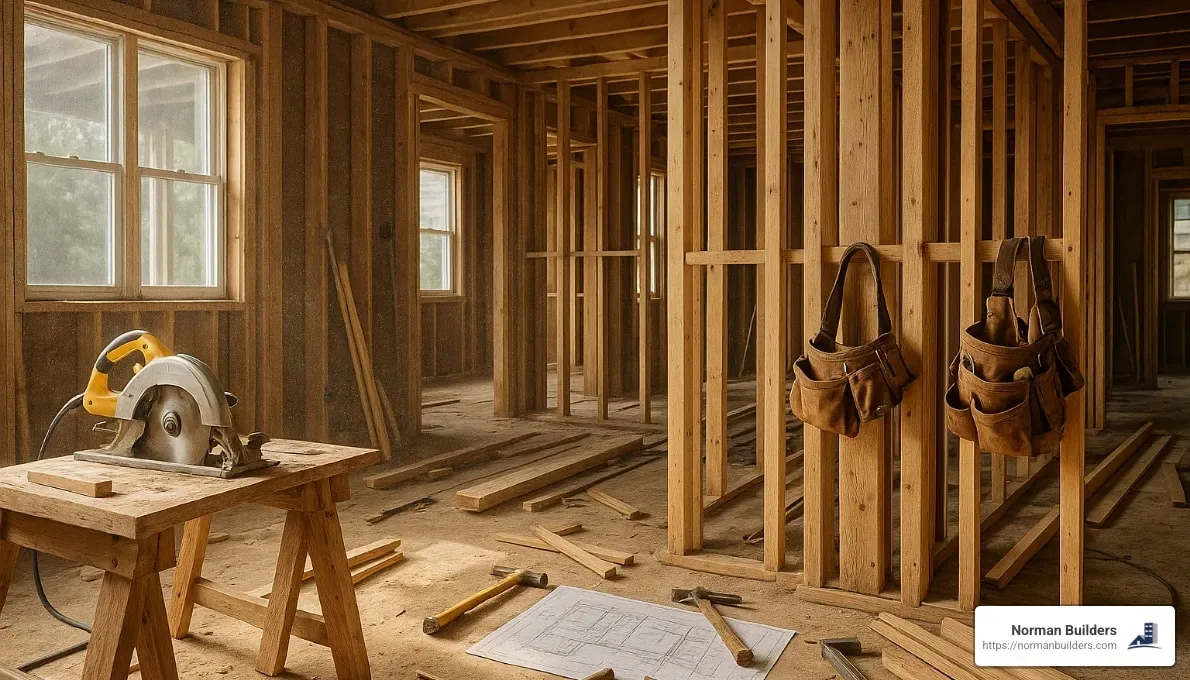
A gut renovation is a complete overhaul of a property where everything is stripped down to the structural framework (studs), allowing for comprehensive rebuilding from the inside out.
What is a gut renovation?
When considering home improvements, many homeowners face the decision between a standard remodel or a complete gut renovation. While a standard remodel focuses primarily on updating appearances and minor functional improvements, a gut renovation involves taking everything down to the bare bones of your home.
This type of renovation means stripping away all interior finishes—walls, flooring, fixtures, cabinetry—often down to the structural studs. It’s the home improvement equivalent of a blank canvas, allowing you to reimagine and rebuild your space from scratch.
Gut renovations are typically undertaken when a home has significant issues that can’t be addressed with surface-level updates. These might include outdated electrical systems, problematic plumbing, structural damage, or the desire for a completely different layout.
I’m Ryan Norman, founder of Norman Builders, and I’ve guided countless homeowners through the transformative process of gut renovation, turning outdated or damaged properties into their dream homes while navigating the complex decisions this level of renovation requires.
Gut renovation glossary:
When homeowners across Andover, the North Shore, or Southern NH reach out to us about major home improvements, we always start with a heart-to-heart about what they’re truly envisioning. The difference between a gut renovation and a standard remodel isn’t just about terminology – it’s about setting the right expectations for the journey ahead.
Think of a standard remodel as giving your home a makeover. You’re refreshing the paint, swapping out fixtures, installing new cabinets, maybe even taking down a non-load-bearing wall to open things up a bit. The fundamental structure stays intact, and you’re essentially working with what you’ve got.
A gut renovation, on the other hand, is more like hitting the reset button on your home’s interior. We strip everything back to the bare bones – the structural skeleton that holds your house together.
| Aspect | Standard Remodel | Gut Renovation |
|---|---|---|
| Scope | Cosmetic updates, minor structural changes | Complete demolition to studs, major reconfiguration |
| Systems Affected | Usually limited to visible elements | Electrical, plumbing, HVAC often replaced |
| Timeline | Weeks to a few months | Several months to years |
| Living Arrangements | Often can stay in home | Usually requires alternative housing |
| Permits Required | Limited permits | Extensive permitting often required |
| Cost Range | Moderate | Substantial investment |
| Best For | Newer homes, minor updates | Older homes, major layout changes, addressing serious issues |
The EPA defines gut rehabilitation as “projects that demolish and rebuild a structure to such an extent that it is considered new construction.” In everyday terms, this means we’re taking your home down to its skeleton – removing walls, floors, ceilings, fixtures, and often completely redoing electrical and plumbing systems.
I remember one homeowner in Andover who perfectly captured the experience: “When we decided to gut renovate, I didn’t realize we would literally see through our house from one exterior wall to another. It was both terrifying and exciting to see our home reduced to just studs and joists.”
That’s the reality of a gut renovation – it creates a blank canvas that lets you completely reimagine your space. It’s not just about making things prettier; it’s about fundamentally changing how your home works and feels.
In our years of experience throughout the North Shore and Seacoast regions, a true gut renovation typically includes:
As one of our Newburyport clients so perfectly put it, it’s like “building a new home within the shell of our old one.”
There comes a point in many homes’ lives when surface-level updates just won’t cut it anymore. This is especially true for the historic homes we often work with in communities like Newburyport, Salem, and Andover.
Your home might be telling you it needs a gut renovation if you’re facing:
Outdated electrical systems that can’t handle modern demands (or worse, pose safety risks). Those charming historic homes with knob-and-tube wiring or undersized electrical panels simply weren’t designed for today’s technology-filled lifestyle.
Plumbing nightmares like galvanized steel or polybutylene pipes that are constantly giving you trouble. These outdated materials are prone to leaks, corrosion, and can even affect water quality.
Structural concerns that make themselves known through sagging floors, cracked foundations, or persistent water damage. These aren’t problems you can paint over.
Inefficient layouts that don’t match how we live today. Those compartmentalized floor plans with tiny kitchens and formal dining rooms made sense a century ago but often feel confining and impractical now.
Energy inefficiency that has you wearing sweaters indoors and wincing at your utility bills. Older homes often lack proper insulation and have drafty windows and doors that let your heating and cooling dollars escape.
Hazardous materials like lead paint (common in homes built before 1978) or asbestos (found in many homes built before the 1980s). A gut renovation provides the opportunity to safely remove these health hazards.
I’ll never forget what a client in Kingston, NH, told me: “We started with plans for a kitchen remodel, but once we found the knob-and-tube wiring behind the walls and realized how inefficient our layout was, we knew a partial approach would just be putting a band-aid on much bigger issues.”
That’s the reality many homeowners face – what starts as a desire to update a kitchen or bathroom often reveals deeper issues that make a full gut renovation the more sensible long-term solution. While it’s certainly a bigger undertaking, it addresses problems at their source rather than just treating symptoms.
Please note: Our services are exclusively available in Massachusetts, specifically in Andover, MA, the North Shore, and New Hampshire, covering the Seacoast and Southern NH regions.
Let’s face it—tearing your home down to the studs isn’t a decision you make lightly. As someone who’s guided countless homeowners through this process across Massachusetts and New Hampshire, I’ve seen how a gut renovation can transform not just houses, but lives. While it’s certainly a significant undertaking, there are compelling reasons why this all-in approach might be your best path forward.
Over my years working with families from Andover to Portsmouth, I’ve noticed patterns in what drives people to take the plunge into a complete home overhaul.
Structural issues often top the list. Many charming New England homes have stood for a century or more, but that history sometimes comes with sagging floors, compromised foundations, or water damage that’s been slowly working its mischief for decades.
One homeowner in Exeter put it perfectly: “We’d been patching problems for years, but eventually realized we needed to address the root causes. Once we opened up the walls, we found joists that had been compromised by decades of small water leaks. It was actually a relief to finally fix everything properly.”
Outdated spaces are another major motivator. Those compartmentalized floor plans that made sense in the 1920s? They don’t exactly support the way we live today. Small, isolated kitchens, insufficient bathrooms, and electrical systems that can’t handle modern technology all signal that surface-level updates just won’t cut it.
“Gutting a home means you are ripping out the entire interior down to the studs,” as renovation experts at Sweeten often explain. This creates the opportunity to reimagine your space while preserving the character that made you fall in love with your home in the first place.
Health hazards lurking behind walls can turn a planned bathroom update into a necessary gut renovation overnight. Mold, asbestos in old flooring or insulation, lead paint, or extensive pest damage aren’t issues you want to simply cover up.
A client in Andover shared: “What started as a simple bathroom remodel turned into a gut renovation when we found extensive mold. In retrospect, I’m grateful we caught it—my daughter’s unexplained respiratory issues disappeared after we completed the renovation.”
Natural disasters sometimes force our hand. From coastal flooding to ice dam damage, New England weather can be unforgiving. When significant portions of a home are damaged, a gut renovation offers the silver lining of building back better than before.
Beyond solving problems, a gut renovation offers transformative benefits that can make the investment truly worthwhile.
Complete customization might be the most exciting aspect. With everything stripped away, you’re essentially working with a blank canvas. Want to knock down walls for an open concept living space? Expand your primary bathroom? Design a chef’s kitchen that perfectly suits how you cook? When you’re down to the studs, almost anything is possible.
Improved energy efficiency is a benefit that keeps giving back month after month. Modern insulation, high-performance windows, and updated HVAC systems can dramatically reduce your energy consumption. A Hampton homeowner told me: “After our gut renovation, our heating bills dropped by nearly 40%. The house is more comfortable year-round, and we feel good about the environmental impact too.”
Increased property value often follows a well-executed gut renovation. While the upfront investment is substantial, modernized homes with updated systems typically command higher resale values. Today’s buyers are increasingly willing to pay a premium for energy-efficient features, open floor plans, and kitchens and bathrooms that don’t need immediate updating.
Perhaps most importantly, the improved quality of life that comes from living in a home that truly works for you is invaluable. Better flow between spaces, improved natural light, reduced maintenance needs, and modern conveniences all contribute to daily comfort and enjoyment.
As one client in Newburyport beautifully expressed: “Our house used to be a collection of problems to solve. Now it’s just… home. Comfortable, functional, and exactly what we need. The peace of mind alone was worth the investment.”
A gut renovation isn’t just about fixing what’s broken—it’s about reimagining what your home could be. While the process requires patience and investment, the change can be nothing short of remarkable.
Please note: Our services are exclusively available in Massachusetts, specifically in Andover, MA, the North Shore, and New Hampshire, covering the Seacoast and Southern NH regions.
A gut renovation is one of those home improvement projects that can transform your living space entirely
– but it also requires a serious financial commitment. As we tell our clients at Norman Builders, understanding what you’re getting into financially is crucial before taking the plunge into a complete home overhaul.
When homeowners in Andover or Portsmouth ask me about costs, I always start with the same caveat: every home tells its own story, and so does every renovation budget. That said, having completed countless projects across the Merrimack Valley and Southern NH, we can provide some helpful guidelines.
According to various internet data, most gut renovations generally fall somewhere between $50 and $400 per square foot. Please note that these figures are averages only and do not represent actual costs from Norman Builders. Your specific costs will depend on several key factors: the size of your home, the quality of materials you select, how much structural work is needed, and even your location (labor costs vary considerably by region).
To put this in perspective, if you own a 2,000-square-foot colonial in Newburyport, internet data suggests that your renovation might cost anywhere from $100,000 for a basic overhaul to $800,000 for a high-end change with premium everything. These examples do not reflect any actual costs from Norman Builders. That’s quite a spread, which is why detailed planning is so essential.
Labor typically accounts for about a third to 40% of your total budget. Skilled tradespeople in our region generally charge between $50 and $150 per hour, depending on their specialty. Electricians and plumbers tend to command higher rates than general laborers, reflecting their specialized training.
Not all spaces in your home cost the same to renovate, either. Bathrooms are typically the most expensive rooms per square foot – all those fixtures, tile work, and waterproofing add up quickly. Kitchens follow closely behind, with their complex mix of cabinetry, appliances, and multiple systems (electrical, plumbing, sometimes gas). Living areas are generally less costly per square foot but still require significant investment in flooring, drywall, trim, and lighting.
I remember working with a family in Boxford who allocated equal budget portions to each room based solely on square footage. Six weeks in, they realized their kitchen needed nearly twice what they’d planned. As the husband told me later, “We cook every night but only use the guest bedroom twice a year – we should have budgeted accordingly!”
If there’s one thing I’ve learned after years of gut renovations in historic New England homes, it’s this: expect the unexpected. Once we start opening up walls in those charming Victorians in Salem or those stately colonials in Portsmouth, surprises almost always await.
That water stain you’ve been ignoring? It might reveal rotted floor joists beneath. Those quirky electrical outlets? They could be connected to knob-and-tube wiring that needs complete replacement. That slightly uneven floor? It might indicate foundation issues that weren’t visible before demolition.
Common surprises we encounter include hidden structural damage from years of small water leaks, outdated electrical systems that don’t meet modern code requirements, plumbing complications like corroded cast iron pipes, hazardous materials such as asbestos in old floor tiles or lead paint on woodwork, and foundation issues that only become apparent once we’ve removed flooring.
This is why I strongly advise every client to build a substantial contingency fund into their renovation budget. While 10% might suffice for a standard remodel, a gut renovation warrants at least 15-20% set aside for these unexpected findies. This isn’t being pessimistic – it’s being realistic.
A client in Rye, NH recently told me, “That contingency fund you insisted on saved our project. When you found that water damage had compromised the entire east wall, we had the funds ready to address it properly instead of cutting corners elsewhere.”
Building codes have also evolved significantly over the decades. What was perfectly acceptable when your home was built in 1920 might not meet today’s safety standards. Bringing electrical, plumbing, and structural elements up to current code requirements is non-negotiable and often represents a substantial portion of a renovation budget.
The good news? While these findies can be frustrating in the moment, addressing them results in a safer, more efficient, and ultimately more valuable home. Many clients tell us that the peace of mind alone was worth the investment – knowing that what’s behind their walls is sound, safe, and built to last.
Please note: Our services are exclusively available in Massachusetts, specifically in Andover, MA, the North Shore, and New Hampshire, covering the Seacoast and Southern NH regions.
When you start on a gut renovation, you’re not just changing your house—you’re temporarily turning your entire life upside down. I’ve guided countless homeowners through this process, and I can tell you firsthand: proper preparation isn’t just helpful—it’s essential for maintaining your sanity during what can be a challenging journey.
Let’s be honest about what’s ahead. A gut renovation creates significant disruption to your daily routine, from dust and noise to limited access to basic facilities. Here’s how to steer these challenges:
Living arrangements are perhaps your most critical decision. While technically possible to stay in your home during a gut renovation (especially if done in phases), I’ve seen many families try this approach only to regret it a few weeks in.
“We initially planned to live in the basement during our renovation,” shared one of our Andover clients with a laugh, “but after two weeks of dust and limited bathroom access, we rented an apartment nearby. It was an additional expense, but saved our sanity and probably our marriage!”
For most full house gut renovations, finding alternative accommodations is worth considering. You might stay with family (great for shorter projects), find a short-term rental, or if your budget allows, rent an apartment during the renovation. Some families successfully live in an untouched portion of their home, though this typically extends your timeline and creates additional logistical challenges.
Your belongings need protection too. Before the first sledgehammer swings, you’ll need a plan for your possessions. Most furniture and large items will require off-site storage during a full gut renovation. Valuable or fragile items should be carefully packed and removed, while items you’ll need regular access to should be organized for easy retrieval. Don’t forget to consider seasonal needs—if your renovation spans winter to summer, you’ll need different clothing accessible at different times.
For items remaining in unaffected areas, heavy-duty plastic sheeting becomes your best friend. I always recommend HVAC protection systems to prevent dust from circulating throughout your home, and clearly marking items that shouldn’t be touched during demolition.
Communication systems might seem like a small detail, but establishing clear protocols with your contractor can prevent countless headaches. Set regular meeting schedules (weekly at minimum), decide on preferred communication methods for different situations, and establish decision-making timelines for selections and changes.
The emotional impact of a renovation is something many homeowners underestimate. The process will be stressful at times—that’s just reality. Try to establish some “renovation-free” topics and times with your family where you don’t discuss the project. Schedule occasional walk-throughs to see progress, which can boost morale when things feel overwhelming. The disruption is temporary, but the results will transform your daily life for years to come.
One of the biggest sources of frustration during a gut renovation is unrealistic timeline expectations. I always have candid conversations with clients about how long their project will actually take.
A full gut renovation typically takes anywhere from several months to a couple of years, depending on various factors. The scope of your project plays a major role—simple interior updates might take 3-6 months, while a full interior gut with reconfiguration often runs 6-12 months. If you’re doing a complete gut with additions or major structural changes, you’re looking at 12-24+ months from start to finish.
Home size and complexity naturally impact your timeline. Historic homes in places like Newburyport or Salem often require specialized approaches and materials that can extend your schedule. Homes with unusual features or custom elements simply take longer to renovate properly, and multi-story homes present additional logistical challenges.
Don’t underestimate the time needed for permitting and approvals. In Massachusetts and New Hampshire towns, standard permits typically take 2-6 weeks, but historic district approvals can add months to your process. If you’re dealing with conservation commission approvals or other special circumstances, timelines vary widely.
Material lead times have become a major consideration in recent years. Custom cabinetry often takes 12-20 weeks from order to delivery. Windows and doors generally run 8-16 weeks, and specialized fixtures or finishes can exceed 20 weeks. I always encourage clients to make selections early to avoid delays.
Living in New England means seasonal considerations affect your renovation timeline. Exterior work is best scheduled during warmer months, and major foundation or structural work may be impacted by freeze/thaw cycles. Holiday periods often slow progress due to worker availability and supply chain limitations.
Finally, unexpected findies are almost guaranteed in a gut renovation. When we open walls in older homes throughout the Merrimack Valley and Seacoast areas, we frequently find surprises that require additional time to address properly.
A realistic approach is to take the initial timeline estimate and mentally add 25-50% for contingencies. As one homeowner in Kingston, NH, wisely advised: “When our contractor said 8 months, we mentally prepared for a year. We moved back in at 10 months, and even though it was longer than the original estimate, we felt good because it was sooner than we’d prepared ourselves for.”
This mindset—expecting the unexpected and building buffer time into your personal planning—will help you maintain perspective during the inevitable challenges of a gut renovation.
Please note: Our services are exclusively available in Massachusetts, specifically in Andover, MA, the North Shore, and New Hampshire, covering the Seacoast and Southern NH regions.
The success of your gut renovation hinges largely on the team you bring together to transform your vision into reality. This isn’t just another line item in your budget—it’s perhaps the most crucial decision you’ll make throughout the entire renovation journey. At Norman Builders, we’ve seen how the right team can make the difference between a renovation nightmare and a dream come true.
When you’re stripping your beloved home down to the studs, you need someone who knows exactly what they’re doing. Finding the right contractor for a gut renovation requires more diligence than a standard remodel.
Think of your contractor search as dating before marriage—because you’ll be in a pretty intense relationship for months to come. Start by looking for professionals with specific experience in whole-house projects similar to yours. A contractor who’s only handled kitchen updates might not be prepared for the complexities of coordinating multiple systems and structural changes.
“I interviewed five contractors before finding the one who truly understood our vision,” shares one of our clients from Newburyport. “The right person doesn’t just nod along—they ask questions I hadn’t even considered and point out potential issues before they become problems.”
Credentials matter tremendously in this space. Verify that any contractor you’re considering carries current licensing appropriate for your state, comprehensive liability insurance, and workers’ compensation coverage. Don’t be shy about asking for certificates—reputable professionals expect these questions and have documentation ready.
References are gold in the renovation world. When a contractor provides references, actually call them! Ask pointed questions about timeline adherence, budget management, and communication style. One particularly revealing question: “Would you hire them again for another project?” Listen carefully to not just what they say, but how they say it.
During initial consultations, pay attention to how well potential contractors listen. Do they rush to provide solutions before fully understanding your goals? Or do they take time to truly comprehend what you’re hoping to achieve? As one industry expert notes, “scope is what drives cost.” A contractor who invests time upfront to thoroughly understand your project demonstrates the kind of attention to detail you’ll need throughout the renovation.
Transparency in pricing approaches reveals a lot about a contractor’s business ethics. Look for detailed, itemized estimates rather than vague lump sums. A trustworthy contractor will clearly explain their payment schedule, how change orders are handled, and any markup on materials and subcontractor work.
Once you’ve chosen your renovation partner, establishing clear ground rules will save countless headaches down the road.
Comprehensive contracts aren’t just legal formalities—they’re your renovation roadmap. Ensure yours includes detailed scope of work, specific materials (down to brands and model numbers when possible), a realistic timeline with major milestones, a clear payment schedule tied to progress, and a well-defined change order process. Don’t forget warranty information and a process for resolving any disputes that might arise.
“The detail in our contract saved us during our renovation,” explains a homeowner from Salem. “When questions came up about the type of insulation to be used, we could point right to the specifications we’d agreed upon.”
Communication can make or break your renovation experience. Before demo day, establish who your main point of contact will be, how often you’ll have formal check-ins (weekly is ideal), and how urgent issues will be handled. Some of our most successful projects involve a shared digital folder where all decisions, changes, and communications are documented. This creates an invaluable record that prevents misunderstandings months into the project.
Understanding local regulations is another critical factor when selecting your team. Each town in our service area has its own building codes, permitting processes, and sometimes historic preservation requirements. A contractor familiar with the specific nuances of Andover’s historic district requirements, for instance, can steer approvals much more efficiently than someone learning as they go.
The decision-making timeline often surprises homeowners undertaking their first gut renovation. Create a schedule for when specific selections need to be finalized, accounting for lead times that can stretch months for custom items. Your contractor should help you understand which decisions impact multiple aspects of the project and therefore need priority attention.
Finally, take time to understand the team structure you’re hiring. Will your primary contractor be on-site regularly, or mainly managing from afar? Which aspects will be handled by subcontractors, and who supervises their work? Is there a dedicated project manager overseeing daily progress? Clarity about roles and responsibilities prevents confusion when questions inevitably arise.
At Norman Builders, we view a successful gut renovation as a true partnership between homeowner and contractor. Like any good partnership, it thrives on clear expectations, open communication, and mutual respect. When these elements align, even the most extensive renovation can be a rewarding journey rather than an endurance test.
Please note: Our services are exclusively available in Massachusetts, specifically in Andover, MA, the North Shore, and New Hampshire, covering the Seacoast and Southern NH regions.
After guiding countless homeowners through gut renovations across the Merrimack Valley and Southern NH, I’ve noticed the same questions pop up time and again. Let’s tackle some of these common concerns with straightforward advice from our experience in the field.
Budget overruns keep many homeowners up at night, and with good reason. A gut renovation represents a significant investment, and costs can creep up quickly if you’re not careful.
The foundation of budget control starts before the first wall comes down. Research thoroughly and get multiple detailed estimates—not just bottom-line numbers. The lowest bid rarely tells the whole story. I always tell clients that understanding what’s included (and what isn’t) matters more than the final figure.
One strategy that’s saved many of our Andover and North Shore clients from financial stress is building in a substantial contingency fund. For gut renovations, aim for at least 15-20% beyond your estimated costs. Think of it as insurance for your sanity when that 100-year-old plumbing reveals itself to be in worse shape than expected.
Creating priority lists has also proven invaluable. Before we begin work, I sit down with homeowners and identify their “must-haves” versus “nice-to-haves.” This clarity becomes your decision-making compass when unexpected costs arise.
“We saved thousands by being flexible about certain finishes,” shared one of our Exeter clients. “We invested where it mattered most to us—the kitchen and primary bath—and found creative alternatives in other areas without compromising the overall vision.”
Perhaps the most impactful budget-saving advice I can offer: avoid changing plans mid-project. Those “while we’re at it” decisions might seem minor, but they often trigger cascading costs and timeline extensions.
This question comes with a pretty clear answer for most situations: yes. While technically possible to live in a home during some gut renovations, particularly phased ones, I generally recommend finding alternative accommodations.
I remember one determined family in Newburyport who planned to live in their basement during their whole-house renovation. Two weeks later, they were calling me about rental options. The reality of construction dust infiltrating everything (despite containment efforts), limited bathroom access, constant noise, and general chaos had become overwhelming.
Beyond comfort, there are practical considerations. Contractors can typically work more efficiently—and often complete the project faster—when they don’t need to maintain livable conditions or work around occupants. That efficiency might actually offset some of your temporary housing costs through a shorter timeline.
Health and safety concerns also can’t be overlooked. Demolition creates dust and potential hazards that are difficult to completely contain, especially in older homes where lead paint or asbestos might be present.
If budget constraints make moving out impossible, talk with your contractor about phasing the renovation to maintain one functional bathroom and a small living area throughout the project. It’s not ideal, but with careful planning, it can work.
If there’s one guarantee with gut renovations, it’s that you’ll encounter surprises once the walls come down—especially in the historic homes common throughout our service area.
Structural problems top the list of common surprises. I’ve lost count of how many times we’ve opened a wall to find joists or studs damaged by water infiltration or insect activity that had gone undetected for decades. These issues can’t be ignored and must be addressed before moving forward.
Outdated wiring is another frequent find. Many homes in Andover and Newburyport still have knob-and-tube wiring hiding behind their walls. Once exposed during renovation, this outdated system typically requires complete replacement to meet current codes and safety standards.
I still remember a homeowner’s face when we finded the extent of plumbing issues in their 1920s colonial—corroded galvanized pipes that were nearly closed with mineral buildup, improper venting causing slow drains, and even some original lead supply lines. All required complete replacement.
Hazardous materials like asbestos in old floor tiles or insulation, lead paint on woodwork, or hidden mold behind shower walls all require specialized remediation that adds both time and cost to your project.
“When we removed the bathroom tile, we finded the subfloor was completely rotted from a slow leak that had gone undetected for years,” recalled one homeowner in Newburyport. “It added several thousand dollars to our budget, but addressing it properly prevented much bigger problems down the road.”
The best approach to these surprises isn’t avoidance (that’s impossible), but preparation—both mental and financial.
When clients ask about timelines, I always begin with a gentle reality check: gut renovations almost always take longer than initially expected.
A straightforward interior gut might take 4-6 months, while a complete renovation with additions or significant structural changes could stretch to 12-24 months. Your home’s size, age, and the complexity of your design all influence this timeline.
Many homeowners don’t realize how much time the pre-construction phase requires. Depending on your location, securing permits can take anywhere from a few weeks to several months—especially in historic districts like those in Salem or Newburyport, where preservation committees may need to review and approve your plans.
Current supply chain challenges have also extended lead times for many building materials. Custom windows might take 12-16 weeks to arrive, specialty tile could have a 3-month backorder, and even standard appliances sometimes face unexpected delays.
For planning purposes, I advise adding at least 25% to initial timeline estimates. And perhaps most importantly, avoid scheduling rigid deadlines (like hosting holiday gatherings) based on expected completion dates. That’s a recipe for disappointment.
While a gut renovation requires significant investment, it typically does improve property value—though the return on investment varies based on several factors.
Location significantly influences your potential return. In desirable areas like Andover, Newburyport, or Exeter, where housing demand remains strong, well-executed renovations tend to yield higher returns than in less competitive markets.
The focus of your renovation matters too. Kitchens, bathrooms, and master suites typically provide the highest return on investment. Creating open-concept living spaces and improving flow between rooms also ranks high on buyers’ wish lists.
One often-overlooked factor is appropriate scale. Your renovation should align with neighborhood standards—over-improving for your area may not yield proportional returns. I’ve seen homeowners invest in luxury renovations that were out of step with their neighborhood, making it difficult to recoup their investment at sale time.
A real estate professional in the North Shore area shared this insight: “Homes that have been thoughtfully gut-renovated, preserving character while updating systems and layouts for modern living, often sell much faster and for premiums of 15-30% over comparable non-renovated properties.”
Beyond financial returns, don’t discount the value of simply enjoying your home more fully. The improved functionality, comfort, and reduced maintenance of a professionally renovated home represents significant quality-of-life value that spreadsheets can’t capture.
Please note: Our services are exclusively available in Massachusetts, specifically in Andover, MA, the North Shore, and New Hampshire, covering the Seacoast and Southern NH regions.
A gut renovation represents both a significant challenge and a remarkable opportunity. It’s not a decision to be taken lightly, but for the right home and situation, it can be transformative—breathing new life into a property while preserving its character and history.
Throughout the Merrimack Valley, North Shore, Seacoast, and Southern NH regions, we’ve guided countless homeowners through the complex journey of gut renovation, turning outdated or damaged properties into dream homes. I’ve seen how proper planning and the right team can yield results that far exceed what a standard remodel could achieve.
As one of our clients in Newburyport recently told me, “The dust and disruption are long forgotten, but we fall in love with our home all over again every morning when we come downstairs to our transformed space.”
When considering whether a gut renovation is right for your home, keep these key insights in mind:
Be honest about your home’s condition. If you’re facing significant structural issues, outdated systems, or a layout that simply doesn’t work for modern living, a gut renovation may be the most sensible long-term solution. One Andover homeowner shared, “We spent years trying smaller fixes, but eventually realized we were just putting bandages on problems that needed surgery.”
Invest time in thorough planning, including detailed budgeting with appropriate contingencies. The most successful renovations I’ve overseen have always started with comprehensive planning sessions where we explore every possibility before the first wall comes down.
The expertise, communication, and reliability of the professionals you hire will largely determine your renovation’s success. Take time to find a team that truly understands your vision and has proven experience with similar projects in your area.
Prepare yourself mentally for disruption. A gut renovation will temporarily change your life, but having realistic expectations makes this period more manageable. As one client wisely put it, “It’s like childbirth—painful in the moment, but you forget all about it once you’re enjoying the result.”
Throughout the inevitable challenges, keep your vision of the transformed space in mind. The temporary inconveniences will fade, but you’ll enjoy the results for years to come.
At Norman Builders, we approach each gut renovation as a partnership with our clients—combining your vision with our expertise to create homes that honor their past while embracing modern living. Whether you’re restoring a historic Newburyport colonial, updating a mid-century home in Andover, or changing a property anywhere in our service area, we bring the same commitment to quality craftsmanship and attention to detail.
Many of our most satisfying projects have been homes that others might have deemed “too far gone,” which we’ve helped transform into the most beautiful houses on their street. There’s something deeply rewarding about preserving a home’s character while giving it new life for generations to come.
If you’re considering a gut renovation and would like to explore whether it’s the right approach for your home, we invite you to contact us for a consultation. Together, we can assess your needs, discuss possibilities, and develop a plan that aligns with your vision, timeline, and budget. Our Whole House Renovations page provides additional information about our approach and process.
Please note: Our services are exclusively available in Massachusetts, specifically in Andover, MA, the North Shore, and New Hampshire, covering the Seacoast and Southern NH regions.
We specialize in high-quality home construction and remodeling services, delivering exceptional craftsmanship tailored to meet your vision and needs. Whether you’re planning a renovation, new construction, or a custom remodel, our experienced team is committed to exceeding expectations with precision, attention to detail, and reliable service.
Our service area includes the Merrimack Valley, North Shore, Seacoast, and Southern NH Areas. We take pride in the quality of our workmanship and our prompt professionalism.
Contact us today to bring your project to life!