

A design-build contract is a project delivery method where a single entity handles both design and construction under one agreement. Unlike traditional approaches, this unified system creates a streamlined process with a single point of responsibility.
What is a design build contract in simple terms:
| Key Element | Description |
|---|---|
| Single Contract | One agreement covers both design and construction phases |
| Single Point of Contact | One entity responsible for the entire project |
| Faster Timeline | Projects delivered 33.5% faster than traditional methods |
| Cost Efficiency | Clients typically save 6-10% on total project costs |
| Risk Transfer | Most design liability shifts from owner to the design-build team |
Design-build contracts represent a return to the historical “master builder” approach, where one team oversees a project from concept to completion. This method eliminates the traditional separation between designers and builders that often leads to miscommunication, delays, and budget overruns.
The biggest advantage for homeowners is simplicity. Rather than managing separate relationships with architects and contractors (and mediating their disputes), you work with one team that handles everything. This creates clear accountability and often results in more innovative solutions since designers and builders collaborate from day one.
I’m Ryan Norman, founder of Norman Builders, and I’ve successfully implemented what is a design build contract approach on dozens of residential projects throughout Massachusetts and New Hampshire, delivering custom homes and renovations that consistently exceed client expectations while maintaining budget and timeline integrity.
Important what is a design build contract terms:
– design and build contractors
– design build construction process
– advantages of design build construction
A design-build contract brings together design and construction under one roof. Instead of juggling multiple agreements, you sign a single contract with one company who handles your entire project from sketch to completion. This streamlined approach creates a true partnership between you and your builder.
Think of it as having one captain steering your ship. Your design-build team works as a unified force – architects and builders collaborating from day one rather than working in isolation. This means fewer communication gaps and a smoother journey for your home project.
As I tell my clients, this approach eliminates the dreaded “blame game” that often happens in traditional construction. When something goes wrong in conventional projects, the architect might point to the builder, who points back to the designer, leaving you caught in the middle. With what is a design build contract, that responsibility sits squarely with one team.
The beauty of this model is the liability shift. Rather than you bearing the burden of coordinating between separate entities, your design-builder assumes responsibility for the entire project. This creates accountability and peace of mind for you as the homeowner.
For families building custom homes in New Hampshire’s Seacoast region or Massachusetts’ Merrimack Valley, understanding what is a design build contract isn’t just helpful – it’s essential.
Our unique New England environment presents specific challenges. When we built a custom waterfront home in Rye last year, our integrated team could immediately address coastal erosion concerns while designing the foundation. No waiting for contractor input after designs were finalized – we solved problems in real-time.
Local building requirements in towns like Exeter, Portsmouth, and Andover can be particularly intricate. Having designers who understand construction realities from the start means your project won’t get derailed by code compliance issues finded too late.
I remember working with a family in Hampton who had previously abandoned a home project after their architect designed beautiful plans that turned out to be financially impossible to build. When they came to us, our design-build approach meant construction experts reviewed every design decision for feasibility before they fell in love with unbuildable features.
The single-contract approach also enables faster completion. With designers and builders working in tandem rather than sequence, we typically deliver projects 30-40% faster than traditional methods. This means less time in temporary housing and quicker enjoyment of your new space.
For New Hampshire homeowners particularly, where weather windows for construction can be limited, this efficiency proves invaluable in ensuring your project stays on track through our challenging seasons.

Please note: Our services are exclusively available in Massachusetts, specifically in Andover, MA, the North Shore, and New Hampshire, covering the Seacoast and Southern NH regions.
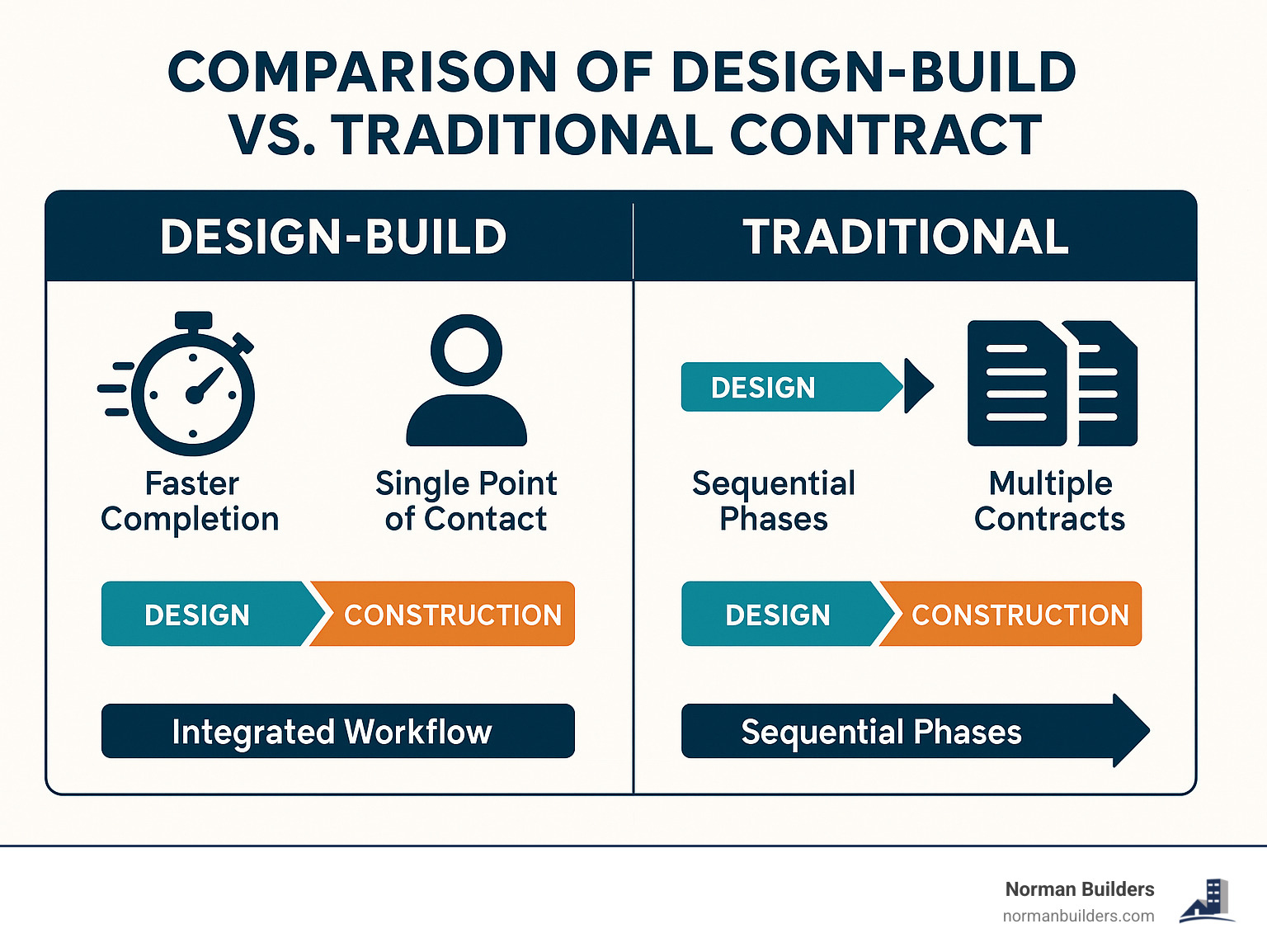
To truly understand what is a design build contract, it helps to compare it with the traditional approach known as design-bid-build (DBB). These delivery methods differ significantly in process, risk allocation, and outcomes.
The traditional design-bid-build process feels like a relay race. You first hire an architect who creates complete plans, then pass those plans to various contractors for bidding, select one (usually the lowest bidder), and finally watch as construction begins. This sequential approach often creates disconnects between what’s designed and what’s actually buildable within budget.
Design-build, by contrast, works more like a basketball team. Everyone’s on the court together from tipoff. Your designer and builder collaborate from day one, with construction often beginning before every last design detail is finalized. When challenges arise—and they always do in construction—solutions emerge through real-time teamwork rather than contractual finger-pointing.
As James Wilson, a homeowner in Exeter, NH, told us after completing his family’s custom home: “Having our builder involved during design meant we never fell in love with ideas that would blow our budget. The practical wisdom they brought to early discussions saved us from disappointment later.”
The question of who bears responsibility when things go wrong marks perhaps the most significant difference between these approaches. In traditional projects, homeowners often become reluctant referees in disputes between architects and builders.
“I built my first home the traditional way,” shares Sarah Thompson from Andover, “and spent countless hours mediating between my architect and contractor when window installations didn’t match the design intent. Neither would take responsibility.”
With design-build, that burden shifts dramatically. Because one entity handles both design and construction, there’s nowhere to pass the buck. This single-point accountability creates powerful incentives for getting things right the first time.
Speed represents one of design-build’s most compelling benefits. Research consistently shows design-build projects finish 33.5% faster overall than traditional methods, with the construction phase alone completing 12% quicker.
This acceleration happens because phases can overlap rather than proceeding strictly sequentially. While foundations are being poured, interior design decisions can still be refined. This “fast-tracking” approach means your family moves into your new home months sooner than with traditional methods.
For seasonal considerations in New England, this timing advantage can be crucial. Starting a project in early spring with design-build might mean you’re enjoying your new space by Thanksgiving, while a traditional approach might leave you waiting until the following summer.
Budget certainty comes earlier with design-build. Because builders participate in design decisions, constructability and cost implications shape choices from the beginning. This proactive approach to value engineering typically results in projects costing 6.1% less than traditional methods.
The traditional method often leads to what we call “design, bid, redesign” when initial bids come in over budget. This cycle creates frustration, delays, and design compromises made under pressure rather than thoughtfully.
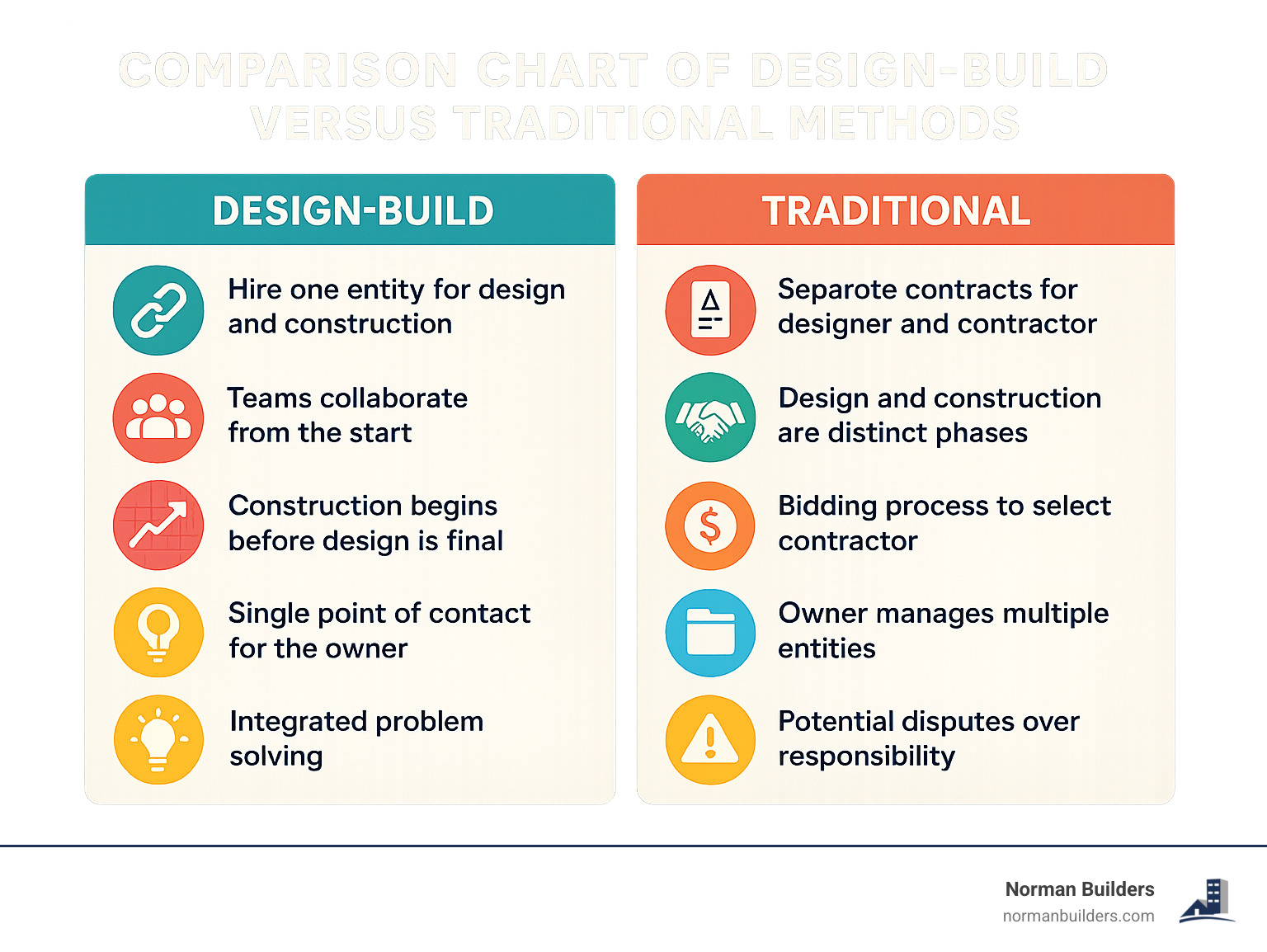
Design-build creates a fundamentally different relationship between all parties. Rather than the adversarial dynamic that often emerges in traditional projects, design-build fosters partnership. When everyone succeeds together or fails together, collaboration replaces confrontation.
For a deeper dive into how design-build works in practice, check out our detailed guide to the design build construction process.
When clients ask us what is a design build contract and why they should consider it, we point to several key benefits that consistently delight homeowners:
The statistics are compelling: design-build projects are delivered 33.5% faster than traditional methods. For homeowners in places like Andover or Exeter, this means less disruption to your life and faster enjoyment of your new space.
A client in Newburyport recently told us: “What impressed me most was how quickly we moved from concept to completion. With my previous renovation, there were weeks of downtime between the architect finishing and the contractor starting. With Norman Builders’ design-build approach, that transition was seamless.”
Research shows design-build projects typically cost 6.1% less than traditional methods. This isn’t magic—it’s the result of a more efficient process. When we work with families in Seacoast NH or North Shore MA, these savings come from reduced change orders, eliminating redesign cycles when bids exceed budgets, and implementing value engineering during design rather than after.
Think about it this way: wouldn’t you rather have construction experts weighing in on costs while the design is still on paper, not after you’ve fallen in love with expensive features that might break your budget?
The magic happens when designers and builders collaborate from day one. On a recent kitchen renovation in North Andover, our design team envisioned a unique island configuration they initially thought might be structurally challenging. Because our construction team participated in early discussions, they suggested an innovative support system that made the design possible while staying within budget.
This kind of creative problem-solving simply isn’t possible when design and construction teams work in separate silos.
According to research from the Construction Industry Institute, design-build projects consistently outperform traditional delivery in quality metrics. This makes intuitive sense—when the same team is responsible for both design and construction, there’s nowhere to pass the buck if quality issues arise.
Our builders regularly suggest more durable or efficient materials during design phases, and constructability reviews happen continuously, not as an afterthought. The latest research on higher quality projects confirms what we’ve seen in practice: integrated teams deliver superior results.
One of the most frustrating aspects of traditional construction is the dreaded change order—those formal requests to alter scope, timeline, or budget after you’ve signed the contract. They often happen when beautiful design plans meet construction reality.
In our design-build projects throughout Southern NH and the North Shore, we typically see 50-75% fewer change orders compared to traditional methods. This creates a more predictable experience and helps maintain budget integrity throughout your project.
Perhaps the most appreciated advantage is having one point of contact throughout the entire process. As one client in Hampton Falls put it: “I didn’t have to referee disputes between my architect and builder or try to figure out who was responsible for what. I just called Norman Builders, and they handled everything.”
This single-source accountability eliminates the finger-pointing that can happen in traditional projects. When there’s an issue (and let’s be honest, in construction there are always some issues), you don’t have to determine if it’s a design problem or a construction problem—it’s simply your design-builder’s problem to solve.
While design-build offers many advantages, it’s important to understand potential challenges and how to mitigate them. Being transparent about risks is part of our commitment to clients.
With traditional contracts, design is complete before construction begins, potentially limiting changes. In design-build, the evolving nature of the process can sometimes lead to scope expansion.
Protection Strategy: We implement detailed scope statements in our contracts and regular milestone reviews to ensure alignment with your vision and budget.
Some homeowners worry that without an independent architect advocating solely for design excellence, aesthetic considerations might be compromised.
Protection Strategy: At Norman Builders, we balance both aspects by employing talented designers who collaborate with our construction team while maintaining design integrity. For larger projects, we often recommend including performance specifications and design intent documents in the contract.
Traditional bidding processes allow owners to compare multiple construction bids based on identical plans. Design-build combines these services, potentially reducing price competition.
Protection Strategy: We provide transparent cost breakdowns and often use “open book” pricing for larger projects, showing exactly where your money goes. We can also structure contracts with Guaranteed Maximum Price (GMP) provisions.
Without complete designs at contract signing, some homeowners worry about cost uncertainty.
Protection Strategy: We use detailed allowances, clear change order processes, and phased contracting when appropriate. For example, a recent renovation in Boxford used a two-phase contract with a design phase that established a firm price before construction began.
Some owners worry about losing control in a design-build arrangement.
Protection Strategy: We establish clear decision points throughout the process and can include third-party review provisions in contracts for added peace of mind. Our contracts clearly outline owner approval milestones.
Design-build shifts liability structures, which requires proper insurance coverage.
Protection Strategy: Norman Builders maintains comprehensive insurance including professional liability coverage for design services. We’re happy to review these protections with you and your legal advisor.
A client in Kensington shared: “I was initially concerned about putting all my eggs in one basket with design-build, but Norman Builders’ transparent approach and detailed contract protections gave me confidence. The process ended up being much smoother than I expected.”
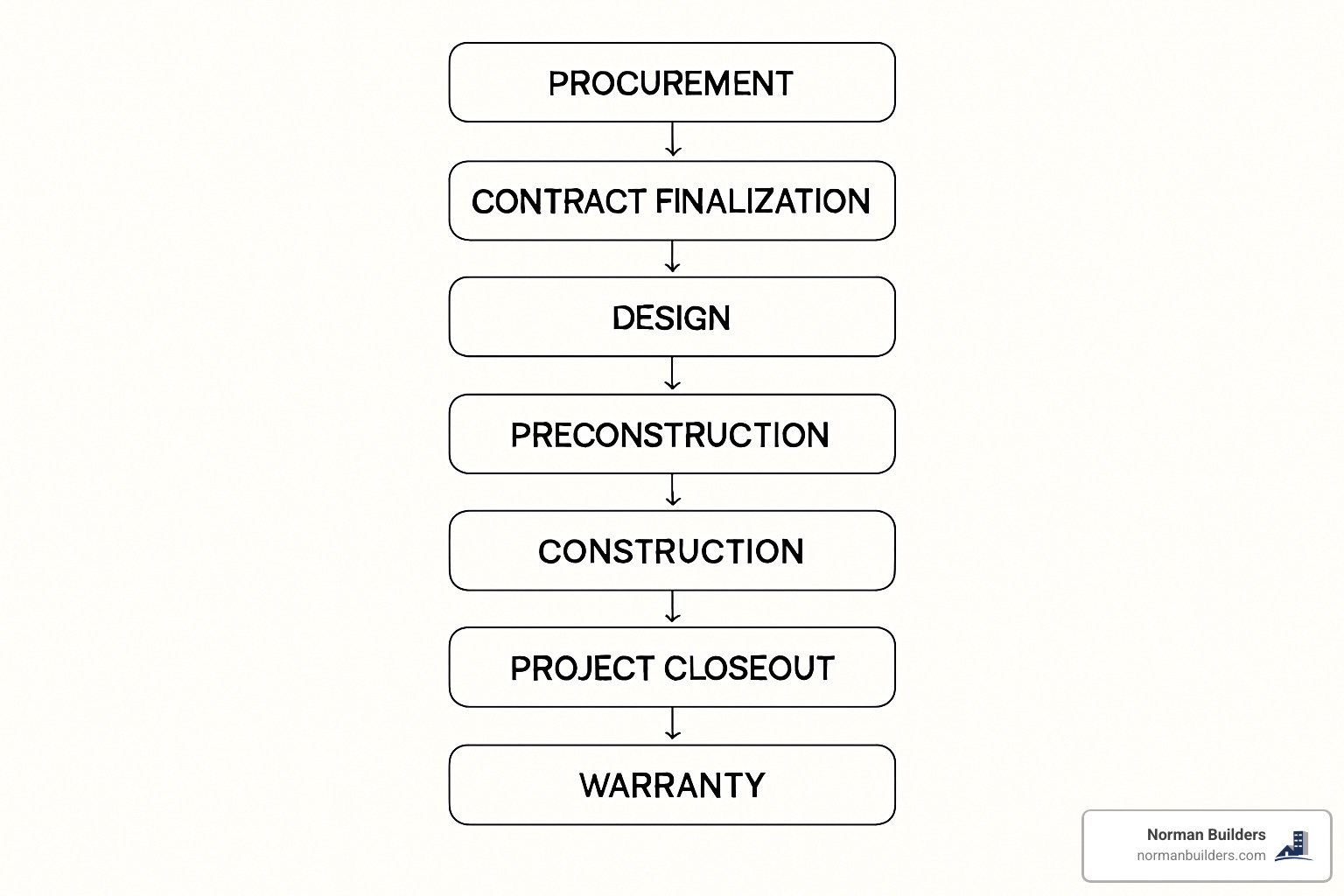
Understanding the design-build process helps clarify what is a design build contract in practical terms. Here’s how we typically structure projects at Norman Builders:
For new construction, we often assist clients in evaluating potential sites throughout the Merrimack Valley and Seacoast regions. We’ll walk properties with you, discussing everything from soil conditions to sunlight patterns.
One Exeter client told us, “Ryan pointed out drainage issues I would have completely missed when looking at the lot. That insight saved us thousands in potential foundation problems.”
During this phase, we examine zoning requirements, environmental factors, utility access, and how the site’s natural features might improve your home’s design. For renovations, we’ll thoroughly assess existing conditions to identify any hidden challenges before design begins.
Think of this phase as creating your wish list. We’ll sit down, often at your kitchen table, and have honest conversations about what you need, what you want, and what fits your budget.
A client in West Newbury shared: “The programming phase helped us distinguish between our ‘must-haves’ and ‘nice-to-haves,’ which was invaluable for staying on budget.”
These discussions cover functional requirements (like the number of bedrooms), aesthetic preferences (modern farmhouse or coastal contemporary?), sustainability goals, budget expectations, and timeline considerations. We take careful notes and begin translating your vision into spatial concepts.
Here’s where the design-build advantage really shines. As our designers sketch concepts, our construction experts provide real-time cost feedback. This prevents the all-too-common scenario where homeowners fall in love with designs they can’t afford.
We’ll present conceptual drawings showing layout options alongside preliminary material selections and initial cost ranges. This integrated approach means you can make informed decisions about where to allocate your budget from the very beginning.
For significant custom homes, we assemble specialized team members early in the process. This might include structural engineers for that dramatic cantilevered deck you want, or specialty craftspeople for custom built-ins or timber framing.
Having these experts at the table during design means their knowledge shapes the plans from the start, rather than forcing expensive changes later. We’ve built strong relationships with the region’s best subcontractors, ensuring quality work on every project.
As your design takes shape, we refine every detail while keeping a watchful eye on the budget. You’ll see increasingly detailed floor plans and elevations, specific material selections, engineering systems, and fixture choices.
Throughout this phase, we encourage you to ask questions and offer feedback. Your active participation ensures the final design truly reflects your vision. By the end of design development, you’ll have a clear picture of your future home and a refined cost projection.
With designs and costs aligned, we formalize our agreement. Our contracts clearly outline the scope of work, construction schedule, payment structure, change order procedures, and performance standards.
We take time to walk through every aspect of the contract, answering questions and ensuring you’re completely comfortable before proceeding. This transparency is why so many of our clients in towns like Andover, Hampton, and Newton refer their friends and family to us.
With plans finalized and contracts signed, we break ground. Construction progresses through distinct stages: site preparation, foundation work, framing, mechanical/electrical/plumbing installations, interior finishes, and exterior details.
Unlike traditional projects where the architect might visit occasionally, our design team remains actively involved throughout construction. This ensures design intent is maintained and allows for thoughtful solutions to any field adjustments that become necessary.
As your project nears completion, we focus on the fine details. This includes systems testing, owner training on new equipment, warranty documentation, final inspections, and meticulous punch list completion.
We don’t consider a project finished until you’re completely satisfied. Many builders rush this phase, but we believe proper closeout is essential for a positive experience and a home that functions flawlessly from day one.
Within the design-build framework, we offer two approaches to meet different client needs:
Fixed-Price Design-Build provides a guaranteed price based on preliminary designs. This offers budget certainty but requires more upfront design work before pricing. It’s ideal for straightforward projects with clear parameters.
Progressive Design-Build uses a two-phase approach where we first contract for preliminary design and budgeting, then create a second contract for final design and construction once scope and budget are aligned. This approach gives you an “off-ramp” if we can’t reach agreement after preliminary design, providing extra peace of mind.
For a complex renovation of a 1920s colonial in Newburyport, we used the progressive approach because of potential hidden issues in the aging structure. This flexibility allowed us to adjust plans when we finded beautiful original hardwood floors under layers of linoleum—a feature the homeowners were thrilled to restore rather than replace.
Your active participation is crucial to design-build success. We’ve structured our process with clear decision points where your input shapes the project’s direction.
At programming approval, you’ll confirm your needs and wants. During concept design review, you’ll sign off on the general direction. As designs develop, you’ll refine details and make selections. Before construction, you’ll review and accept final contract terms.
Throughout construction, we’ll invite you to inspect work at key stages and approve any necessary scope modifications. Near completion, we’ll conduct a thorough walkthrough together, and you’ll have final acceptance once all work meets your expectations.
A client in Salisbury shared: “I appreciated knowing exactly when my input was needed. The process felt collaborative without being overwhelming. Ryan made sure I was involved in the important decisions without bogging me down with every minor detail.”
Please note: Our services are exclusively available in Massachusetts, specifically in Andover, MA, the North Shore, and New Hampshire, covering the Seacoast and Southern NH regions.
When homeowners ask what is a design build contract, they’re often most curious about how costs work. Let’s break down the common pricing models you’ll encounter:
The Lump Sum approach offers the comfort of a single, fixed price covering all design and construction. This works well if you want maximum budget certainty, though it requires more detailed planning upfront. As one of our Andover clients put it: “Having that fixed number gave us peace of mind – we knew exactly what we were committing to from day one.”
With a Cost-Plus structure, you pay the actual costs plus either a fixed fee or percentage for overhead and profit. This provides complete transparency into where every dollar goes, but offers less budget predictability. This can work well for complex renovations where unforeseen conditions might arise.
Many homeowners prefer the Guaranteed Maximum Price (GMP) model, which combines the best of both worlds. We guarantee costs won’t exceed a maximum figure, and often include shared savings provisions if the project comes in under budget. This creates an incentive for efficiency without sacrificing quality.
Based on industry averages, design-build firms typically charge around 5% of the total project cost for design services. According to internet data (not Norman Builders’ specific pricing), custom home construction in New England typically ranges from $150 to $450 per square foot. These figures represent industry averages from online sources, not our specific pricing.
An important cost element in design-build contracts is allowances – budgeted amounts for items not fully specified at contract signing, like lighting fixtures or cabinet hardware. Clear allowance amounts prevent misunderstandings and budget surprises later.
A solid design-build contract protects both homeowner and builder. Here are the essential elements to look for:
Your contract should contain a comprehensive scope definition that leaves little room for misinterpretation. This includes detailed project descriptions, plans and specifications, clearly stated exclusions, and identified allowance items. When we built a custom home in Hampton Falls, the detailed scope prevented confusion when the homeowner later questioned whether deck railings were included (they were, as clearly stated in the scope).
Schedule provisions establish timeline expectations, including start and completion dates, milestone deadlines, accommodations for weather delays, and deadlines for owner decisions. This creates accountability while acknowledging that some factors are beyond anyone’s control.
Clear payment terms outline when and how much you’ll pay throughout the project. This typically includes a payment schedule, retainage provisions (money held back until satisfactory completion), change order pricing methods, and final payment conditions.
Risk allocation clauses determine who’s responsible for what if something goes wrong. These include design liability provisions, construction warranties, dispute resolution processes, and termination conditions. In design-build, most design liability shifts to the builder – a significant advantage for homeowners.
Finally, performance standards establish quality benchmarks, testing requirements, code compliance guarantees, and sustainability targets if applicable. As one Newton, NH client noted: “Having performance standards in our contract gave us confidence that the final product would meet our expectations.”
Let’s clear up some misconceptions about design-build contracts:
Myth: Owners lose control in design-build projects
Reality: While you’re working with one team rather than separate entities, well-structured contracts include clear owner approval points throughout the process. You maintain decision-making authority while gaining the efficiency of integrated delivery. As one Exeter homeowner told us: “I actually felt more in control because I wasn’t caught between conflicting recommendations from separate architect and builder teams.”
Myth: Design-build is only suitable for large projects
Reality: While design-build gained popularity in large commercial projects, it’s equally effective for residential work of all sizes. We’ve successfully used this approach for projects ranging from bathroom renovations to luxury custom homes throughout Massachusetts and New Hampshire. The principles of integration and efficiency benefit projects of all scales.
Myth: Quality suffers without an independent architect
Reality: Research from the Construction Industry Institute actually shows design-build projects outperform traditional delivery in quality metrics. The key is selecting a design-build team with strong design credentials and a portfolio demonstrating design excellence. When both designers and builders collaborate from day one, the result is often superior integration of aesthetics and functionality.
FAQ: Do design-build contracts save money?
On average, clients save between 6% and 10% when using design-build. These savings come from reduced change orders, streamlined communication, and the ability to value-engineer during design rather than after construction has begun. As one Merrimack Valley client said: “The upfront collaboration meant we didn’t waste money on designs that couldn’t be built within our budget.”
FAQ: How do design-build firms charge?
Design-build firms usually charge around 5% of a project’s total cost for design services, with construction costs determined by scope, materials, and complexity. Some use fixed fees rather than percentages. The integrated approach typically means lower overall costs compared to hiring separate design and construction firms.
FAQ: Who takes the risk in a design-build contract?
Most risks shift from the homeowner to the design-build firm, which becomes responsible for design errors. This single-point responsibility is one of the model’s key advantages. You’re no longer caught in the middle of disputes between separate design and construction teams.
FAQ: How does design-build handle changes during construction?
Change orders still exist in design-build, but they’re typically less frequent due to better upfront planning. A good design-build contract clearly outlines the change order process, including how changes are priced and approved. The collaborative nature of design-build means many potential changes are identified and addressed before construction begins.

Please note: Our services are exclusively available in Massachusetts, specifically in Andover, MA, the North Shore, and New Hampshire, covering the Seacoast and Southern NH regions.
When homeowners ask me what is a design build contract, I often explain that it’s far more than paperwork—it’s a relationship built on trust and shared vision. This collaborative approach brings design and construction expertise together from day one, creating a seamless experience that traditional methods simply can’t match.
Throughout our years serving Massachusetts and New Hampshire communities, from Andover to Exeter, we’ve witnessed how the design-build approach transforms the homebuilding experience. Projects not only finish faster (33.5% quicker on average), but they also stay more aligned with initial budgets, reducing those dreaded mid-project surprises that keep homeowners up at night.
Perhaps the greatest advantage is the simplicity of having a single point of contact. Rather than becoming the reluctant referee between your architect and builder when disagreements arise, you have one team that takes full responsibility for your project’s success. This unified accountability creates peace of mind that’s invaluable during what can otherwise be a stressful process.
The single-contract approach also means better coordination throughout your project. When your kitchen designer understands the structural limitations from the beginning, or your framing team knows exactly what the finish carpenters will need later, the result is a more thoughtful, integrated home that functions as beautifully as it looks.
I remember a client in Hampton Falls who told me, “The best part was never hearing ‘that wasn’t in my scope’ from anyone on the team.” That’s the design-build difference—shared responsibility that leads to shared success.
For homeowners planning custom homes in Southern NH or renovations along the North Shore, this integrated approach offers the ideal balance of creativity and practicality. Your design dreams remain intact while benefiting from construction expertise that ensures those dreams are buildable and within budget.
The construction industry has acceptd this approach for good reason—nearly half of all construction projects nationwide now use design-build delivery. The data consistently shows better outcomes in terms of timeline, budget, and quality when teams work collaboratively from concept to completion.
At Norman Builders, we’re proud to bring this modern, efficient approach to our clients throughout the Merrimack Valley and Seacoast regions. Whether you’re dreaming of a custom waterfront home in Newburyport or renovating a historic property in Exeter, our design-build process ensures that your vision becomes reality with minimal stress and maximum satisfaction.
To learn more about how our design-build approach could benefit your next project, we invite you to explore our custom home building services or reach out to discuss your specific needs.
Please note: Our services are exclusively available in Massachusetts, specifically in Andover, MA, the North Shore, and New Hampshire, covering the Seacoast and Southern NH regions.

We specialize in high-quality home construction and remodeling services, delivering exceptional craftsmanship tailored to meet your vision and needs. Whether you’re planning a renovation, new construction, or a custom remodel, our experienced team is committed to exceeding expectations with precision, attention to detail, and reliable service.
Our service area includes the Merrimack Valley, North Shore, Seacoast, and Southern NH Areas. We take pride in the quality of our workmanship and our prompt professionalism.
Contact us today to bring your project to life!