

Home renovation financing options come in many forms, from tapping into your home’s equity to securing personal loans or government-backed programs. Whether you’re planning a kitchen remodel or a whole-house change, understanding your funding choices is crucial for turning your vision into reality.
Quick Overview of Home Renovation Financing Options:
Home renovations can be expensive, but they don’t have to drain your bank account or derail your financial goals. The key is matching the right financing option to your project scope, timeline, and personal financial situation.
You have many options for financing home renovations, each with pros and cons. Some homeowners prefer the lower interest rates that come with home equity products, while others value the simplicity of personal loans or the flexibility of lines of credit. Credit card interest rates can top 18%, making them suitable mainly for smaller projects you can pay off quickly.
The right financing choice depends on factors like your credit score, available home equity, project timeline, and risk tolerance. For example, if you’re doing a phased renovation over several months, a HELOC’s revolving credit might work better than a lump-sum personal loan.
I’m Ryan Norman, founder of Norman Builders, and I’ve helped homeowners steer home renovation financing options for over 15 years while managing construction projects from kitchen remodels to custom homes. My background in technology and real estate gives me unique insight into both the financial and construction aspects of bringing your dream project to life.
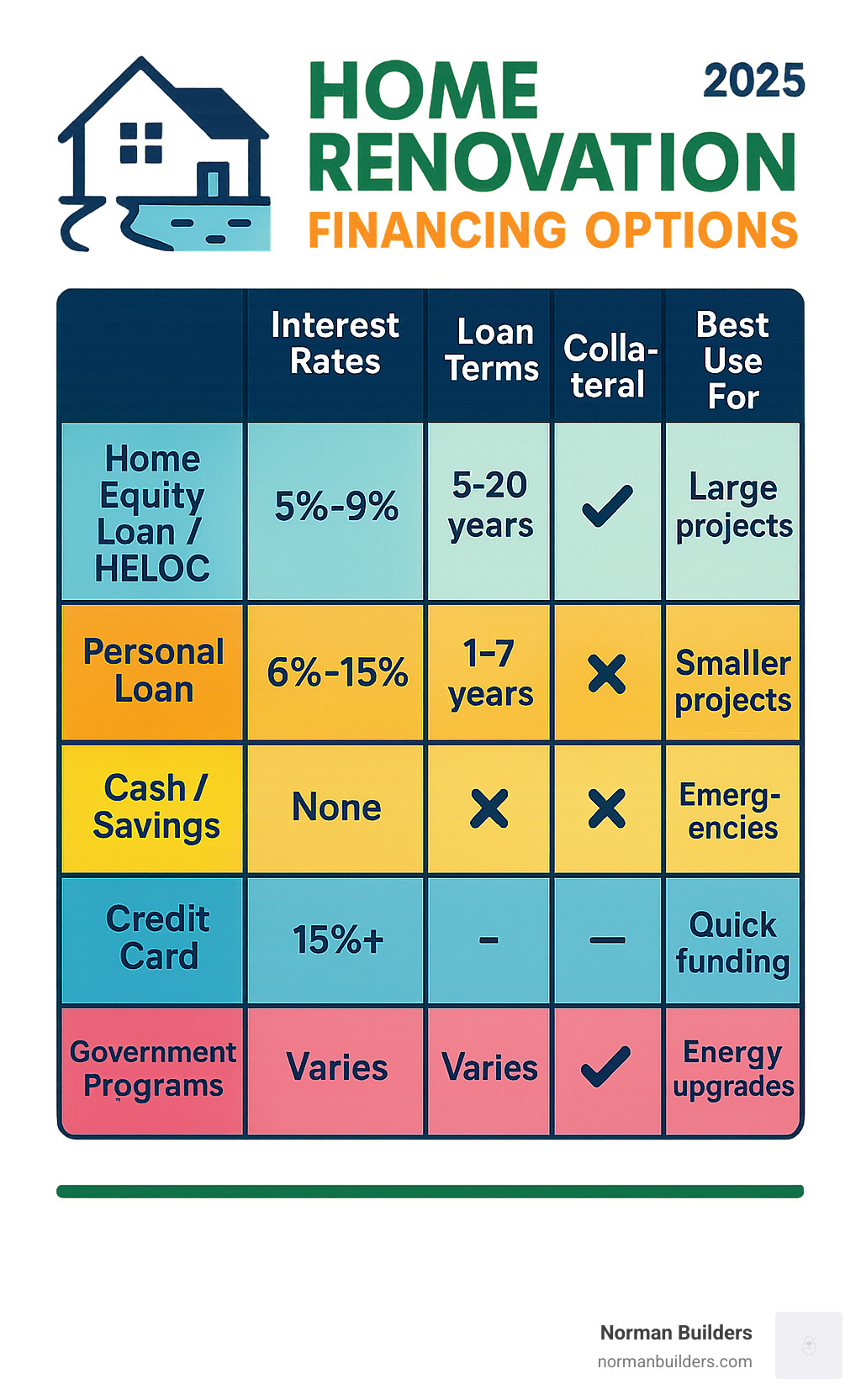
Simple home renovation financing options word guide:
Before exploring home renovation financing options, solid planning and budgeting are essential. Think of it as the foundation for your project—skip this step, and everything gets shaky.
Here’s the truth about renovation budgets: they almost always grow. That beautiful kitchen remodel you estimated at $40,000? Don’t be surprised if it creeps toward $50,000 once you find that gorgeous tile or realize your electrical panel needs upgrading. That’s why smart homeowners always set aside 10-20% extra for a contingency fund. This buffer isn’t pessimism – it’s wisdom earned from countless projects.
This cushion covers surprises and gives you breathing room to make decisions without scrambling for emergency financing or compromising on quality when unexpected issues arise.
Getting your numbers right from the start sets you up for financing success. The secret? Break everything down into bite-sized pieces instead of guessing at one big number.
Start with materials – everything from the obvious stuff like flooring and paint to the hidden essentials like screws and underlayment. Then factor in labor costs for your contractors and any specialists you’ll need. Don’t forget about permits – your local building department wants their piece of the pie, and skipping permits can cause major headaches down the road.
If you’re working with designers or architects, include their design fees in your calculations. At Norman Builders, this often comes together seamlessly through our design-build construction approach, where design and construction work hand-in-hand from day one.
Getting multiple quotes isn’t just smart – it’s essential. Three quotes give you a realistic range and help you spot any outliers. The cheapest bid isn’t always your best bet. Quality craftsmanship and reliable service matter more than saving a few dollars upfront. You can learn more about our approach on our construction services page.
Renovation costs vary wildly depending on your scope and location. A simple bathroom refresh might run $5,000 to $15,000, while a major kitchen overhaul could range from $25,000 to $75,000 – or even $150,000+ for luxury custom work. Full home additions can easily reach into the hundreds of thousands. These are average costs based on internet data and not actual costs for Norman Builders services.
Once you know what you want to spend, it’s time to figure out what you can actually borrow. Think of this as your financial fitness test – lenders want to see you’re in good shape before they hand over their money.
Your credit score is like your financial report card. Generally, you’ll want 620 or higher to qualify for most loans, though 700+ opens doors to the best rates. This number tells lenders how reliably you pay your bills.
Your debt-to-income ratio (DTI) is equally important. This compares all your monthly debt payments to your gross monthly income. Most lenders prefer seeing 43% or less, though some flexibility exists. A lower DTI means more room in your budget for loan payments.
If you own your home, your home equity becomes a powerful tool. This is the difference between your home’s current value and what you still owe on your mortgage. We’ll explore this goldmine in the next section since it often provides the most affordable financing for larger projects.
When you apply for financing, expect to provide documentation proving your financial stability. Recent pay stubs, tax returns, and bank statements are standard requirements. Having these organized upfront speeds up the process.
Want a head start on understanding your borrowing capacity? Try using an online calculator to estimate borrowing potential. These tools give you a realistic preview of what you might qualify for, helping align your renovation dreams with financial reality.
Here’s a bonus tip: consider getting a home energy audit during your planning phase. A licensed professional examines your home’s systems and recommends energy-efficient improvements. Not only can this reveal money-saving opportunities, but energy-efficient renovations often qualify for special financing programs and rebates – making your renovation dollars stretch further.
For many homeowners, your house is your biggest financial asset. As you pay down your mortgage and property value grows, you build equity. This equity is a powerful tool for funding renovations, often offering the most attractive home renovation financing options available.
Think of equity as the difference between what your home is worth today and what you still owe on your mortgage. If your house is valued at $400,000 and you owe $250,000, you have $150,000 in equity. Using your home as collateral typically open ups lower interest rates compared to unsecured loans, making these secured loan options particularly appealing for larger renovation projects.
The beauty of equity-based financing lies in its flexibility and affordability. Since lenders have your property as security, they’re willing to offer better terms. Most lenders will let you borrow against up to 80% of your home’s market value, though some may go as high as 90% depending on your financial profile.
When it comes to accessing your home’s equity, you’ll encounter two main paths: Home Equity Loans and Home Equity Lines of Credit (HELOCs). While both tap into the same source—your home’s value—they work in completely different ways.
A Home Equity Loan is straightforward: you get all the money upfront in one lump sum. It’s like getting a second mortgage with a fixed interest rate and predictable monthly payments over a set term, usually anywhere from 5 to 15 years. This makes budgeting simple because you know exactly what you’ll pay each month.
On the flip side, a HELOC functions more like a giant credit card secured by your home. You get approved for a credit limit, but you only draw money as you need it. During the “draw period” (typically 10 years), you can borrow, repay, and borrow again up to your limit. You usually only pay interest during this phase. After the draw period ends, you enter the “repayment period” (often 20 years) where you can’t access more funds and must pay back both principal and interest.
| Feature | Home Equity Loan | Home Equity Line of Credit (HELOC) |
|---|---|---|
| Payment Type | Lump sum | Revolving credit line |
| Interest Rate | Typically fixed | Typically variable |
| Payment Schedule | Fixed monthly payments from day one | Variable payments, often interest-only during draw period |
| Access to Funds | All at once | As needed, up to credit limit |
| Best For | Large, one-time projects with a fixed cost | Ongoing or multi-phase projects, uncertain costs |
| Pros | Predictable payments, fixed interest | Flexibility, pay interest only on what you use |
| Cons | Less flexible if costs change | Variable rates mean fluctuating payments, requires discipline |
We typically see homeowners choose a home equity loan when they’re tackling a specific project with a known cost—like a complete kitchen overhaul or adding a master suite. The fixed payments and interest rate provide peace of mind and make financial planning straightforward.
A HELOC shines when you’re doing a phased renovation or aren’t completely sure about final costs. Maybe you’re planning a whole-house renovation that will happen room by room over several months. The flexibility to draw funds as needed can be invaluable, and you’re not paying interest on money you haven’t used yet.
For a deeper dive into the nuances of each option, check out this helpful resource: HELOC vs Home Equity Loan: Major Differences.
The key is matching the financing type to your project style and comfort level. If you prefer predictability and have a well-defined project scope, a home equity loan might be your best bet. If you value flexibility and don’t mind some uncertainty in your payments, a HELOC could be the perfect fit.
With either option, you can typically refinance up to 80% of your home’s market value, giving you substantial borrowing power for even ambitious renovation dreams.

Sometimes home equity isn’t available, or maybe you’d rather keep your house out of the financing equation entirely. That’s where unsecured and alternative home renovation financing options shine, though they typically come with higher interest rates since lenders take on more risk without your home as collateral.
Think of it this way: when a lender can’t knock on your door to reclaim their money through your house, they’re going to charge you a bit more for that privilege. But that doesn’t mean these options aren’t valuable – they can be perfect for certain situations and project types.
Personal loans work much like their home equity cousins, but without putting your house on the line. You’ll receive a lump-sum payment upfront and repay it with fixed monthly payments over typically one to seven years. This predictable repayment schedule makes budgeting straightforward – you’ll know exactly what you owe each month from day one.
Personal loans shine when you have a well-defined renovation project with a clear budget. Maybe you’re updating that guest bathroom or finally tackling the kitchen backsplash you’ve been dreaming about. The structured payment schedule can actually be helpful if you’re someone who benefits from a set-it-and-forget-it approach to debt repayment.
A personal line of credit offers more flexibility, functioning like a credit card but typically with better interest rates. You can draw funds as needed up to your credit limit, repay them, and draw again – only paying interest on what you actually use. This revolving credit structure works beautifully for projects where costs might evolve or if you’re planning a phased renovation over several months.
The key difference comes down to structure and flexibility. If you need help staying on track with repayment goals, a personal loan’s fixed schedule can be your financial guardrail. If your project timeline is uncertain or you prefer maximum flexibility, a personal line of credit might be your best friend.
For smaller projects, or if you’re someone who prefers avoiding debt altogether, your personal savings and credit cards become viable home renovation financing options. Each comes with its own personality, so to speak.
Using personal savings means you’re financing your renovation debt-free. No loan applications, no credit checks, no interest payments – just immediate access to your money. It’s the financial equivalent of paying cash, and there’s something deeply satisfying about owning your renovation outright from day one.
But here’s where we need to pump the brakes a bit. Depleting your emergency fund for a bathroom remodel might leave you vulnerable if life throws you a curveball. We strongly advise against dipping into funds earmarked for retirement or your emergency savings – these are your crucial financial safety nets.
There’s also something called opportunity cost to consider. If your savings are currently invested and earning returns higher than what you’d pay in loan interest, it might actually be smarter to take out a loan and let your investments keep growing.
Credit cards offer incredible convenience for smaller purchases – materials, tools, fixtures. Many cards provide rewards, extended warranties, or other perks that can add value to your renovation spending. They’re particularly useful for projects like a bathroom remodel where you can pay off the balance quickly.
However, credit card interest rates can easily top 18% and often climb much higher. This makes them expensive if you carry a balance month to month. They work best when you can pay off purchases in full each billing cycle, essentially using the card as a short-term convenience rather than long-term financing.
Using credit cards for significant renovation costs can quickly spiral into mounting debt if not managed carefully. A $15,000 kitchen update financed entirely on credit cards could end up costing you thousands more in interest if you only make minimum payments.
The sweet spot for credit card financing is usually smaller, manageable amounts that you can pay off within a few months. Think of them as a tool for smoothing out cash flow during your project rather than shouldering the entire financial load.
When it comes to home renovation financing options, specialized government programs can be a real game-changer, especially if you’re planning energy-efficient upgrades. These programs often come with attractive incentives like grants, rebates, or favorable loan terms that can significantly reduce your overall project costs.
The beauty of government-backed financing is that it’s designed to encourage specific types of improvements that benefit both homeowners and the environment. Think of it as getting rewarded for making smart choices that will save you money in the long run.
If you’re buying a home that needs work, all-in-one renovation mortgages are among the smartest home renovation financing options available. These specialized programs let you combine your home purchase and renovation costs into a single loan with one monthly payment.
The HomeStyle Renovation mortgage from Fannie Mae is a perfect example of how these programs work. Instead of juggling multiple loans and payments, you get one loan that covers everything – the house price plus all your planned improvements.
Here’s what makes these programs so appealing: you’re financing your renovation work at mortgage interest rates, which are typically much lower than personal loans or credit cards. Plus, the paperwork is streamlined since you’re dealing with one lender instead of multiple financing sources.
These loans are quite flexible too. They can cover everything from cosmetic updates like fresh paint and new flooring to major structural changes and room additions. The key requirement is that all improvements must be permanently attached to the property and meet local building codes.
Most programs allow you to draw funds in stages as work progresses, which helps with cash flow during construction. You can often access a portion upfront for materials, then receive additional funds as milestones are completed.
Energy-efficient renovations open up a whole world of special financing opportunities. Governments at all levels are eager to help homeowners reduce energy consumption, and they’re putting their money where their mouth is.
Government incentives and rebates can dramatically reduce your upfront costs. Federal, state, and local programs often offer cash back for specific upgrades like ENERGY STAR® appliances, improved insulation, high-efficiency windows, and solar panels. These rebates can sometimes cover 25% or more of your project costs.
A home energy audit is usually your starting point for accessing these benefits. A licensed professional examines your home’s heating and cooling systems to identify the most impactful improvements. This audit often qualifies you for additional rebates and helps prioritize which upgrades will give you the biggest bang for your buck.
Specialized green loans are another fantastic option. These loans often come with discounted interest rates or extended repayment terms because lenders recognize that energy-efficient improvements increase your home’s value and reduce your monthly utility costs.
The eligibility requirements for government renovation programs typically include being the primary homeowner, completing a pre-renovation energy evaluation, and ensuring all work is done by qualified contractors. You’ll also need to meet standard credit and income requirements, plus provide documentation like property tax bills and contractor quotes.
The long-term savings make these programs even more attractive. Energy-efficient upgrades don’t just reduce your financing costs – they keep reducing your utility bills for years to come. A new high-efficiency HVAC system or upgraded insulation can cut your monthly energy costs by hundreds of dollars.
For homeowners planning comprehensive energy improvements, our whole house renovations services can help you maximize both government incentives and long-term energy savings.

Navigating home renovation financing options can bring up a lot of questions. Here are some of the most common ones I hear from homeowners, along with straightforward answers to help you make informed decisions.
Generally, personal loans are considered among the easiest loans to get for home improvement projects. These unsecured loans don’t require you to put up your home as collateral, which simplifies the application process significantly.
Most personal loan approvals focus primarily on your credit score and debt-to-income ratio. If you have decent credit (usually 620 or higher), you can often get approved within days rather than weeks. The trade-off is that you’ll typically pay higher interest rates compared to secured options like home equity loans.
Credit cards are even easier to access if you already have them, offering immediate funds for smaller projects. However, their high interest rates make them practical only for projects you can pay off quickly.
Secured loans like home equity loans offer better rates, but they require more documentation, home appraisals, and longer approval times. While not the “easiest” to get, they’re often worth the extra effort for larger renovations due to their lower costs.
Financing a renovation affects your credit score in several ways, both immediately and over time. Understanding these impacts helps you plan better.
When you apply for any loan, lenders perform hard inquiries on your credit report. Each inquiry typically drops your score by a few points temporarily. If you’re shopping around for the best rates, try to do all your applications within a 14-45 day window, as credit scoring models often treat multiple inquiries for the same type of loan as a single inquiry.
Taking on new debt initially increases your overall debt burden, which can lower your score in the short term. This is especially true if you’re using a credit card or HELOC, as increased credit utilization (the percentage of available credit you’re using) directly impacts your score. Keeping utilization below 30% is ideal.
The most significant long-term impact comes from your payment history. On-time payments build your credit over time and can actually improve your score. Conversely, missed or late payments can seriously damage your credit for years.
Yes, financing a renovation with bad credit is challenging but definitely possible. You’ll face higher interest rates and fewer options, but several paths remain open.
Secured loans become more attractive when your credit isn’t perfect. If you have home equity, even with poor credit, some lenders will work with you because your home serves as collateral, reducing their risk. The rates will be higher than what someone with excellent credit would pay, but they’re often still better than unsecured alternatives.
FHA loans offer government-backed renovation financing with more flexible credit requirements. Some FHA programs accept credit scores as low as 580, making them accessible when conventional loans aren’t an option.
Specialized lenders focus on personal loans for lower credit scores, though these come with significantly higher interest rates to offset the increased risk. While expensive, they can be worthwhile for essential renovations that add substantial value to your home.
The key is being honest about your financial situation and shopping around with different lenders. Some credit unions and community banks are more flexible than large national lenders, especially if you have an existing relationship with them.
Improving your credit score even slightly before applying can make a meaningful difference in the rates you’re offered. Sometimes waiting a few months while paying down existing debt or correcting credit report errors can save you thousands in interest costs.
Choosing the right home renovation financing options is like finding the perfect foundation for your dream home – it needs to be solid, reliable, and perfectly suited to what you’re building on top of it. The financing path you choose should align seamlessly with your project’s scope, timeline, and your family’s financial comfort zone.
Whether you decide to tap into your home’s equity for those lower interest rates, secure a personal loan for its simplicity, or take advantage of government incentives for energy-efficient upgrades, the key is thoughtful planning from the start. Smart financing decisions can mean the difference between a renovation that improves your life and one that creates financial stress.
Home renovation financing options aren’t one-size-fits-all. A kitchen remodel might call for a different approach than a whole-house change. Small bathroom updates could work perfectly with savings or a credit card you can pay off quickly, while major structural changes might benefit from the lower rates of a HELOC or home equity loan.
At Norman Builders, we’ve walked alongside hundreds of homeowners through both the construction and financial planning aspects of their renovation journey. We understand that creating your dream space involves more than just selecting beautiful materials and skilled craftspeople – it’s about making smart financial choices that let you enjoy your new space without worry.
We’re here to help you steer not only the construction process but also to share insights about funding strategies that have worked well for other families in similar situations. When you’re ready to explore how your vision can become reality, let’s discuss your whole house renovation project and create a plan that works for both your home and your budget.
Please note: Our services are exclusively available in Massachusetts, specifically in Andover, MA, the North Shore, and New Hampshire, covering the Seacoast and Southern NH regions.

We specialize in high-quality home construction and remodeling services, delivering exceptional craftsmanship tailored to meet your vision and needs. Whether you’re planning a renovation, new construction, or a custom remodel, our experienced team is committed to exceeding expectations with precision, attention to detail, and reliable service.
Our service area includes the Merrimack Valley, North Shore, Seacoast, and Southern NH Areas. We take pride in the quality of our workmanship and our prompt professionalism.
Contact us today to bring your project to life!