

A full home remodeling guide is essential for homeowners looking to transform their entire house from the ground up. This process involves taking your home down to the studs for a complete renovation, often including significant floor plan changes, structural updates, and infrastructure overhauls to plumbing, electrical, and HVAC systems.
Key steps in a full home remodel:
Perhaps it’s that moment when you realize your kitchen feels cramped and outdated, or when you’re standing in line to use your own bathroom. Or maybe you’ve found the perfect property in a great location that just needs everything updated. Whatever your reason, a whole home remodel can give you essentially a new home without the hassle of moving.
This isn’t about cosmetic updates or a quick flip. We’re talking about a comprehensive change that rewires, replumbs, reframes, and redesigns your entire living space. It’s complex, yes—but with the right plan and team, it’s absolutely achievable.
The challenge most homeowners face isn’t deciding if they want to remodel. It’s figuring out how to steer the complexity without getting overwhelmed by decisions, costs, and contractor concerns. That’s where a clear, step-by-step approach makes all the difference.
I’m Ryan Norman, founder of Norman Builders, and I’ve guided homeowners through this exact process since 2007, completing over 100 projects from kitchen remodels to custom homes. This full home remodeling guide draws on real-world experience to help you understand what to expect and how to plan for success.
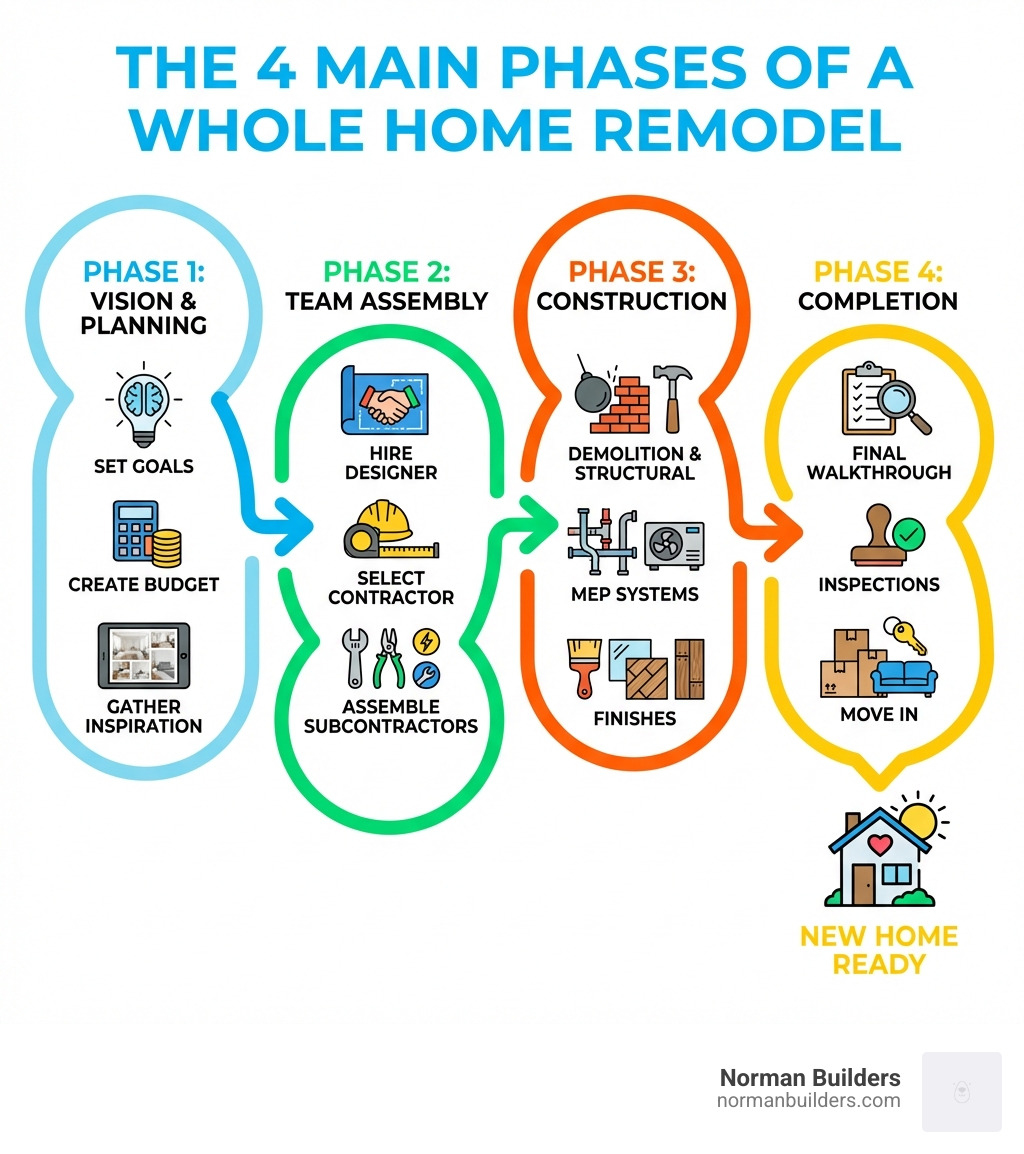
A whole home remodel is the most extensive type of renovation you can undertake, changing nearly every aspect of your property. It goes far beyond painting walls or replacing a few fixtures. Think of it as hitting the reset button on your entire living space.
At its core, a whole house remodel often involves taking the home down to its bare studs. This “gut renovation” allows for significant structural changes, such as knocking down walls to create an open-concept layout or even adding new rooms. With the walls open, it’s the perfect opportunity to overhaul essential systems like HVAC, plumbing, and electrical wiring, ensuring they meet modern standards for efficiency and safety. Reconfiguring floor plans is a common goal, optimizing the flow and functionality of your home to better suit your lifestyle.
This comprehensive approach sets a whole home remodel apart from other types of renovations. Let’s look at how it compares:
| Feature | Whole Home Remodel | Partial Renovation | Cosmetic Updates |
|---|---|---|---|
| Scope | Most or all of the home, interior and/or exterior | Specific areas or rooms | Surface-level changes |
| Structural Changes | Often includes significant changes to layout/structure | Rarely involves structural changes | No structural changes |
| System Overhauls | HVAC, plumbing, electrical often updated | Limited to specific room’s systems | No system overhauls |
| Permits Required | Almost always | Often, depending on scope | Seldom |
| Disruption Level | High | Moderate | Low |
| Cost | High | Moderate | Low |
| Timeline | Long (months to over a year) | Shorter (weeks to a few months) | Short (days to a few weeks) |
A whole home remodel is a strategic investment that offers numerous benefits. It can significantly increase your home’s value, especially if you’re updating an older property in a desirable area. Beyond financial gains, it dramatically improves functionality, allowing you to customize your space to better serve your family’s needs. By updating systems and materials, you can also improve energy efficiency, leading to lower utility bills and a more comfortable living environment. It’s about creating a home that perfectly reflects your vision and lifestyle. You can find More info about whole house renovations on our website.
Who typically benefits most from a full home remodel? We often see clients who:

Every successful renovation begins with a solid plan. Think of this as your personal architectural blueprint, guiding every decision and action. This initial phase is crucial for defining your vision, setting realistic expectations, and laying the financial groundwork for your full home remodeling guide journey.
We encourage our clients to start by asking themselves: “Why are we remodeling?” and “What do we want to feel when we walk into this room?” Your answers will shape the entire project. This is the “sky’s-the-limit” phase. Gather all your ideas, page through decorating magazines, watch home improvement programs, and surf the internet for inspiration. Websites like Pinterest are excellent resources for creating visual mood boards.
Consider your current home’s pain points. Is the kitchen too small for entertaining? Are the bathrooms always congested in the mornings? What’s not working? Now, dream big: What are the “must-have” features for your ideal home? What are the “nice-to-haves”? Creating a detailed wish list will help us prioritize and make informed decisions later.
It’s also important to think long-term. If you plan to stay in your home for decades, consider future needs. For example, incorporating universal design elements now can make your home more accessible as you age. You can find valuable Tips for ‘aging in place’ that might influence your design choices.
Once your vision starts to take shape, it’s time to talk numbers. Setting a realistic budget is perhaps the most critical step in any comprehensive renovation. Without it, even the most beautifully designed plans can quickly solve.
Please note: The following are average costs based on internet data and not actual costs for Norman Builders’ services.
A home renovation can cost an average of $15 to $60 per square foot. For a home between 1,250 to 1,600 square feet, the average cost can be around $52,040, but this can easily go up to $189,000 or more, depending on the scope and finishes. For a true whole-home renovation, especially a luxury one, costs can start at $200,000 and extend well beyond $600,000 for larger or more custom projects.
Several factors influence these costs:
We always recommend setting aside a contingency fund of 15-20% of your total budget for unexpected issues. Hidden damage—such as outdated wiring, plumbing problems, or structural issues—often surfaces once demolition begins. A contingency fund ensures these surprises don’t derail your project.
When planning your budget, it’s wise to consider your neighborhood. As the experts at HomeZada advise, “When you remodel a home, pay attention to your budget so you don’t overbuild in your neighborhood.” While we aim for top-tier quality, ensuring your investment aligns with local property values is a smart move. You can find more specific Advice on not overbuilding for your neighborhood.
For financing a large-scale renovation, several options are available:
A whole home remodel is your chance to infuse your living space with modern aesthetics and functionality. Staying abreast of current trends can inspire your design choices and ensure your home remains stylish and valuable for years to come.

Now that you have a clear vision and a well-defined budget, it’s time to bring your dream to life by assembling the right team. This is where professional expertise truly shines. While the allure of DIY can be strong, statistics show that more than 30% of all jobs professional home remodelers perform come from failed DIY projects. For a project as extensive as a whole home remodel, entrusting the work to experienced professionals is the best way to ensure success.
We believe a strong partnership with a reliable remodeling team improves communication and helps the renovation stay on track, reducing stress and improving decision-making.
Your team will typically include:
Clear, detailed contracts are paramount. They outline the scope of work, timelines, payment schedules, and a process for handling change orders—which are inevitable in large projects. Understanding these documents upfront will prevent misunderstandings and unnecessary conflicts down the line. We also emphasize that homeowners should take an active role in managing the economics of their project by documenting every payment, invoice, and expense. This helps maintain budget control and provides crucial records for potential tax benefits or future resale value.
Selecting the right contractor is arguably the most critical decision you’ll make in your full home remodel journey. A good contractor is not just a builder; they are your partner, guiding you through the complexities and ensuring your vision becomes a reality.
Here’s how we recommend choosing your contractor:
Be aware that popular contractors may have a waitlist, sometimes up to 12 months, as noted by Forbes. Starting your search early is always a good strategy.
Once your team is assembled and plans are finalized, the real change begins! This phase is dynamic, exciting, and sometimes a little messy. Knowing what to expect will help you steer the construction process with confidence.
Before the first hammer swings, preparing your home is essential.
A full home remodel follows a logical progression, with each step building upon the last:
For more information on expanding your living space, including information about structural work, you can visit our More info about home additions page.
Even with the best planning, challenges can arise. Unexpected issues, such as finding lead-based paint, asbestos, or significant structural damage, are not uncommon in older homes. This is precisely why that 15-20% contingency fund is so important.
Communication is key. We emphasize regular check-ins with your project manager. Weekly meetings and daily updates keep everyone aligned and allow for quick decision-making when issues inevitably arise.
Here are some Typical renovation project timelines based on internet data, though a whole home remodel will be an amalgamation of these and often take longer:
Once construction wraps up, we move into the final stages:
We understand that a full home remodel sparks many questions. Here are some of the most common ones we hear:
The timeline for a whole house remodel is highly dependent on the scope of work, the size of your home, and the complexity of the changes. Simple cosmetic updates might take a few weeks, but a comprehensive gut renovation that involves structural changes and system overhauls can easily take several months, sometimes extending over a year.
Factors influencing the timeline include:
However, a well-planned project with a professional team like ours can mitigate many of these delays. As mentioned earlier, typical timelines for individual components can range from 6-12 weeks for kitchens and 3-10 weeks for bathrooms, with room additions taking 12-20 weeks. A full home remodel will encompass many of these elements.
Whether you can live in your home during a full remodel depends entirely on the extent of the renovation.
A thoughtfully executed whole home remodel can significantly increase your property’s value, but it’s important to differentiate between monetary return on investment (ROI) and lifestyle improvement.
Starting on a full home remodeling guide journey is a significant undertaking, but it’s one that promises immense rewards. From the initial spark of inspiration to the final walkthrough, it’s a process of change – not just of your house, but of how you experience living in it.
We’ve walked through the essential steps: defining your vision and budget, assembling a skilled team, navigating the intricacies of construction, and celebrating the completion of your renewed home. The importance of meticulous planning, transparent communication, and a partnership with an expert team cannot be overstated.
At Norman Builders, we pride ourselves on delivering top-tier, custom-built homes and remodels with exceptional craftsmanship and personalized service. Since 2007, we’ve helped homeowners in the Merrimack Valley, North Shore, Seacoast, and Southern NH areas turn their visions into reality. We believe that your home should be a reflection of your dreams, and we’re here to make that happen.
If you’re ready to create a home that truly inspires you every day, we invite you to connect with us. Let’s discuss how our expertise and dedication to quality can bring your dream home to life. Start planning your whole house renovation with us today.
Please note: Our services are exclusively available in Massachusetts, specifically in Andover, MA, the North Shore, and New Hampshire, covering the Seacoast and Southern NH regions.

We specialize in high-quality home construction and remodeling services, delivering exceptional craftsmanship tailored to meet your vision and needs. Whether you’re planning a renovation, new construction, or a custom remodel, our experienced team is committed to exceeding expectations with precision, attention to detail, and reliable service.
Our service area includes the Merrimack Valley, North Shore, Seacoast, and Southern NH Areas. We take pride in the quality of our workmanship and our prompt professionalism.
Contact us today to bring your project to life!