

Imagine standing on an empty lot, blueprint in hand, envisioning the home that perfectly fits your family’s lifestyle. That’s where the journey of custom home construction begins – a deeply personal process that transforms your vision into reality.
Custom home construction is fundamentally different from buying a production home. It’s the art and science of creating a one-of-a-kind residence specifically custom to your needs and the unique characteristics of your land. Unlike cookie-cutter homes built in volume, your custom home offers complete design control from the architectural style down to the doorknobs.
When you choose to build custom, you’re investing in a home that works with your land’s natural features – capturing that perfect view, preserving mature trees, or maximizing natural light. The materials aren’t selected from a limited menu but chosen specifically for your preferences, whether that’s reclaimed wood flooring or specialized kitchen surfaces that match your cooking style.
The personalization extends to every aspect of how you live. Need a mudroom designed for four active kids? Want a home office with built-in technology? Dream of a kitchen that accommodates three generations cooking together? With custom home construction, these aren’t upgrades – they’re standard parts of the collaborative design process.
This journey typically unfolds over 10-24 months, depending on your home’s complexity, size, and the seasonal building conditions in New England. The investment varies widely based on your location, material selections, and design choices – but the result is a home that fits you perfectly rather than one you need to adapt to.
Your custom home trip begins with finding the right piece of land, creating architectural plans that bring your vision to life, navigating permits, and selecting a builder who understands your dreams. Throughout construction, you’ll make countless decisions that shape your future home – from structural elements to finishing touches.
I’m Ryan Norman, founder of Norman Builders, and I’ve guided countless families through the rewarding journey of custom home construction throughout New England. My approach combines technical expertise with hands-on building knowledge, ensuring your dream home becomes a reality through a process that’s as enjoyable as the final result.
Custom home construction definitions:
– cost to build a luxury house
– must have new home construction
– are new construction homes worth it
Please note: Our services are exclusively available in Massachusetts, specifically in Andover, MA, the North Shore, and New Hampshire, covering the Seacoast and Southern NH regions.
Deciding to build a new home opens up a world of possibilities, but it also presents an important choice: what type of construction approach is right for you? Custom home construction creates a fundamentally different experience than other building methods, and understanding these differences can help you make the best choice for your future.
A custom home is truly one-of-a-kind – designed exclusively for you and built on your specific piece of land. Every aspect, from the foundation footprint to the roof pitch and everything in between, reflects your personal preferences, family needs, and the unique characteristics of your building site. There’s no catalog or template – just your vision brought to life.
Production homes take a completely different approach. These are built in volume by developers constructing multiple houses simultaneously, typically in planned communities. Think of these as the “ready-to-wear” of housing – efficient, predictable, and built using a limited menu of floor plans with minimal customization options. Production builders typically complete more than 10 homes annually using standardized designs, creating economies of scale that can significantly reduce costs.
Semi-custom homes occupy the middle ground. They begin with a base floor plan that allows for some modification, offering more flexibility than production homes but less than fully custom ones. You can choose from pre-designed elements and make limited structural changes, but you’re still working within a framework created for broader appeal rather than your specific vision.
| Home Type | Design Flexibility | Cost | Timeline | Builder Volume | Personalization |
|---|---|---|---|---|---|
| Production | Limited (preset plans) | $ | 4-8 months | High (10+ homes/year) | Minimal (colors, fixtures) |
| Semi-Custom | Moderate (modified plans) | $$ | 6-12 months | Medium | Partial (layout adjustments, finish options) |
| Custom | Complete (unique design) | $$$ | 10-24 months | Low (<10 homes/year) | Total (architecture to finishes) |
| Fine Luxury Custom | Unlimited (bespoke) | $$$$$ | 12-36+ months | Very Low | Extraordinary (rare materials, custom features) |
“Custom builders often work on fewer than ten homes per year, spending more time on each project compared to production builders,” explains Rob McGibney, an industry expert. “This focused attention allows for truly personalized homes that reflect the owner’s vision.”
What truly sets custom home construction apart is the creation of something that exists nowhere else in the world. While a production home might be replicated dozens or even hundreds of times across developments, your custom home will be uniquely yours – a physical expression of your personality and needs.
Custom homes are inherently site-specific. Rather than forcing a predetermined design onto your property, the home is thoughtfully designed to accept and improve your land’s natural features. Have a sloping lot with distant mountain views? Your architect can position living spaces to capture that panorama. Working with a waterfront setting? Window placement can maximize those water vistas. Love the mature oak trees on your wooded lot? The home can be positioned to preserve and showcase them.
“Building a custom home stands out from the crowd,” notes a design expert from the National Association of Home Builders. “Owners get to enjoy a one-of-a-kind creation that offers luxurious modern living upgrades and unique architectural design.”
The collaboration with an architect represents another significant distinction in the custom process. While production homes emerge from in-house teams focused on efficiency and mass appeal, custom homes involve direct partnership with architects who translate your vision into buildable plans. This relationship typically unfolds over multiple meetings and revisions, ensuring the design perfectly aligns with both your lifestyle needs and aesthetic preferences.
At Norman Builders, we’ve witnessed how this collaborative journey creates homes that authentically reflect our clients’ personalities – whether that’s designing a chef’s kitchen with professional-grade appliances for the culinary enthusiast, crafting a sophisticated home office suite for remote professionals, or creating flexible multi-generational spaces that accommodate extended family living arrangements.
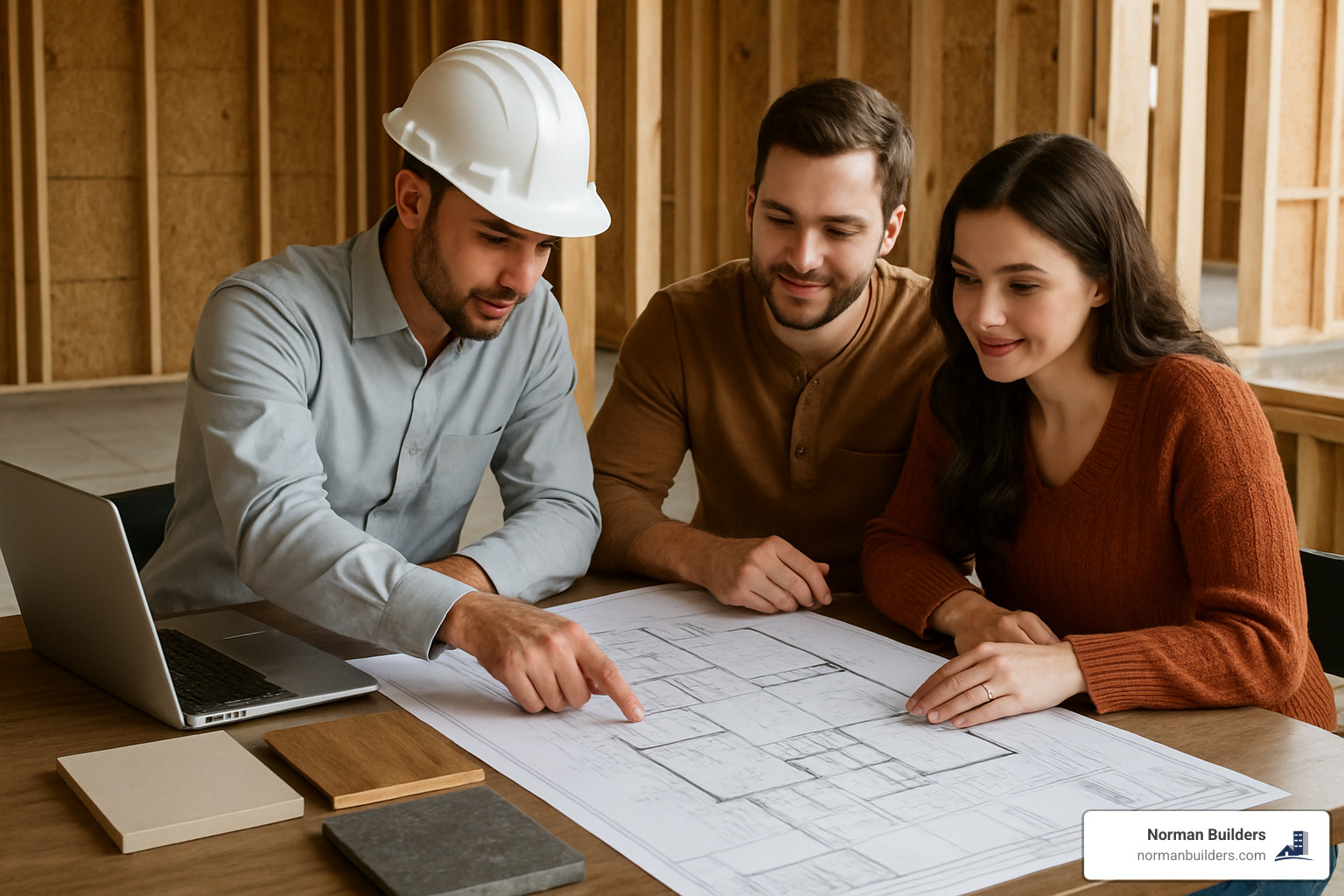
The journey of custom home construction unfolds like a story, with each chapter bringing you closer to your dream home. Let’s walk through what this trip looks like from start to finish.
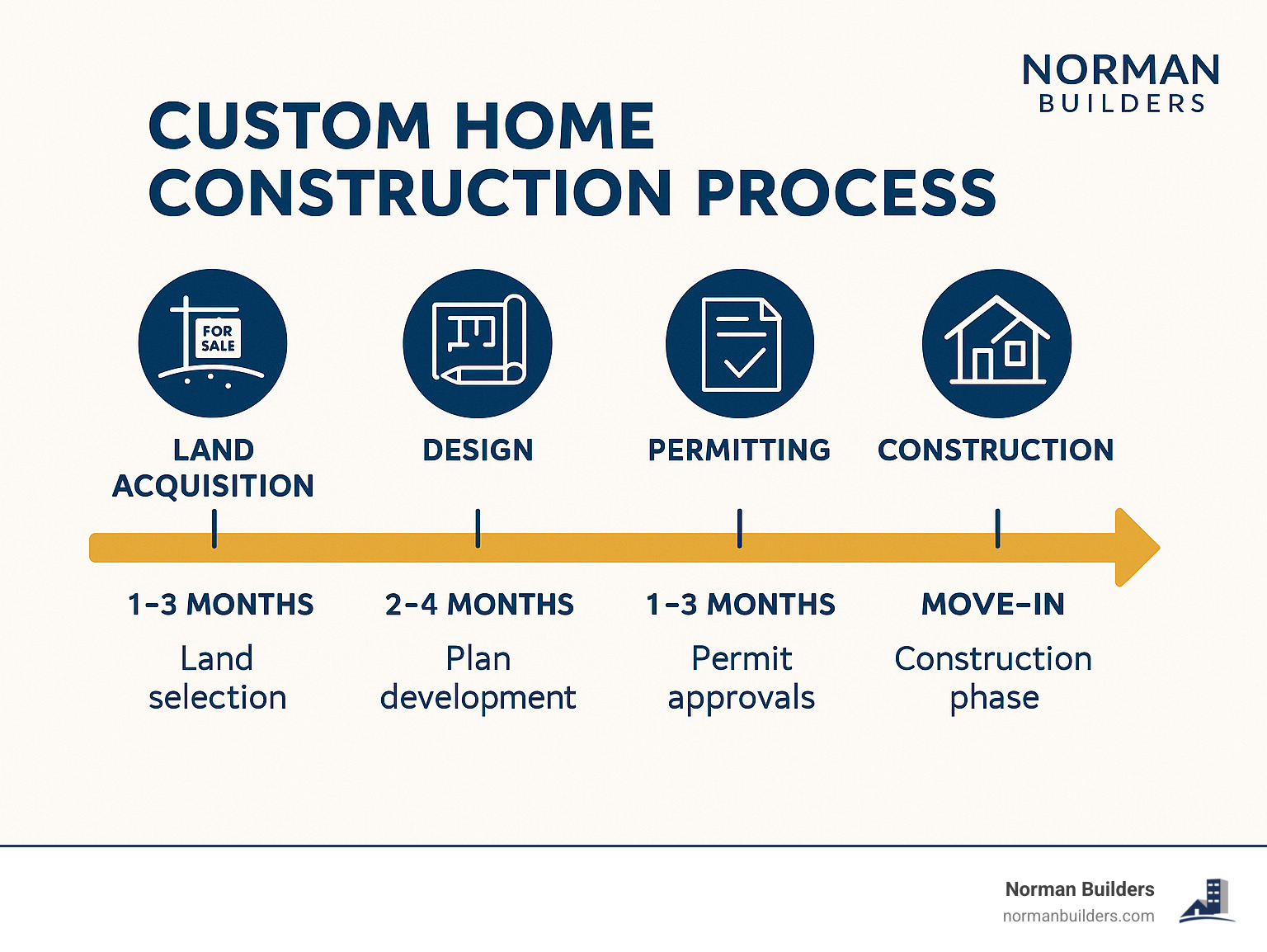
Finding the perfect piece of land is where your story begins. This treasure hunt can take anywhere from a few weeks to several months, depending on your location preferences and budget. You’ll need to consider things like school districts, commute times, and whether the lot has the right features for your dream home. During this phase, we’ll help you evaluate soil conditions, check for any environmental concerns, and understand local building codes that might affect your plans.
Once you’ve secured your land, the design phase begins – a time of creativity and excitement that typically spans 2-6 months. This is where your vision starts taking shape on paper. We’ll have conversations about your lifestyle needs, architectural preferences, and must-have features. Your architect will transform these discussions into preliminary sketches, then detailed blueprints. Meanwhile, you’ll be selecting everything from cabinet styles to doorknobs – decisions that make your home uniquely yours.
The permitting process follows, sometimes testing your patience as local authorities review your plans. This governmental dance can take 1-3 months, depending on your location and how busy the building department might be. We’ll handle the paperwork and any required revisions to keep things moving forward.
With permits in hand, we’ll spend about a month on pre-construction activities – finalizing contracts, securing financing, and preparing your site. Then comes the exciting day when equipment rolls onto your property and construction officially begins!
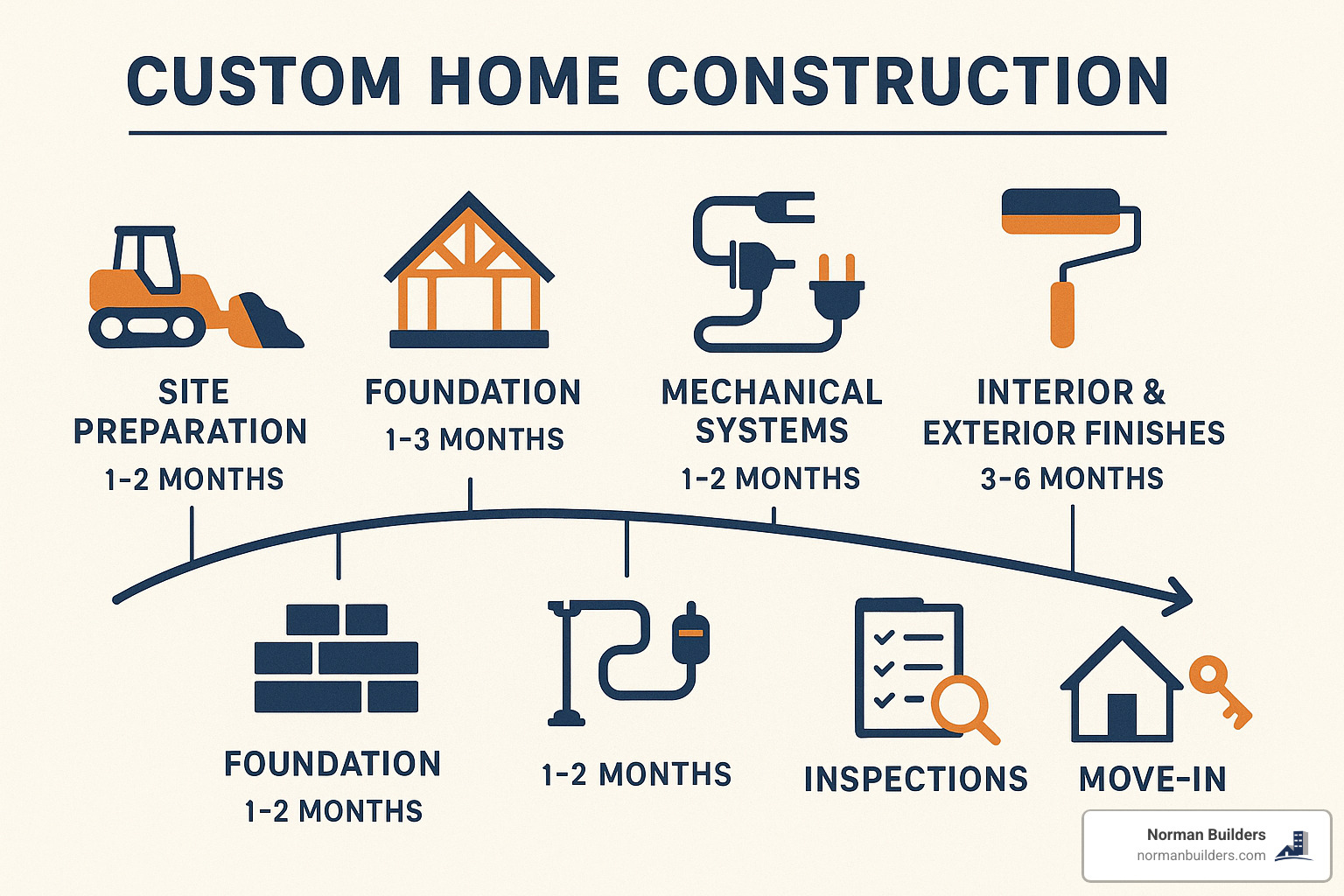
The foundation work kicks off the physical building process, typically taking 2-4 weeks. This crucial phase includes excavation, pouring concrete footings and foundation walls, and installing proper drainage systems – essentially creating a solid platform for everything that follows.
Next comes framing – a transformative 1-2 month period when your home’s skeleton rises from the ground. Almost overnight, two-dimensional plans become three-dimensional spaces. You’ll see walls defining rooms, roof trusses spanning overhead, and openings for windows and doors. It’s during this phase that many homeowners start to feel the reality of their project taking shape.
“The most magical part of our build was watching the framing go up,” shares one Norman Builders client. “Suddenly we could walk through spaces that had only existed in our imagination.”
The mechanical systems installation follows, typically lasting 1-2 months. This behind-the-scenes work includes running electrical wires, installing plumbing pipes, and setting up heating and cooling systems. Though less visually dramatic than framing, these systems are the unseen heartbeat of your future home.
The longest phase is usually the interior and exterior finishes, spanning 2-4 months. This is where your home truly becomes personalized, as drywall goes up, trim gets installed, cabinets and countertops transform your kitchen, and your chosen flooring materials are laid down. Outside, siding and trim create your home’s public face, while driveways and walkways complete the approach.
Final inspections and completion activities take about a month, as municipal inspectors verify that everything meets code requirements. We’ll address any last-minute adjustments on your punch list, complete the landscaping, and thoroughly clean your new home before the big day arrives – move-in day!
All told, you can expect the entire custom home construction process to take between 10-24 months. Simpler homes on straightforward lots might finish faster, while larger or more complex designs may take longer. Weather conditions, material availability, and the current construction climate all influence timing as well.
Throughout your custom home construction journey, certain moments stand out as particularly significant – checkpoints that mark progress and require your attention.
Lot due diligence is your first critical milestone. Before you commit to a piece of land, we’ll help you investigate thoroughly. This means testing soil quality, understanding setback requirements, checking for any easements, and confirming utility availability. These investigations can prevent costly surprises later. I remember one client who skipped proper drainage evaluation and later faced significant water issues that could have been avoided with proper planning.
The pre-construction meeting brings together the entire team – you, your builder, architect, and key subcontractors – before breaking ground. At Norman Builders, we use this gathering to align everyone’s expectations, establish clear communication channels, and set decision deadlines. Think of it as the kickoff meeting for your project, setting the tone for the collaboration ahead.
As your home takes shape, the framing walk-through offers an exciting milestone. This is your chance to physically walk through the skeletal structure of your home, visualizing room sizes and sightlines before walls close things in. Many clients find this helps them fine-tune details like outlet placements or confirm window positions while changes are still relatively easy to make.
The pre-drywall inspection serves as a crucial quality checkpoint. Before walls get covered with drywall, we’ll verify that all electrical wiring, plumbing pipes, and HVAC ducts are properly installed. This technical inspection ensures that the systems you’ll rely on daily are set up correctly from the start.
Weekly site visits become a rhythm throughout construction. These regular check-ins keep you connected to the process and informed about progress. Many families make these visits special occasions – bringing coffee and donuts while watching their dream home materialize. These consistent touchpoints also allow for timely decisions and quick problem-solving if needed.
Meeting finish selection deadlines keeps your project on schedule. Throughout construction, you’ll need to make decisions about everything from paint colors to light fixtures. We’ll provide a selection schedule early in the process so you can plan accordingly and prevent delays caused by last-minute decisions.
The final walk-through represents the culmination of your journey. This comprehensive inspection identifies any remaining items that need attention before you take ownership. We’ll create a punch list of these items and address them promptly so you can move into a home that’s complete in every detail.
By actively participating in these key milestones, you’ll help ensure your custom home truly reflects your vision while staying on schedule and within budget. After all, building your dream home should be an exciting journey, not just a destination.
Please note: Our services are exclusively available in Massachusetts, specifically in Andover, MA, the North Shore, and New Hampshire, covering the Seacoast and Southern NH regions.
When you start on a custom home construction journey, understanding the financial landscape is crucial. Unlike buying an existing home with its straightforward price tag, building custom involves a complex financial puzzle with multiple moving pieces.
Custom homes typically range from $100 to $500+ per square foot, excluding land costs. And yes, that’s quite a range! Your actual costs will depend on countless factors from location to finishes. A modest custom home might land on the lower end, while a luxury residence with high-end everything can easily push beyond the upper limits.
Let’s break down where your money actually goes:
Land is your foundation – both literally and financially. Property costs vary dramatically by location, from as little as $11,000 per acre in some rural areas to a staggering $1.45 million in prime locations. One client told me, “I was shocked at how much site work our sloped lot needed – we hadn’t budgeted for the $65,000 in drainage systems!”
Your design team deserves their due. Architect and engineering fees typically run 5-15% of your total construction budget. While it might be tempting to skimp here, these professionals ensure your dream becomes a structurally sound reality. Think of this as an investment in avoiding costly mistakes.
The actual construction forms the bulk of your budget – materials, labor, and your builder’s overhead and profit. Builder fees generally range from 15-25% of construction costs, reflecting their expertise in managing the complex process.
Don’t forget the paperwork. Permits, impact fees, and utility connections can add thousands to your budget. These vary widely by municipality, so research your specific location.
The contingency fund is your best friend. I always advise clients to set aside at least 20% of their construction budget for unforeseen costs. As one seasoned builder puts it, “Whatever you think it’s going to cost, add 20% at minimum.” From hidden rock ledges to supply chain hiccups, something unexpected always comes up.
Financing a custom home requires specialized loan products. Typically, you’ll need a construction loan during the building phase, which then converts to a permanent mortgage upon completion. These loans work differently than traditional mortgages – they release funds in stages (called “draws”) as construction milestones are reached, with interest-only payments during construction.
“Regional banks often offer better construction loan terms through their established relationships with local builders,” notes a financial advisor I work with. “Don’t just shop rates – compare the draw process and conversion features too.”
When budgeting for your custom home construction, cost per square foot provides a useful starting point, though it’s influenced by numerous factors:
Where you build matters enormously. The same home that costs $287,670 in Mississippi might run $363,314 in California – before even considering land costs! Labor rates, material availability, and local regulations all impact regional pricing.
Material choices create vast price differences. Basic builder-grade fixtures and finishes keep costs down, while custom cabinetry, imported marble, and high-end appliances push them up. One client saved $40,000 by choosing a local granite over an imported Italian stone – with a difference only a geologist could spot!
Design complexity directly affects your bottom line. Simple rectangular footprints with standard roof pitches cost substantially less than homes with complex angles, multiple roof lines, or curved walls. Each corner and angle adds labor and material costs.
Size impacts efficiency in interesting ways. Larger homes often have a lower cost per square foot due to economies of scale, but obviously cost more overall. Well-designed smaller homes might cost more per square foot but significantly less in total.
Sustainability investments pay off differently. Energy-efficient systems and sustainable materials typically increase upfront costs while offering long-term operational savings. As one homeowner shared, “Our geothermal system added $30,000 upfront but saves us $2,400 annually in energy costs – it’ll pay for itself while making our home more comfortable.”
To illustrate these variations: in urban Wisconsin, custom homes typically range from $150-$300 per square foot, while in rural areas of the same state, costs often drop to $100-$200 per square foot.
Financing a custom home construction project requires specialized loan products designed for the unique challenges of building rather than buying:
Construction-to-permanent loans offer convenience through their “one-time close” approach. They combine the construction phase and permanent mortgage into a single loan, saving you time and duplicate closing costs. During construction, you make interest-only payments on the funds disbursed, then the loan automatically converts to a traditional mortgage once your builder hands over the keys.
Stand-alone construction loans provide flexibility but require more paperwork. These short-term loans cover only the building phase, requiring you to obtain a separate permanent mortgage once construction finishes. This means two closings and two sets of fees, but gives you freedom to shop for the best permanent mortgage when the time comes.
Home equity can be your secret weapon. If you already own a home with substantial equity, you might leverage that through a HELOC to finance your custom build. This approach works particularly well if you plan to sell your current home once the new one is complete.
Cash reserves give you negotiating power. Some buyers use significant cash savings to fund part or all of their construction, reducing or eliminating loan costs. This approach requires careful cash flow management but can save thousands in interest.
Land loans might be necessary if you’re buying property well before breaking ground. These typically require larger down payments (20-50%) and carry higher interest rates than residential mortgages.
When applying for construction financing, be prepared to provide detailed construction plans, a signed builder contract, timeline, cost breakdowns, proof of insurance, and your financial information.
“With younger people, especially younger families, they often skip critical financial planning steps,” says John McCafferty, a financial planning director. “They get into a home, and suddenly the reality of homeownership hits them: ‘Oh, we still have all these other obligations.’ Take care of those things first, then build your home.”
Working with a lender experienced in construction loans is crucial – they understand the draw process and are familiar with local builders and market conditions. At Norman Builders, we can recommend financial institutions that specialize in construction lending and have a track record of smooth transactions.
More info about custom home cost guide
Please note: Our services are exclusively available in Massachusetts, specifically in Andover, MA, the North Shore, and New Hampshire, covering the Seacoast and Southern NH regions.
Building your own home is an exciting journey filled with possibilities. Custom home construction offers remarkable rewards but also comes with real challenges that every potential homeowner should understand before breaking ground.
When you build custom, you’re creating a home that truly reflects who you are. Every corner, every feature can be custom specifically to your lifestyle and preferences. From the overall layout to tiny details like where outlets are placed or what door handles you prefer, the home becomes uniquely yours.
Custom homes accept their surroundings in ways pre-designed homes simply can’t. Your architect can design around that magnificent oak tree, position windows to capture mountain views, or create solutions for challenging slopes on your property.
Today’s custom homes are energy powerhouses, incorporating cutting-edge insulation, high-efficiency systems, and smart technology that can dramatically reduce your utility bills compared to older homes. Many of our clients are pleasantly surprised by how comfortable and efficient their new homes feel throughout all seasons.
Multi-generational living has become increasingly important in modern home design. With nearly 40% of adults between 18-34 having moved back with parents at some point, and over 4 million U.S. households including three generations under one roof, custom homes can thoughtfully accommodate these changing family dynamics with in-law suites, first-floor bedrooms, or separate entrances.
The quality control advantage can’t be overstated. When building custom, you’re not inheriting someone else’s shortcuts or maintenance issues. You’ll know exactly what’s behind every wall and under every floor, with materials and craftsmanship you’ve personally approved.
Well-designed custom homes often enjoy a significant resale premium when it’s time to move on. The unique features, thoughtful design, and quality construction typically command higher market values than production-built homes of similar size.

Let’s be honest – budget management is perhaps the biggest challenge in custom building. Without disciplined planning and clear boundaries, costs can climb quickly. Those beautiful marble countertops you fell in love with mid-construction? That’s a change order that impacts both your timeline and budget.
Patience becomes essential during the custom building process. While a production home might be ready in 6-8 months, custom homes typically take 10-24 months from design to move-in. This longer timeline requires emotional stamina and flexible living arrangements during construction.
Many clients don’t anticipate the sheer volume of decisions they’ll face. From big choices like architectural style down to the color of grout between bathroom tiles, decision fatigue is real. As one of our clients joked, “I never knew I could have such strong opinions about doorknobs!”
Financing a custom build is more complex than getting a traditional mortgage. Construction loans work differently, with draw schedules and interest-only payments during building, converting to a permanent mortgage upon completion. Working with lenders experienced in construction financing makes this process smoother.
The coordination of architects, engineers, builders, and dozens of specialized tradespeople requires expert management. When one trade falls behind schedule, it can create a domino effect of delays. Professional builders earn their fee by masterfully orchestrating this complex dance.
Many people believe custom homes are only for the wealthy. While luxury custom homes grab attention in magazines, custom building happens at many price points. By prioritizing where to invest and where to economize, custom homes can be built within a range of budgets. What matters most is aligning your vision with your financial reality.
Another misconception is that you need to hire an architect first. While architects are vital partners, many successful projects begin with a builder who helps assemble the right team for your specific needs and budget. At Norman Builders, we often help clients determine whether they need a full architectural firm or if a design-build approach might better suit their project.
Custom doesn’t mean everything is built from scratch on site. Many custom homes incorporate prefabricated elements like roof trusses or cabinet boxes that are then customized during installation. This hybrid approach can save time and money while maintaining quality and personalization.
Some homeowners believe they can save money by acting as their own general contractor. Without experience in construction management, this approach typically leads to costly mistakes, scheduling problems, and quality issues. Professional builders bring established subcontractor relationships, purchasing power, and crucial expertise in building science and project management.
While complex custom homes can indeed take years to complete, not all custom projects are marathon endeavors. More straightforward designs with decisive homeowners and efficient builders can be completed in 10-12 months. Clear decision-making and minimal changes during construction are key to maintaining timelines.
When starting on your first custom home construction journey, avoiding these common pitfalls will save you considerable stress:
Making significant changes after construction begins is probably the most expensive mistake. Each change ripples through the project, affecting multiple trades and materials. One client wanted to expand their kitchen island after framing was complete – what seemed like a simple change required reworking electrical, plumbing, and cabinetry plans, adding thousands to the budget.
Underestimating total project costs catches many first-timers off guard. Beyond basic construction costs, remember to budget for site work, design fees, permits, landscaping, and furnishings. Always include at least a 20% contingency fund for unexpected expenses – you’ll likely need it.
Choosing a builder based solely on the lowest bid often leads to disappointment. Focus on value rather than just price – consider experience, reputation, communication style, and the quality of past work. Visit completed homes and speak with former clients whenever possible.
While your home should reflect your unique preferences, extremely personalized or unusual features might impact future resale. Finding the sweet spot between personal expression and market appeal ensures your investment holds value.
Comprehensive, detailed contracts protect everyone involved. Your agreement should clearly specify materials, allowances, payment schedules, change order procedures, and warranty terms. Vague contracts inevitably lead to misunderstandings and disputes.
Weather delays, material shortages, and unexpected site conditions are realities of construction. Building realistic time and financial buffers into your plans helps manage the inevitable surprises that arise during the building process.
Regular, clear communication with your builder and design team is essential for success. Establish communication protocols early and maintain them throughout the project. At Norman Builders, we implement weekly check-ins and use project management software that keeps everyone informed and decisions documented.
Building a custom home is a significant undertaking, but with proper planning, realistic expectations, and the right team, it can be one of life’s most rewarding experiences. The joy of walking into a home designed specifically for you makes the challenges worthwhile.
Please note: Our services are exclusively available in Massachusetts, specifically in Andover, MA, the North Shore, and New Hampshire, covering the Seacoast and Southern NH regions.
Today’s custom home construction accepts designs that blend beauty with practicality, sustainability, and flexibility. The modern custom home isn’t just about looking good—it’s about living well for years to come.
Smart home technology has moved from luxury to expectation in new custom builds. Homeowners now want integrated systems that let them control lighting, temperature, security, and entertainment with just a few taps on their smartphone. As one client told me, “Being able to adjust my home’s systems from anywhere gives me both convenience and peace of mind.”
The boundary between indoor and outdoor living continues to blur in meaningful ways. Expansive sliding glass doors, covered outdoor kitchens, and year-round sunrooms create homes that feel connected to nature while staying comfortable in any weather. These transitions make even modest-sized homes feel more spacious and inviting.
Wellness has become a cornerstone of thoughtful home design. Dedicated spaces for exercise, meditation, or simply unwinding are increasingly common requests. “Building a home that features a resistance pool and fitness room has transformed our daily health routines,” shared one Massachusetts homeowner who worked with us. Natural light, improved air quality systems, and spaces that promote relaxation all contribute to homes that nurture physical and mental wellbeing.
Eco-friendly building practices have firmly entered the mainstream of custom home construction. Today’s environmentally conscious homeowners aren’t just thinking about aesthetics—they’re considering their home’s impact on the planet and their utility bills.
High-performance insulation and tight building envelopes dramatically reduce energy consumption, creating homes that stay comfortable with minimal heating and cooling. These well-insulated homes feel different too—they’re quieter, with fewer drafts and more consistent temperatures throughout.
Water conservation features like low-flow fixtures and rainwater collection systems make homes more resilient and less taxing on local resources. In drought-prone areas, native landscaping reduces the need for irrigation while still creating beautiful outdoor spaces.
Sustainable and recycled materials bring character while reducing environmental impact. Reclaimed wood flooring tells a story while giving new life to old-growth timber. Countertops made from recycled glass or paper composite offer unique appearances while diverting waste from landfills.
“Using green building techniques not only reduces environmental impact but can also lead to significant long-term savings,” explains an industry expert. “The initial investment often pays dividends through lower utility bills and potential tax incentives.”
Universal Design creates homes that work beautifully for everyone, regardless of age or ability. This thoughtful approach is particularly valuable for homeowners planning to age in place or welcome multiple generations under one roof.
Zero-step entries eliminate barriers while looking neat. Wider doorways and hallways create an open, spacious feel while ensuring accessibility for wheelchairs or walkers. Lever-style door handles and touch faucets make daily tasks easier for everyone, whether you’re carrying groceries or dealing with arthritis.
In bathrooms, curbless showers with bench seating offer luxury and accessibility in one beautiful package. Throughout the home, strategic lighting reduces fall risks while creating ambiance. Adjustable-height countertops and accessible storage solutions ensure the kitchen works for cooks of all abilities.
“Universal Design is the practice of creating environments accessible and functional for the widest range of people, regardless of age, ability, or stature,” explains a design professional. “Starting with accessible floor plans—wide hallways, open spaces—and selecting durable, low-maintenance finishes like non-slip flooring and lever handles extends design seamlessly to outdoor areas.”
With more families embracing multi-generational living, custom homes increasingly include thoughtful features that allow independence while maintaining connection. Well-designed in-law suites with private entrances give parents or adult children their own space while keeping them close. First-floor primary bedrooms eliminate stair concerns while flexible spaces throughout the home adapt as family needs evolve.
“Multi-generational custom homes can include fully independent apartment-style suites within the same structure,” notes a housing expert. “This provides privacy while maintaining the benefits of shared living.”

Several specific elements have become particularly sought-after in contemporary custom home construction:
Dedicated home offices have moved from “nice to have” to “must have” for many families. These spaces now feature sound insulation, built-in storage, and thoughtful technology integration that make working from home both productive and pleasant.
Storage has become a priority, with generous walk-in pantries, mudrooms with built-in organization systems, and clever storage solutions throughout. As one homeowner told me, “Having a place for everything means we actually enjoy keeping our home tidy.”
Flex rooms that adapt to changing needs provide long-term value. The playroom that becomes a teen hangout and eventually a hobby space ensures your home evolves with your family.
Energy-efficient building envelopes with high-performance windows and doors create homes that are both more comfortable and less expensive to heat and cool. These tight envelopes also make homes quieter, keeping outside noise where it belongs.
Primary suites have evolved into true retreats, with spa-inspired bathrooms featuring free-standing tubs and generous showers. These personal sanctuaries provide a daily dose of luxury and relaxation.
Outdoor living spaces now function as true extensions of the home, with covered areas, outdoor kitchens, and fire features that make outdoor living comfortable for much of the year. These spaces effectively increase your living area while connecting you with nature.
At Norman Builders, we help our clients steer these trends and select features that truly match their lifestyle needs and long-term goals. The result? Homes that feel current without chasing fads—homes designed to bring joy for decades to come.
External link on design trends
Please note: Our services are exclusively available in Massachusetts, specifically in Andover, MA, the North Shore, and New Hampshire, covering the Seacoast and Southern NH regions.
Selecting the ideal builder and property are perhaps the two most critical decisions in the custom home construction process. These choices set the foundation—literally and figuratively—for your entire project.
The right builder can transform your custom home journey into an exciting trip rather than a stressful ordeal. When I work with clients at Norman Builders, I always emphasize that this relationship will last months or even years—so it needs to be a good match!
Start your search by casting a wide net. Talk to friends who’ve built custom homes, ask your real estate agent for recommendations, check with local home builder associations, and spend some weekend afternoons visiting open houses of newly built customs. Online research is valuable too, but nothing beats seeing a builder’s work in person.
Once you’ve created a shortlist, it’s time for some detective work. Verify credentials thoroughly—proper licensing, comprehensive insurance coverage, and professional affiliations are non-negotiable. A builder’s membership in organizations like the National Association of Home Builders often indicates their commitment to industry standards and continuing education.
Past work speaks volumes about what you can expect. I always encourage potential clients to tour our completed homes (when possible) or review detailed portfolios. Pay attention to the quality of finishes, how spaces flow together, and the small details that reveal craftsmanship.
When interviewing builders, look beyond the sales pitch. How do they communicate? Are they truly listening to your vision or just pushing their standard approaches? Do they seem organized and professional? The best builders ask as many questions as they answer—they want to understand your lifestyle, priorities, and dreams for your new home.
“Using a single point of contact to handle permits, inspections, and subs,” as one homeowner noted, creates a smoother building experience. This is exactly how we structure our projects at Norman Builders, ensuring clear communication throughout.
Don’t skip reference checks! Past clients can provide invaluable insights about working with a builder day-to-day. Ask specific questions: Did the project stay reasonably within budget? Was communication consistent? How were problems addressed? Would they choose this builder again?
Finally, review contracts with extreme care—preferably with an attorney experienced in construction law. A solid contract protects both parties and clearly outlines expectations, specifications, payment schedules, and change order procedures.
Finding the right piece of land is equally crucial to your custom home construction success. The perfect lot balances location, site characteristics, and development potential.
Location fundamentals matter tremendously, both for your daily life and future resale value. Consider your commute, proximity to schools and amenities, and the overall community character. Even if you don’t have children, school district quality significantly impacts property values. Research local development plans too—that peaceful field across the street might be slated for commercial development in five years.
When evaluating site characteristics, think beyond the view (though that matters too!). The land’s topography will influence construction costs and living experience. South-facing lots typically offer better natural lighting and potential for passive solar benefits. Existing trees can provide shade and privacy but might also complicate building placement.
I always advise clients to conduct thorough soil testing before purchasing land. Poor soil conditions can require expensive foundation solutions. As one homeowner finded, “Building at the bottom of a hill required an extensive $65,000 drain system to manage stormwater.” This kind of surprise can devastate your budget if not identified early.
Regulatory considerations might seem boring but are absolutely critical. Zoning regulations, setback requirements, and HOA rules can drastically limit what and where you can build. Environmental regulations might protect wetlands or endangered species habitats on your property. Always verify these restrictions before purchasing.
Infrastructure and utilities availability can make or break your budget. Is municipal water available, or will you need a well? Is the property served by sewer, or will you need a septic system? How far will utility companies need to extend service lines, and at what cost? In rural areas, internet service can be surprisingly challenging to secure.
At Norman Builders, we often help clients evaluate potential building sites before purchase. Our experienced eyes can spot opportunities and challenges that might not be obvious. This early involvement can prevent costly surprises and help you find land that perfectly suits your dream home vision.
More info about choosing a builder
When interviewing potential builders for your custom home construction project, your instincts matter. If something feels off, it probably is. Watch for builders who seem reluctant to provide references or show past work. Be wary of high-pressure tactics to sign contracts quickly or those requesting unusually large deposits upfront.
Communication style during the interview process often reflects how the entire project will unfold. If a builder is slow to respond or vague with answers before you’ve signed a contract, imagine how they’ll behave when challenges arise during construction.
Essential questions to ask builders should cover everything from credentials to problem-solving approaches:
When discussing licensing and insurance, don’t just ask if they have it—request documentation. Proper insurance protects both you and the workers on your property.
Ask about experience and specialization: “How many custom homes like mine have you built in the past few years?” A builder who primarily constructs production homes might not be the best fit for a highly customized design.
Understanding project management is crucial. Will you have a dedicated supervisor, and how often will they be on-site? At Norman Builders, we maintain daily site supervision and weekly client meetings to ensure projects stay on track.
The conversation about subcontractors reveals much about quality control. The best builders maintain long-term relationships with reliable subcontractors and have systems to ensure consistent quality.
Timeline guarantees and handling of delays can make or break your experience. While weather and material delays happen, good builders build reasonable buffers into their schedules and communicate proactively about any changes.
The change order process should be clearly defined. Changes during construction are almost inevitable, but how they’re handled (and priced) varies widely between builders.
Discussions about payment schedules should feel transparent and fair. Payments should be tied to completed construction milestones, not arbitrary dates.
Warranty coverage varies significantly between builders. Beyond the length, understand exactly what’s covered and the process for addressing warranty issues.
Communication systems reveal a builder’s organizational sophistication. The best builders use project management software that gives clients visibility into schedules, selections, and decisions.
Finally, ask about problem resolution. How a builder handles challenges says everything about their character and competence. Ask for specific examples of problems they’ve faced and how they resolved them.

One homeowner who successfully steerd the custom building process offers this advice: “Request a lump-sum (fixed-price) contract to lock in specifications and costs. This transfers cost overrun risk to contractors and provides peace of mind.”
At Norman Builders, we welcome these detailed questions. We believe informed clients make better partners, and transparent communication from the start builds the foundation for a successful project.
Please note: Our services are exclusively available in Massachusetts, specifically in Andover, MA, the North Shore, and New Hampshire, covering the Seacoast and Southern NH regions.
When it comes to first-time homebuyers, custom home construction often represents a significant challenge. As industry executive Rob McGibney puts it: “If you’re a first-time buyer, I would probably skip the new build. You might be biting off more than you can chew.”
The reality is that custom homes typically demand more financial resources and emotional bandwidth than many first-timers can muster. You’ll need excellent credit to qualify for construction loans, substantial cash reserves, and the ability to juggle paying for your current housing while funding construction. Perhaps most importantly, you’ll need the emotional resilience to weather the inevitable ups and downs of a complex building project.
That said, we’ve worked with determined first-time buyers who have successfully built custom homes by taking a thoughtful approach. Some start with semi-custom options that offer personalization with less complexity. Others begin with smaller, simpler designs specifically created with future expansion in mind. In some cases, family partnerships on land or financing can make custom building more accessible for newcomers.
At Norman Builders, we take time to assess each client’s situation honestly. Sometimes we recommend gaining some homeownership experience before starting on a custom project. For those first-timers who are determined to build, we provide extra guidance and support throughout the journey to help steer the challenges that inevitably arise.
The timeline for custom home construction varies considerably based on several key factors, and realistic expectations are crucial for your sanity during the process.
Home size and complexity play a major role in determining your timeline. A straightforward 2,000 square foot home might be completed in 10-12 months, while a complex 4,000+ square foot luxury residence could easily require 18-24 months or more. We’ve seen this difference play out countless times, as one homeowner shared: “One builder finished a cookie-cutter 2600 sq ft home in 8 months, while a relative’s 3000 sq ft custom home took 18 months and is still ongoing.”
Weather and seasons significantly impact construction schedules. Breaking ground in spring generally allows exterior work to be completed before winter arrives, particularly important in our New England climate. Permitting timelines also vary dramatically by location—some towns process permits in weeks, while others with strict architectural review boards might take months.
Your own decision-making speed matters too. Clients who promptly select finishes and approve changes keep projects moving, while delayed decisions can extend timelines significantly. Material availability also affects schedules, with certain specialty items requiring extended lead times.
For most custom homes, a realistic breakdown includes 3-6 months for pre-construction (design, engineering, permitting), followed by 8-18 months of active construction depending on complexity. At Norman Builders, we provide detailed construction schedules at the outset and update them regularly, giving our clients realistic expectations about when they’ll be able to move into their new home.
After you’ve completed your custom home construction journey and moved into your new home, understanding what ongoing support to expect is important for peace of mind.
Most reputable custom builders offer a tiered warranty program. This typically includes a one-year warranty covering workmanship and materials, a two-year warranty on mechanical systems (electrical, plumbing, HVAC), and a ten-year structural warranty covering major structural elements. As one construction expert notes, “A 10-year transferrable structural warranty is a standard industry offering among reputable builders.”
The warranty process usually includes several key touchpoints. Many builders conduct a 30-day adjustment period to address immediate issues, followed by a 90-day follow-up inspection to tackle any settling or seasonal changes. A comprehensive 11-month review before the one-year warranty expires helps catch any issues that might have developed over different seasons. Quality builders will also have emergency response protocols for urgent situations like water leaks or HVAC failures.
Beyond warranty coverage, good builders provide ongoing maintenance support. This should include a detailed homeowner’s manual with maintenance schedules, documentation of all systems and materials used in your home, and recommended service provider lists for ongoing maintenance needs. Some builders even offer seasonal maintenance checklists or online portals where you can access warranty and home information.
Many components in your new home carry their own manufacturer warranties beyond what your builder provides. These typically include 25-50 years for roofing materials, 10-20 years for windows, 1-5 years for major appliances, and 5-10 years for HVAC equipment.
At Norman Builders, we take pride in our comprehensive warranty program and responsive service. We formally check in with our clients at 90 days and 11 months, but we remain available throughout the warranty period and beyond. Our goal is ensuring your home continues to perform beautifully for years to come.
Please note: Our services are exclusively available in Massachusetts, specifically in Andover, MA, the North Shore, and New Hampshire, covering the Seacoast and Southern NH regions.
Starting on a custom home construction journey is both exciting and challenging. It offers unparalleled opportunities to create a living space that perfectly reflects your lifestyle, preferences, and needs. While the process requires significant investment of time, energy, and resources, the reward is a truly one-of-a-kind home built specifically for you.
As you consider whether custom home construction is right for you, think about what matters most in your future home. Is it an open-concept kitchen where your family can gather? A primary suite that feels like a luxury retreat? Or perhaps sustainable features that align with your values? Your priorities will guide every decision along the way.
The path to your dream home begins with careful planning. Start by exploring potential building sites in neighborhoods you love, keeping in mind factors like school districts, commute times, and community amenities. As you search, visualize how your home might sit on each property, taking advantage of views or natural features.
Next, interview several custom builders to find someone whose communication style, portfolio, and approach resonate with you. The builder-client relationship is crucial to a successful project, so take time to find the right match. Ask for references and speak with past clients about their experiences.
Financial preparation is equally important. Meet with lenders who specialize in construction loans to understand your options and get pre-approved. Having a clear budget from the beginning helps guide design decisions and prevents disappointment later.
Begin gathering inspiration for your design vision through home tours, magazines, and online resources. Create collections of ideas that speak to you, whether through Pinterest boards or old-fashioned scrapbooks. These will help communicate your preferences to your design team.
When you’re ready to translate your vision into reality, consult with an architect who can bring your ideas to life while ensuring your home is structurally sound and optimized for your site. Your builder can often recommend professionals who fit your style and budget.
At Norman Builders, we’ve guided countless homeowners through the custom building process since 2007. Our team brings experience in new home construction throughout the Merrimack Valley, North Shore, Seacoast, and Southern NH areas. We understand the local building codes, climate considerations, and regional design preferences that influence successful custom projects in New England.
We believe that building your dream home should be an exciting and rewarding experience, not an overwhelming one. Our approach combines technical expertise with personalized service to simplify the complex process of custom home construction.
Whether you’re ready to break ground on your dream home or just beginning to explore the possibilities, we’re here to help you steer each step of the journey with confidence and peace of mind.
More info about new-build services
Please note: Our services are exclusively available in Massachusetts, specifically in Andover, MA, the North Shore, and New Hampshire, covering the Seacoast and Southern NH regions.

We specialize in high-quality home construction and remodeling services, delivering exceptional craftsmanship tailored to meet your vision and needs. Whether you’re planning a renovation, new construction, or a custom remodel, our experienced team is committed to exceeding expectations with precision, attention to detail, and reliable service.
Our service area includes the Merrimack Valley, North Shore, Seacoast, and Southern NH Areas. We take pride in the quality of our workmanship and our prompt professionalism.
Contact us today to bring your project to life!