

The cost of building a garage attached to house isn’t a one-size-fits-all number, but most homeowners can expect to invest between $28,000 and $55,000 for their project. If you’re planning a standard two-car garage with vinyl siding and an asphalt shingle roof, you’ll likely land around the $42,000 mark.
When my clients ask about budgeting for their garage addition, I typically break it down like this: expect to pay between $40 and $100 per square foot, with about 50-70% of your budget going toward skilled labor. The good news? You’ll likely recoup about 65-85% of your investment when you sell your home.
Size naturally drives cost, with one-car garages typically running $15,300-$45,000, two-car garages between $26,000-$80,000, and three-car garages commanding $28,200-$120,000. These ranges reflect the tremendous variety in finishes, materials, and regional labor costs.
I’m Ryan Norman, founder of Norman Builders, and after guiding hundreds of New England homeowners through garage additions over the past 15 years, I’ve seen how an attached garage transforms daily life. Beyond just sheltering vehicles, these spaces create a weather-protected entrance to your home, add valuable storage, and boost your property’s curb appeal.
Choosing an attached versus detached design offers practical benefits beyond convenience – you’ll typically save 10-15% on construction costs since you’re sharing at least one existing wall. This approach also simplifies utilities and creates that seamless connection many homeowners prefer.
When researching the cost of building a garage attached to house, you might encounter various terms. Understanding concepts like the average cost per sq ft to build a garage helps you compare quotes accurately. If you’re considering upscale options, the cost to build a brick garage will differ significantly from standard siding. And general garage construction cost resources can provide helpful benchmarks as you plan.
Please note: Our services are exclusively available in Massachusetts, specifically in Andover, MA, the North Shore, and New Hampshire, covering the Seacoast and Southern NH regions.
Let’s face it – when you’re considering adding an attached garage to your home, the first question is almost always about price. As a homeowner, you deserve a clear picture of what this investment will look like before taking the plunge.
The cost of building a garage attached to house typically falls between $28,000 and $55,000 for most projects, with the sweet spot around $42,000 for a standard 24′ x 24′ two-car garage with vinyl siding, asphalt shingles, and comfortable but not extravagant finishes. The good news? This investment typically returns 65-85% of its value when you sell your home.
“I always tell my clients that while the price tag might make you pause, the daily convenience of walking straight from your car into your home during a New England snowstorm is something you simply can’t put a price on,” shares our lead project manager at Norman Builders.
One key insight that helps explain price variations: labor typically makes up 50-70% of your total project cost, while materials account for the remaining 30-50%. This explains why identical garages might cost significantly different amounts in Boston versus rural New Hampshire.
When builders talk about the cost of building a garage attached to house, they often quote prices per square foot – typically between $40 and $100 depending on your choices and location.
Traditional site-built attached garages usually run $60-$80 per square foot, while prefab options might start lower at $40-$60 per square foot (though they offer less customization and potentially lower resale value).
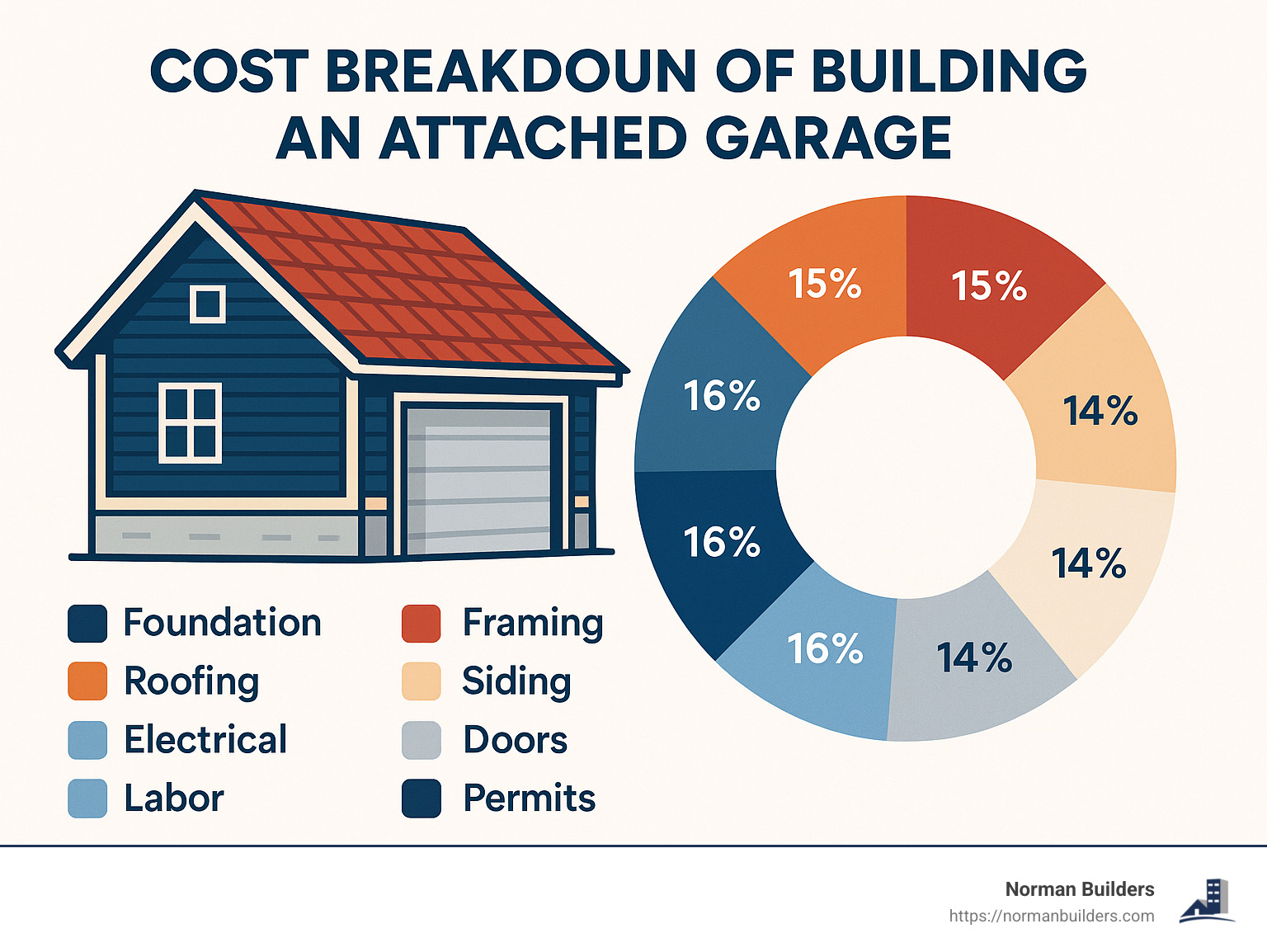
Your square footage costs break down across several elements:
Foundation costs range from $4-$25 per square foot – and in our frost-prone New England climate, you’ll likely need those deeper footings that push you toward the higher end of that range. Framing typically adds $10-$20 per square foot for conventional timber construction, while roofing contributes another $4-$12 for standard asphalt shingles (more for premium materials). Siding adds $7-$15 per square foot for vinyl, but can jump to $18-$35 for brick or stone finishes. Finally, utilities add $1,000-$4,000 for basic electrical work, with additional costs for heating or workshop connections.
One financial bright spot: attached garages share a wall with your existing home, reducing overall costs by 10-15% compared to detached structures. This shared wall not only saves on materials but often simplifies those utility connections.
In 2024, the cost of building a garage attached to house continues to reflect both where you live and ongoing material price fluctuations. Here’s what typical projects are costing:
Single-Car Attached Garage (12′ x 20′ or 14′ x 22′)
– Basic finish: $15,300-$21,500
– Standard finishes: $22,000-$30,000
– Premium finish: $31,000-$45,000
Two-Car Attached Garage (20′ x 20′ or 24′ x 24′)
– Basic finish: $26,000-$35,000
– Standard finishes: $36,000-$48,000
– Premium finish: $49,000-$80,000
Three-Car Attached Garage (30′ x 20′ or 36′ x 24′)
– Basic finish: $28,200-$42,300
– Standard finishes: $43,000-$65,000
– Premium finish: $66,000-$120,000
I recently worked with a family in Exeter, NH who wanted a standard two-car attached garage that would blend seamlessly with their existing home. We matched their vinyl siding, installed basic electrical, added ceiling insulation, and finished with two quality garage doors. Their project landed right in the middle of our average range – a perfect example of typical New England construction costs.

The cost of building a garage attached to house isn’t a one-size-fits-all figure. Like fingerprints, every garage project is unique, shaped by a variety of factors that can either trim your budget or stretch it beyond expectations. Understanding these key influences will help you create a more realistic budget and avoid those mid-project financial surprises that keep contractors up at night.
Size matters—especially when it comes to garages. While a single-car garage (typically 12′ x 20′) might be perfect for your compact sedan, it could feel claustrophobic if you’re trying to park your F-150 and still have room for a workbench.
Most homeowners find that adding an extra 4-5 feet of clearance around vehicles creates a much more functional space. If you’ve got larger vehicles like SUVs or pickup trucks, you might want to increase standard dimensions accordingly. The difference between “technically fits” and “comfortably fits” is often just a few feet—but those few feet can make all the difference in your daily experience.
Where you build has a surprising impact on the cost of building a garage attached to house. Here in New England, we face some unique challenges:
Our skilled labor rates tend to run higher than the national average—particularly in communities like Andover, MA and Portsmouth, NH. Those beautiful New England winters? They require deeper foundations below the frost line, adding to excavation and concrete costs. And if you’re building in a historic district like Newburyport or Salem, be prepared for stricter aesthetic requirements that might limit your material choices.
Coastal properties in places like Hampton or Plum Island may need additional structural reinforcement against high winds, while inland areas might have different drainage requirements. It’s these regional nuances that make local expertise so valuable when planning your garage project.
The paperwork might not be exciting, but it’s essential—and it comes with a price tag. Most garage projects in our service area require permits costing between $1,200 and $1,500. Some towns charge flat fees, while others calculate costs based on your project’s value.
Beyond the basic building permit, you’ll likely need electrical permits, especially if you’re adding significant power capacity for a workshop or EV charging. Some communities also require architectural review to ensure your garage complements the neighborhood aesthetic. These regulatory costs aren’t optional extras—they’re mandatory investments in a legally compliant structure.
What lies beneath can dramatically affect your bottom line. A flat, clear lot with good drainage is the budget-friendly dream, but reality often looks different. Sloped properties might need extensive grading or retaining walls. Rocky New England soil—especially that notorious granite ledge—can require specialized excavation equipment and techniques.
One of our Exeter clients finded their “perfect spot” for a garage sat atop a significant underground boulder, adding about $3,500 to their site prep costs. Poor drainage might necessitate French drains or other water management systems, while large tree removal can add $500-$2,000 per tree to your budget. This is why we always conduct thorough site evaluations before providing detailed estimates—what’s underground matters just as much as what’s above.
Your material choices can either keep costs modest or send them soaring. For siding, vinyl remains the economical champion at $7-$10 per square foot installed, while brick veneer creates a premium look at $18-$35 per square foot. Roofing follows a similar pattern—basic asphalt shingles run $4-$7 per square foot with a 20-40 year lifespan, while slate might cost $15-$30 per square foot but last 75+ years.
Garage doors deserve special attention since they’re such a visible element of your home’s exterior. While basic steel doors start around $750-$1,200 installed, custom carriage-style doors can command $3,000-$10,000. As our design consultant often tells clients, “The garage door is like your home’s handshake—it’s the first impression many visitors get.”
For attached garages, we typically recommend matching your home’s existing materials when possible. This creates a cohesive appearance that looks intentional rather than an afterthought, and typically yields a better return on investment when it’s time to sell.
Labor typically accounts for 50-70% of the total cost of building a garage attached to house. This substantial portion reflects the skilled craftsmanship required at every stage—from pouring a perfectly level foundation to ensuring your roof won’t leak during those notorious New England nor’easters.
Working with licensed contractors isn’t just about quality; it’s about safety and compliance. New England building codes include specific requirements for snow load capacity, wind resistance, proper insulation, and fire separation between the garage and living spaces. The American Lung Association emphasizes the importance of proper ventilation in attached garages to prevent carbon monoxide and other exhaust fumes from entering your home.
Electrical code compliance is equally important, requiring GFCI outlets for safety, dedicated circuits for major tools, proper lighting distribution, and weather-resistant exterior outlets. These code requirements aren’t arbitrary—they’re designed to protect your family and property for decades to come.
Please note: Our services are exclusively available in Massachusetts, specifically in Andover, MA, the North Shore, and New Hampshire, covering the Seacoast and Southern NH regions.
When planning your garage project, understanding how size affects the cost of building a garage attached to house is crucial for budgeting. Let’s break down what you can expect to pay based on the number of cars your garage will accommodate:
| Garage Type | Typical Dimensions | Square Footage | Average Cost Range | Common Features |
|---|---|---|---|---|
| One-Car | 12′ x 20′ to 14′ x 22′ | 240-308 sq ft | $15,300-$45,000 | Single door (8′-9′ wide), basic electrical |
| Two-Car | 20′ x 20′ to 24′ x 24′ | 400-576 sq ft | $26,000-$80,000 | Two single doors or one double door (16′-18′ wide), standard electrical |
| Three-Car | 30′ x 20′ to 36′ x 24′ | 600-864 sq ft | $28,200-$120,000 | Three single doors or various combinations, improved electrical |
It’s interesting to note that single-car garages have become something of a rarity in modern American homes. Only about 6% of homes feature these smaller spaces, while a whopping 63% of homes sport two-car designs. This trend reflects our preference for extra space, even when we might only have one vehicle to park.
“I can’t tell you how many times I’ve had clients initially request a one-car garage only to change their minds once they realize how valuable that extra space can be,” says Ryan Norman, owner of Norman Builders. “Most people find that even with just one car, having room for storage, a workbench, or just the ability to open car doors comfortably makes the two-car option worth the investment.”
When deciding on the right size for your family, think beyond your current needs. Consider future vehicles, hobby space, or storage requirements. We’ve found that expanding a garage later almost always costs significantly more than building the right size from the start.
Want to maximize your investment? Consider adding living space above your garage. This option transforms your project from simple vehicle storage to a multi-functional space that can serve as:
Adding this bonus space typically increases the cost of building a garage attached to house by $125-$250 per square foot for the upper level. This brings the total project cost to somewhere between $60,000 and $270,000 depending on size and finish quality.
While this represents a significant investment, the returns can be substantial. Unlike a standard garage which typically returns 65-85% of costs at resale, living space additions often recoup more of their investment while providing immediate utility.
One of our clients in Newburyport recently added a charming home office above their new two-car garage. With large windows overlooking their garden and a small bathroom, the space doubles as occasional guest quarters when family visits. “It’s become my favorite room in the house,” the client told us. “I actually look forward to Monday mornings now!”
As you weigh your options, it’s worth understanding how attached garages compare to alternatives:
An attached garage typically costs 10-15% less than a detached structure, averaging $40-$70 per square foot. Beyond cost savings, you’ll enjoy direct access to your home without braving the elements (a significant benefit during New England winters), shared utilities for simpler connections, and improved overall energy efficiency for your home.
A detached garage runs higher at $50-$100 per square foot but offers greater flexibility in placement and design. These standalone structures eliminate concerns about vehicle exhaust entering your home and reduce noise transfer. However, they typically require separate utility connections and mean a chilly walk to your car on winter mornings.
Carport conversion presents a middle-ground option if you already have a carport structure. Converting an existing carport to an enclosed garage typically costs $20,000-$35,000 if the foundation can be reused. This jumps to $25,000-$50,000 if a new foundation is needed. While often simpler than building from scratch, these projects may have limitations based on the existing structure.
“Here in New England, I generally recommend attached garages for most families,” explains our lead designer. “After watching clients dash through blizzards to reach detached garages, I’ve seen how much more practical an attached option is for our climate. That direct access becomes priceless around January!”

When planning your garage project, the basic cost of building a garage attached to house is just the starting point. Several potential upgrades and hidden expenses can significantly affect your final budget. Being aware of these factors now helps prevent those dreaded mid-project surprises that can strain your finances.
Here in New England, where winters can be brutal and summers increasingly hot, proper insulation isn’t just a luxury—it’s essential, especially for attached garages that share walls with your living space.
Insulation costs vary dramatically based on the type you choose:
“One thing many homeowners overlook is the garage door itself,” says our energy efficiency specialist. “An insulated door makes a tremendous difference in maintaining temperature, especially in attached garages where heat loss directly affects your home’s energy bills.”
If you’re planning to use your garage as a workshop or spend significant time there, climate control becomes important. A mini-split heat pump system typically costs $3,000-$7,000 installed, while electric baseboard heating runs $1,000-$2,500. For occasional use, portable heating and cooling options from $300-$1,200 might suffice.
Modern garages require substantial electrical work, with costs typically ranging from $1,000-$4,000 depending on complexity. Basic lighting and outlets start around $1,000-$1,500, while workshop power with 220V outlets jumps to $1,500-$2,500.
Planning to charge an electric vehicle? Budget an additional $1,000-$2,500 for a proper charging station. Smart garage features like automated lighting and security systems add another $500-$2,000.
For attached garages, we can often extend your home’s existing electrical service, creating a more seamless integration. However, some homes require panel upgrades if the current service lacks sufficient capacity—a change that can add $1,500-$4,000 to your project.
Adding plumbing features significantly increases functionality but also adds to the cost of building a garage attached to house. A simple utility sink installation runs $500-$1,500, while a proper floor drain system costs $800-$2,000. If you’re dreaming of a full bathroom in your garage space, plan for $5,000-$15,000 additional.
Water management around your garage is equally important. Proper gutters and downspouts ($4-$30 per linear foot), French drains ($20-$30 per linear foot), or a sloped concrete apron ($6-$15 per square foot) protect your investment from water damage for years to come.
“I’ve seen too many beautiful garages damaged by poor drainage,” one of our project managers often reminds clients. “Water management isn’t glamorous, but it’s absolutely critical to protecting your investment.”
While not technically part of construction costs, most homeowners should budget for storage solutions that transform a simple garage into a truly functional space:
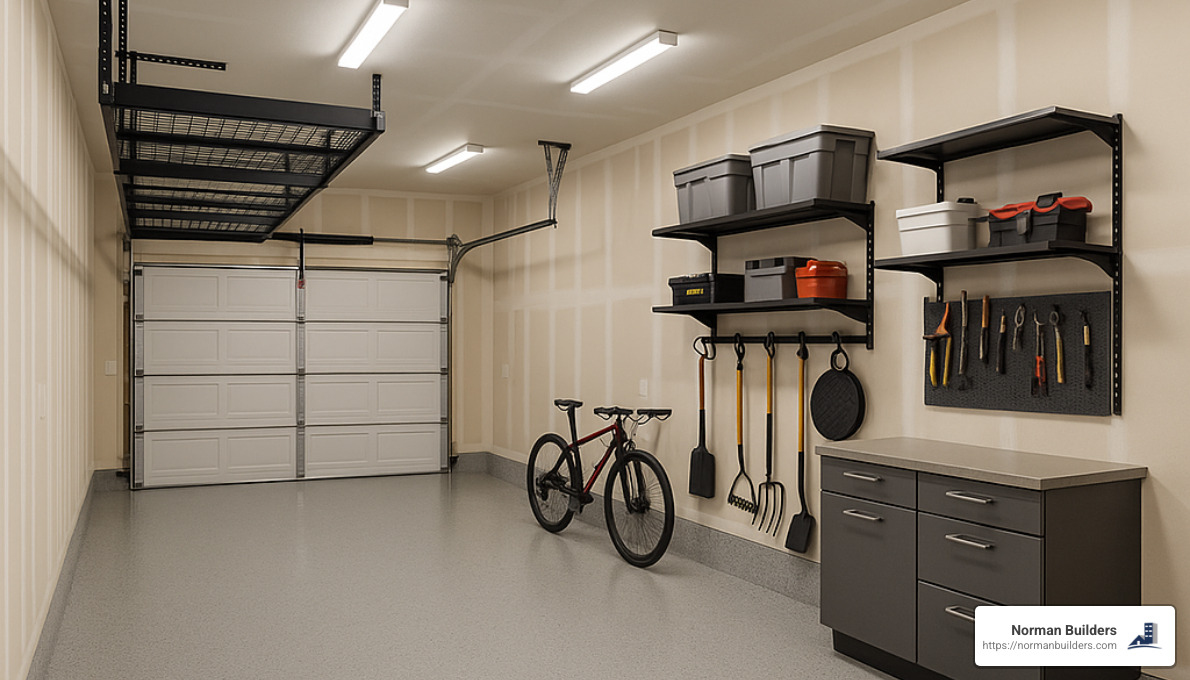
Basic shelving costs $200-$1,000 (though DIY options can significantly reduce this), while wall organization systems run $500-$2,000. Overhead storage racks add another $300-$1,500, and custom cabinetry can range from $2,000-$10,000 depending on materials and complexity.
“Storage planning should be part of your initial design,” our storage specialist recommends. “Considering electrical outlet placement, wall reinforcement for heavy shelving, and your daily workflow will save you significant headaches later.”
Many homeowners forget to budget for connecting their new garage to their existing driveway. This essential component typically adds $3,000-$10,000 to your project depending on length, width, and materials chosen.
Asphalt extensions cost about $7-$13 per square foot, while concrete runs $8-$18 per square foot. If you prefer something more decorative, pavers or stamped concrete will set you back $15-$30 per square foot.

When researching the cost of building a garage attached to house, you’ll inevitably come across prefabricated garage kits, which typically start around $7,200 for a basic two-car model (not including foundation, labor, and permits).
While prefab options offer lower initial material costs, faster installation, and a simplified construction process, they come with significant drawbacks. Many HOAs and historical districts prohibit them outright. They generally use lower quality materials, offer limited customization, provide lower ROI, and can be difficult to properly integrate with existing homes.
In our 15+ years serving communities throughout Massachusetts and New Hampshire, we’ve found that site-built garages almost always provide better long-term value, especially for attached garages where seamless integration with your existing home architecture is crucial.
The good news about garage investments is their strong return potential. A well-designed attached garage typically adds significant value to your home, with homeowners recouping 65-85% of construction costs at resale. This ROI can increase to over 80% when the garage includes additional living space above.
To maximize your garage’s contribution to home value, focus on architectural consistency with your existing home, quality materials that match or complement the main structure, and proper proportions. A garage that’s too large or small for the home can actually detract from value.
“In our New England market, a well-designed attached garage is practically essential for maximum resale value,” explains our real estate consultant. “Buyers in this region strongly prefer not having to brush snow off their cars or walk through bad weather to reach their vehicles.”
For more information about garage construction costs and options, visit our detailed guide at Norman Builders.
Please note: Our services are exclusively available in Massachusetts, specifically in Andover, MA, the North Shore, and New Hampshire, covering the Seacoast and Southern NH regions.
Building an attached garage is a significant investment, but there are plenty of ways to manage the cost of building a garage attached to house without cutting corners on quality. With some strategic planning and know-how, you can create your dream garage while keeping your budget intact.
“Many homeowners don’t realize how much they can save with thoughtful planning,” says our lead estimator at Norman Builders. “Sometimes shifting your timeline by just a few months can mean thousands in savings.”
One of the most effective money-saving strategies is scheduling your project during the off-season. In New England, most homeowners want to build in spring and summer, making fall an excellent time to secure better labor rates when contractors aren’t as swamped with projects. This timing alone can sometimes save 5-10% on your overall costs.
Sticking with standard dimensions also makes financial sense. A 24′ x 24′ two-car garage uses materials efficiently with minimal waste. Each customization away from standard sizes typically adds cost – not just in materials but in labor time as contractors adapt to non-standard measurements.
The shape of your garage matters too. A simple rectangular design with a standard gable roof will cost substantially less than complex designs featuring multiple angles, dormers, or architectural flourishes. While those details can add character, they also add significant expense.
Windows provide natural light but come at a premium – each window typically adds $300-$600 to your project. Instead of eliminating windows entirely, consider strategic placement of fewer windows to maximize light while minimizing costs.
Smart positioning of your garage can also yield savings. Building close to existing utilities reduces the expense of trenching and extending electrical, plumbing, and HVAC connections. Sometimes moving a planned garage location by just a few feet can save thousands in utility connection costs.
If you’re replacing an old garage or converting a carport, having your contractor evaluate whether the existing foundation can be reused could save $2,000-$7,000. Even if some reinforcement is needed, partial reuse is often possible.
Finally, always get multiple bids – we recommend at least three detailed estimates to ensure competitive pricing. Just make sure all contractors are bidding on the exact same scope of work for a fair comparison.
While structural elements require professional expertise, several aspects of garage construction can be handled by homeowners with basic skills:
Interior painting is perhaps the most accessible DIY task, saving $1.50-$3.00 per square foot. A typical two-car garage interior might cost $800-$1,500 to paint professionally, but only $150-$300 in materials if you do it yourself.
Installing basic shelving and storage systems is another area where DIY makes sense. Pre-made shelving units or simple wall-mounted systems can save $200-$1,000 compared to having them professionally installed.
Many homeowners successfully apply epoxy floor coatings themselves, saving $3-$7 per square foot. For a standard two-car garage, this represents $1,400-$3,200 in potential savings, though proper floor preparation is crucial for lasting results.
“We often structure projects to leave specific elements for homeowner completion,” explains our project manager. “This collaborative approach lets us handle the critical structural and technical components while empowering homeowners to put their personal touch on finishing elements.”
Several financing options can help manage the cost of building a garage attached to house, each with distinct advantages:
Home Equity Loans and HELOCs are popular choices for garage projects. These use your home’s equity as collateral, typically offering lower interest rates than unsecured loans. The interest may even be tax-deductible (though you should always consult your tax advisor). HELOCs are particularly well-suited to construction projects because they allow you to draw funds as needed during different construction phases, matching the typical staged payment schedule of building projects.
Construction Loans are specifically designed for building projects and convert to permanent mortgages upon completion. They require detailed plans and contractor agreements, which we’re happy to help provide. While they often have slightly higher interest rates during the construction phase, they convert to standard mortgage rates upon completion.
Personal Loans offer a faster approval process than equity-based options but typically come with higher interest rates since they’re unsecured. For smaller garage projects under $30,000, they can be a convenient option, especially if you don’t have significant home equity or prefer not to use it.
FHA 203(k) Rehabilitation Loans combine home purchase or refinancing with renovation costs. These government-backed loans offer competitive rates but involve more paperwork than conventional loans. They’re an excellent option if you’re buying a home that needs a garage addition, as you can finance both the purchase and the improvement in a single loan.
“The right financing approach depends on your specific financial situation,” notes our financial consultant. “For most of our clients, using a HELOC provides the best balance of low interest rates and flexibility during the construction process.”
Please note: Our services are exclusively available in Massachusetts, specifically in Andover, MA, the North Shore, and New Hampshire, covering the Seacoast and Southern NH regions.
Most attached garage projects take between 6-10 weeks from permit approval to final inspection. This timeline reflects the reality of construction in New England, where weather conditions can sometimes extend projects beyond initial estimates.
“The six-week garage is possible with perfect conditions and no surprises,” explains our construction manager, “but we typically tell homeowners to plan for 8 weeks for a standard attached garage to account for the inevitable small delays that come with any construction project.”
For a typical two-car garage in our service area, the construction schedule usually follows this pattern:
Week 1 focuses on site preparation and foundation excavation, where our team clears the area and prepares for concrete work. During week 2, we pour the foundation and allow proper curing time – crucial for structural integrity. Weeks 3-4 see rapid visible progress with framing and roof installation, which transforms the project from a concrete slab to a recognizable structure. By week 5, we’re completing exterior finishing including siding, trim, and windows to match your home. Week 6 brings electrical work and insulation installation, followed by interior finishing and garage door installation in week 7. The final week involves completing details, site cleanup, and passing the final inspection.
Projects that include living space above the garage or custom architectural features naturally require additional time, sometimes extending to 12-14 weeks for completion.
An attached garage almost always boosts your home’s value, but the return on investment varies significantly depending on several factors. In our New England market, where winter weather makes protected parking highly desirable, the ROI typically falls between 60-85% of your construction costs.
“Garages are practically essential in our climate,” notes our real estate consultant. “I’ve had buyers immediately cross homes off their list when they find there’s no garage, regardless of how perfect the rest of the house might be.”
The value-add depends heavily on how well the garage integrates with your existing home. Attached garages that appear as natural extensions of the home’s architecture – rather than obvious afterthoughts – command the highest returns. Similarly, garages with proportional size to the home (typically matching the number of bedrooms to garage bays) tend to maximize value.
Location plays a crucial role too. In upscale communities like Andover or Newburyport, a well-designed two-car garage might return nearly 100% of its cost, while in areas where garages are less common, the return might be lower. The good news is that throughout our service area in Massachusetts and New Hampshire, garages remain highly valued features that consistently improve property marketability.
When examining the cost of building a garage attached to house, several elements typically stand out as the biggest budget items. Understanding these can help you plan more effectively and decide where to invest for the best return.
Skilled labor consistently represents the largest expense, accounting for 50-70% of your total project budget. This includes the specialized work of framers, roofers, electricians, and finish carpenters. In our New England market, experienced tradespeople command premium rates – but their expertise ensures your garage will stand strong through decades of harsh winters and summer storms.
For many projects, premium materials become the second-largest expense, particularly when homeowners select brick veneer siding ($18-$35 per square foot) or architectural-grade roofing materials. High-end garage doors with insulation, windows, and custom designs can range from $3,000-$10,000 each, becoming a significant budget item that’s immediately visible from the street.
Foundation work often surprises homeowners with its cost, especially in our region where frost-protected foundations are necessary. When site conditions involve ledge removal or poor soil requiring improved foundations, this initial phase can consume a substantial portion of your budget.
“The most unexpected costs usually come from what’s underground,” our lead estimator often tells clients. “Once we can see what we’re dealing with below the surface, the rest of the project tends to be much more predictable.”
For attached garages with living space above, interior finishing represents another major expense, with costs for insulation, drywall, flooring, and trim quickly adding up to create comfortable, usable space.
Please note: Our services are exclusively available in Massachusetts, specifically in Andover, MA, the North Shore, and New Hampshire, covering the Seacoast and Southern NH regions.
Building an attached garage is more than just adding a space for your car – it’s an investment that transforms your home’s functionality while boosting its market value. Throughout this guide, we’ve explored the various elements that influence the cost of building a garage attached to house to help you steer this significant home improvement journey.
The beauty of an attached garage project lies in its blend of practical benefits and financial returns. When designed thoughtfully, your garage becomes both a daily convenience and a valuable asset that can return 65-85% of your investment when it’s time to sell.
“Most homeowners tell us the convenience factor alone makes their garage worth every penny,” shares our lead designer. “Not having to scrape ice off windshields during those brutal New England winters is something you simply can’t put a price tag on.”
At Norman Builders, we’ve guided hundreds of Massachusetts and New Hampshire homeowners through successful garage projects since 2007. Our deep understanding of regional challenges – from snow load requirements to town-specific permitting processes – ensures your project addresses all the unique considerations of building in New England.
The most successful garage projects start with thorough planning. By taking time to consider both your immediate needs and long-term goals, you’ll create a space that serves your family well for decades to come. Quality construction isn’t just about aesthetics – it’s about durability, functionality, and creating genuine value.
Ready to explore how an attached garage could improve your home? Here’s your roadmap to getting started:
For even more information about garage addition costs and options, our garage addition cost guide provides additional insights to support your planning process.
Whether you’re dreaming of a simple one-car garage or envisioning a multi-functional space with a bonus room above, the perfect attached garage strikes a balance between your budget, your home’s architecture, and your family’s needs. With thoughtful planning and expert guidance, your garage addition can become one of the most rewarding investments you make in your home.
Please note: Our services are exclusively available in Massachusetts, specifically in Andover, MA, the North Shore, and New Hampshire, covering the Seacoast and Southern NH regions.

We specialize in high-quality home construction and remodeling services, delivering exceptional craftsmanship tailored to meet your vision and needs. Whether you’re planning a renovation, new construction, or a custom remodel, our experienced team is committed to exceeding expectations with precision, attention to detail, and reliable service.
Our service area includes the Merrimack Valley, North Shore, Seacoast, and Southern NH Areas. We take pride in the quality of our workmanship and our prompt professionalism.
Contact us today to bring your project to life!