

Learning how to remodel a house step by step can save you thousands of dollars and prevent costly mistakes. A whole house renovation is a complex project that requires careful planning and coordination. Following the correct order of operations is key to avoiding budget overruns, timeline delays, and quality issues.
Quick Answer – How to Remodel a House Step by Step:
The average whole house renovation can cost anywhere from $15 to $180+ per square foot, depending on the scope. Major renovations are a significant investment, but they also offer the chance to create a home that perfectly suits your needs.
I’m Ryan Norman, founder of Norman Builders. For over 15 years, I’ve guided homeowners through the how to remodel a house step by step process, completing more than 100 successful renovations across Massachusetts and New Hampshire. My team and I use proven systems to deliver quality results on every project.
How to remodel a house step by step helpful reading:
This first phase is the thoughtful groundwork that lays the foundation for a successful remodel. Please remember: All cost estimates shared here are national averages from various online sources and don’t reflect the actual pricing for our services. For a detailed quote custom to your specific project, please contact us directly.
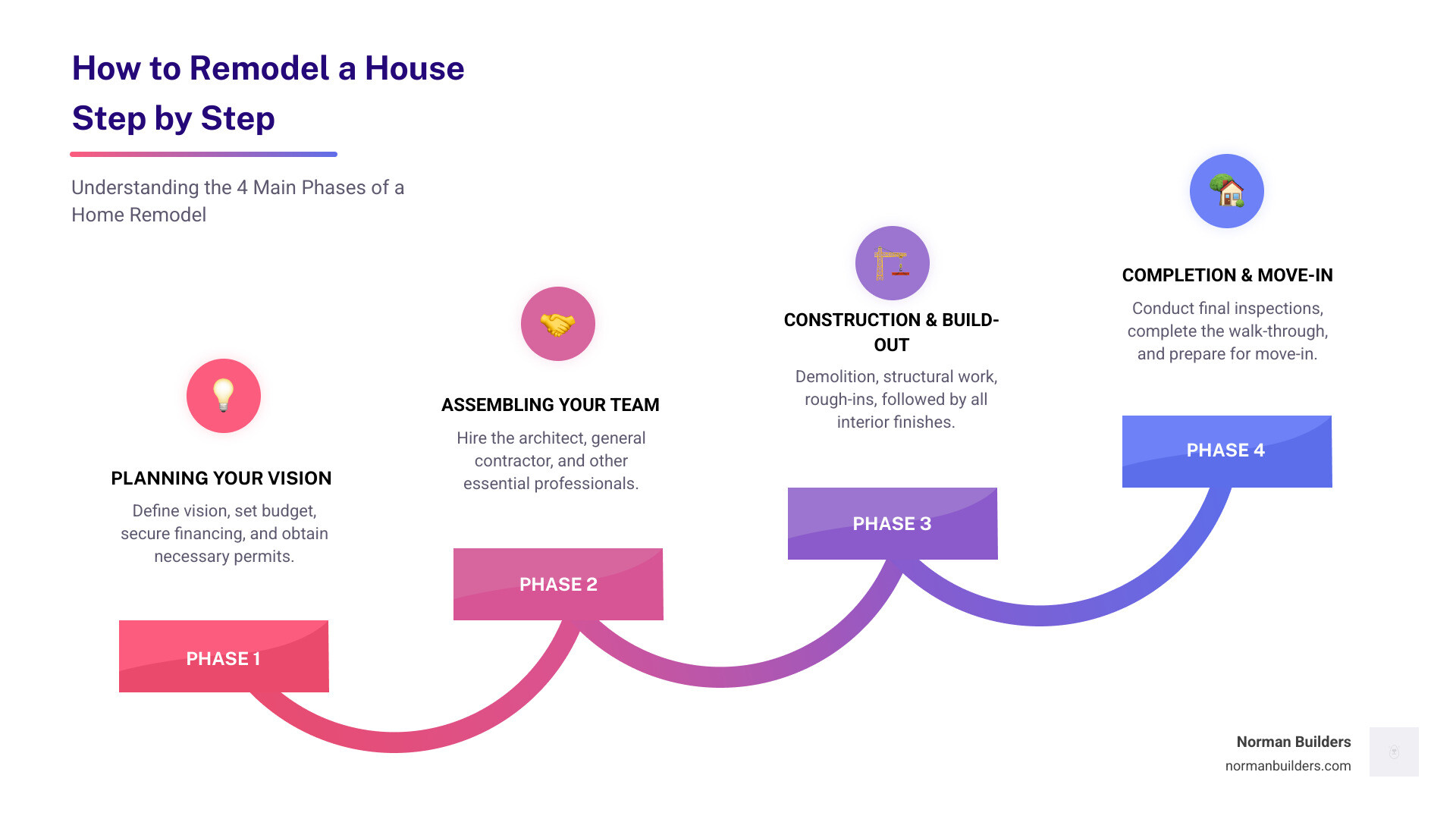
Before any construction begins, the first step in how to remodel a house step by step is to define your vision. A whole house remodel involves renovating most of your home, often including structural changes. Homeowners undertake these projects to expand their space, increase home value, fix structural issues, or adapt their homes for life changes, such as adding features for aging-in-place.
To start, distinguish your “needs” from your “wants.” List everything you’d like to change, then prioritize them into “must-haves” and “nice-to-haves.” If remodeling for resale, consult a real estate agent. If it’s your forever home, design it for yourself. Gather inspiration by creating a design file or a digital board on Pinterest to help clarify your ideas and communicate your vision to your remodeling team.
More info about whole house renovations

With a clear vision, the next step is setting a realistic budget. Home renovation costs vary widely, from $15 to $60 per square foot on average, with high-end remodels reaching $180 or more per square foot. Labor alone can account for 20-40% of your total budget.
Here are some national average cost ranges for popular projects:
| Remodel Type | Average Cost Range (National) |
|---|---|
| Kitchen | $30,000 – $90,000+ |
| Bathroom | $11,000 – $33,000+ |
| Basement | $20,000 – $60,000+ |
| Home Addition | $50,000 – $150,000+ |
All pricing is based on national averages from online sources and does not reflect Norman Builders’ actual pricing.
Crucially, set aside a contingency fund of 10-20% of your total budget. This is essential for covering unexpected issues finded during demolition, such as old plumbing, mold, or faulty wiring. This buffer prevents surprises from derailing your project.
Homeowners have several common financing options:
Also, look into government incentives or rebates for energy-efficient upgrades. For personalized advice, consult a financial advisor.
Government incentives and rebates
Permits are a vital, non-negotiable step. Building codes exist to ensure all work is safe and structurally sound. Ignoring them can lead to fines and issues when selling your home. You will almost certainly need permits for any project involving structural changes, electrical, plumbing, or HVAC work. A professional contractor will be familiar with local codes and can manage the permit application process for you. Be aware that obtaining approvals for architectural plans can take 4-6 months, so factor this into your timeline. If you’re in a homeowners’ association (HOA), check their rules as well.
Once your plan is in place, the next critical phase in how to remodel a house step by step is assembling the professionals who will bring your vision to life.
While DIY can be tempting for small projects, a major home renovation involves significant risks and complexities. Professionals are equipped to handle hazardous materials like asbestos, steer strict building codes, and coordinate the various trades required. A professional firm like Norman Builders brings expertise and a streamlined process, taking the stress off your shoulders and ensuring a high-quality, safe outcome.

Your team will likely include an architect for design and structural changes and a general contractor to oversee the entire project. The general contractor is the orchestrator, managing subcontractors, schedules, and quality control. We recommend getting at least three detailed quotes.
When choosing your team, follow these key steps:
Taking these steps will help you build a trustworthy team for your how to remodel a house step by step journey.
With your plan and team in place, construction begins. This is where your vision becomes a reality. While every project is unique, construction generally follows a logical sequence to ensure efficiency and quality.
This is the first, and often messiest, step. It involves protecting areas of your home not being renovated by moving furniture and sealing off work zones with plastic barriers to contain dust. Then, demolition begins: removing old cabinetry, taking down non-load-bearing walls, and stripping out old finishes. This process generates significant waste, so a roll-off dumpster is essential for disposal. If your home was built before the 1980s, this is also when certified professionals will handle the abatement of hazardous materials like lead paint or asbestos.
With a clean slate, the rebuilding starts. This foundational stage includes:
Once the rough-ins are inspected and approved, the space starts to look more finished.

As the interior comes together, the exterior and final details are completed.
This final phase is about managing the details, bringing your vision to a beautiful conclusion, and ensuring every element is perfect.
This is where your personal style comes to life. When choosing materials, balance aesthetics with practicality. Investing in high-quality, durable materials can save you money on future repairs. Consider durability, your personal style, and sustainable or non-toxic options. We recommend visiting showrooms to see and feel materials in person. Crucially, order your materials early, as lead times for custom items can significantly impact your project timeline.
Living through a major renovation can be disruptive. For a whole-house remodel, arranging for alternative housing can make the process faster and less stressful. If you stay, set up a temporary kitchen and living area. Protect your belongings by moving them out of the work zone or covering them securely in plastic. Your contractor should use dust control measures, but daily cleaning and an air purifier can help. Establish a clear communication plan with your contractor, including regular site meetings, and use project management tools if available to stay informed on progress, schedules, and budgets.
Being aware of common challenges can help you steer them smoothly.
As the dust settles, it’s time to finalize the project.

Congratulations! You’ve successfully steerd the process of how to remodel a house step by step.
More info about our construction services
Here are answers to the most common questions we hear about how to remodel a house step by step.
Every project is unique, but here are some realistic timeframes. The planning phase alone often takes 6-12 months for design, permits, and material orders. For construction, a kitchen remodel typically takes 6-12 weeks, a bathroom 3-10 weeks, and a major home addition 12-20 weeks. That reputable contractors often have wait lists of up to 12 months, so it’s important to plan ahead.
It is standard practice to set aside a contingency fund of 15-20% of your total project budget. This is not money you plan to waste; it’s a crucial safety net. Once demolition begins, it’s common to uncover hidden issues like water damage, pest infestations, or outdated electrical systems that must be addressed for safety and quality. Your contingency fund ensures these “unexpected findies” don’t derail your project.
This depends on the scope of work. For a single-room remodel, it’s often manageable to stay in your home. However, for a whole-house renovation, especially one that involves your kitchen and all bathrooms, we generally recommend arranging for alternative housing. While this adds to the cost, the project often progresses faster, is safer for your family, and is significantly less stressful than living in a construction zone without essential facilities.
Starting a whole-house remodel is a major investment, but with careful planning and the right team, you can transform your house into the home of your dreams. Understanding how to remodel a house step by step provides the roadmap, but an experienced professional guide makes all the difference.
At Norman Builders, we’ve served the Massachusetts and New Hampshire communities since 2007. We understand that your home is where your life unfolds. Whether you’re expanding for a growing family or creating your forever home, we bring the experience and craftsmanship needed to make your vision a reality. Our team handles the complex coordination, permits, and details so you can focus on the excitement of the change.
If you’re ready to take the first step on your how to remodel a house step by step journey, we’re here to help.
Learn more about our whole house renovation services
Please note: Our services are exclusively available in Massachusetts, specifically in Andover, MA, the North Shore, and New Hampshire, covering the Seacoast and Southern NH regions.

We specialize in high-quality home construction and remodeling services, delivering exceptional craftsmanship tailored to meet your vision and needs. Whether you’re planning a renovation, new construction, or a custom remodel, our experienced team is committed to exceeding expectations with precision, attention to detail, and reliable service.
Our service area includes the Merrimack Valley, North Shore, Seacoast, and Southern NH Areas. We take pride in the quality of our workmanship and our prompt professionalism.
Contact us today to bring your project to life!